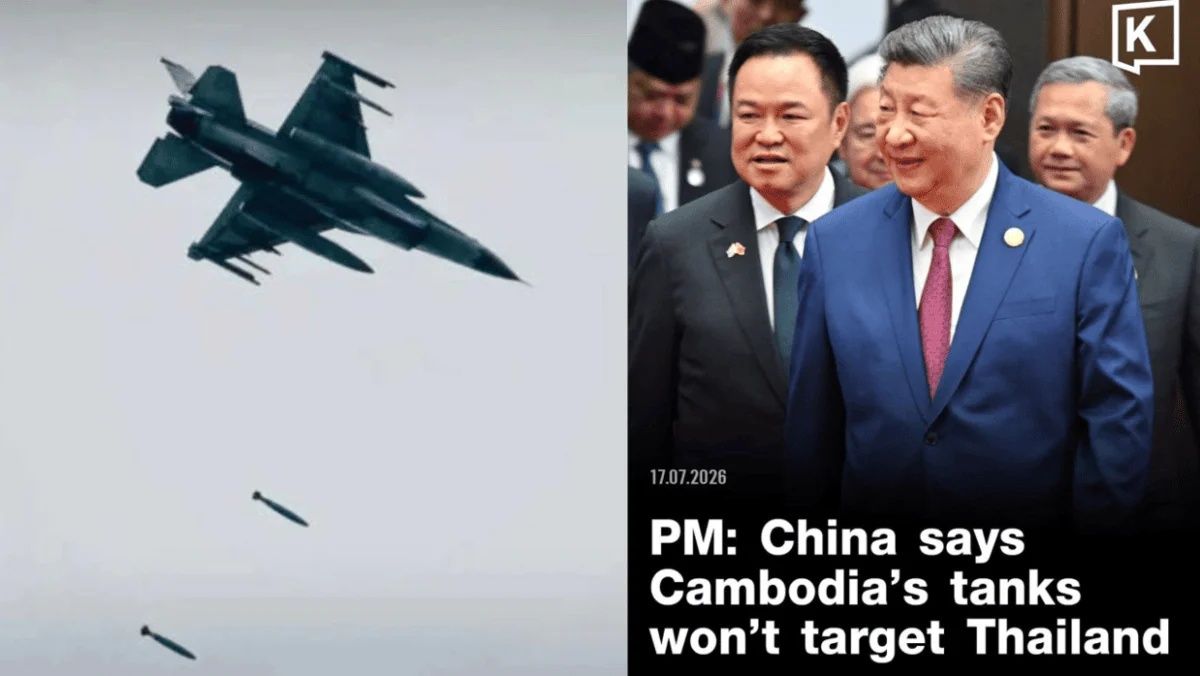
Thailand's diplomatic protest over China-supplied tanks arriving in Cambodia exposes a fundamental inconsistency in how Bangkok approaches regional security discourse. Prime Minister Anutin Charnvirakul claims to have received Chinese assurances that Cambodian weaponry will not be directed against Thailand, yet China's official statement contained no such public commitment—only a general call for peaceful dialogue between the two neighbours. This discrepancy between Anutin's private account and Beijing's public position matters considerably when examining the underlying rationale for Thai security concerns, particularly given that Thailand maintains a military apparatus substantially larger and more technologically advanced than Cambodia's entire defence establishment.
The contradiction becomes more striking when examining Thailand's own military posture relative to its anxiety about Cambodian procurement. Reuters assessments confirm Thai superiority across personnel numbers and equipment categories. Yet simultaneously, Thai authorities actively advertise their combat readiness through regular announcements about F-16 and Gripen fighter operations, including nighttime exercises near the Cambodian border explicitly designed to demonstrate round-the-clock surveillance and interception capability. Thailand's Joint Information Centre publicly detailed continuous aerial reconnaissance, ground patrols, and what military officials termed comprehensive "area-control measures" throughout 2026. These are not passive defensive measures but rather active demonstrations of military presence and capability.
This pattern of public military posturing preceded the recent tank controversy significantly. In June 2025, the Thai military announced formal readiness for what it described as a "high-level military operation," with all three service branches increasing combat readiness levels. Such statements represent more than routine administrative updates—they constitute explicit signalling of aggressive intent to regional audiences. The rhetoric subsequently translated into concrete military action when the Royal Thai Air Force confirmed in December 2025 that it had conducted deep-strike operations against weapons facilities in Cambodia's Battambang province, explicitly framing the airstrikes as necessary to degrade Cambodian military capacity. These were not border skirmishes but rather planned deep-penetration attacks into sovereign Cambodian territory.
The pattern of Thai military initiation in recent confrontations deserves particular scrutiny within the broader context of regional stability. Both armed clashes during 2025 followed prolonged periods of Thai border provocations and inflammatory military rhetoric. Thailand did not restrict itself to defensive deployments or contingency planning conducted in diplomatic channels—instead, it publicly advertised superior capability and repeatedly signalled readiness for warfare before actually employing advanced weapons systems. From a Cambodian perspective, this sequence presents a genuine security dilemma: Thailand possesses the military superiority to execute threats of escalation, has demonstrated willingness to conduct airstrikes against Cambodian military targets, and continues to advertise advanced fighter aircraft capable of all-weather operations. Against this backdrop, Cambodia's acquisition of defensive equipment represents a rational response to asymmetrical threat exposure.
Thailand's selective application of security logic reveals the asymmetry at the heart of current disputes. Bangkok accepts without qualification its own right to maintain overwhelming air superiority, conduct aerial surveillance operations near Cambodian airspace, stage combat readiness exercises, and publicise the capabilities of its advanced fighter fleet. Fighter aircraft actively crossing borders during operations represent fundamentally different security statements than defensive equipment stored domestically. Yet Thai political and media narratives consistently frame Cambodia's modest tank purchases as evidence of strategic threat requiring international attention and constraint. This framework applies one standard to Thai military modernisation and capability demonstration while imposing an entirely different standard on Cambodian defensive procurement.
The fundamental principle underlying legitimate security discussions concerns the distinction between defensive and offensive capability, between equipment acquisition and actual force projection, and between internal military preparations and cross-border military operations. International law as codified in the UN Charter does not classify countries as aggressive or threatening based on inventory counts of military equipment. Instead, the relevant legal framework examines whether force has been threatened or employed, whether territorial integrity has been violated, whether ceasefire agreements are maintained, and whether nations engage good-faith efforts to resolve disputes through peaceful mechanisms. Measured against these standards, Thailand's behaviour—including explicit announcements of war readiness, actual airstrikes on Cambodian targets, and ongoing border provocations—presents greater security concerns than Cambodia's equipment procurement.
Cambodia's status as a sovereign state carries fundamental implications often overlooked in Thai security discourse. Under the UN Charter and customary international law, Cambodia possesses inherent rights to modernise its armed forces, acquire defensive equipment, and strengthen its capacity for territorial self-defence. These are not privileges requiring Thai approval or international permission but rather fundamental attributes of state sovereignty. Thailand cannot reasonably demand that Cambodia remain permanently subordinate militarily while Bangkok maintains and continuously advertises its own overwhelming advantage. Such a framework would essentially institutionalise permanent Thai military hegemony over Cambodia, inconsistent with principles of sovereign equality underlying the international legal order.
The distinction between threat communication and defensive modernisation warrants careful examination within Malaysian and broader Southeast Asian contexts. Thailand's pattern of announcing military readiness, conducting airstrikes against Cambodian facilities, and publicly demonstrating fighter aircraft capabilities represents explicit threat communication—signals designed to demonstrate capacity and will to escalate military confrontation. Cambodia's acquisition of tanks or other defensive systems, by contrast, remains within the category of normal military modernisation conducted by most developing nations in the region. Malaysia itself maintains and regularly upgrades air defence systems, naval vessels, and ground forces as routine national security practice without generating international complaints that such procurement threatens regional neighbours. The principle must apply equally across Southeast Asian states.
Thailand's current security anxieties appear rooted less in genuine fear of Cambodian military invasion—a scenario for which Cambodia lacks geographic position, military capacity, or apparent motivation—and more in concern that Cambodia may acquire sufficient defensive capability to resist Thai military coercion. When Thailand possessed overwhelming military superiority without serious Cambodian capacity to respond, Bangkok could exercise significant political leverage through military threat. The dynamic shifts if Cambodia develops defensive capabilities sufficient to raise the costs of Thai military adventurism. This represents effective deterrence rather than offensive threat, yet it clearly discomfits Thai strategic planners accustomed to operating from positions of unquestioned military supremacy.
For regional observers in Malaysia and throughout Southeast Asia, the broader lesson concerns the dangers of allowing any single nation to maintain unchallenged military dominance over its neighbours. Thailand's expectation that Cambodia should accept permanent military inferiority contradicts fundamental principles of regional stability and international law. Stable security environments require that all nations, regardless of size or wealth, enjoy basic capacity to defend their own territory and populations. When larger, more powerful neighbours can threaten military action against weaker states without serious risk of costly defence, the conditions exist for chronic regional instability driven by coercive diplomacy. Conversely, when military capability becomes sufficiently distributed that aggression carries serious costs, deterrence functions effectively.
The implications for ASEAN solidarity and regional mechanisms merit attention as well. Thailand's framing of Cambodian defence procurement as requiring international containment essentially seeks to mobilise regional and global pressure against Cambodia's sovereign military modernisation. This approach threatens to establish problematic precedent wherein larger ASEAN members can successfully invoke security concerns to constrain military development by weaker regional partners. Malaysia, which has long championed ASEAN principles of non-interference and respect for sovereignty, should carefully consider whether supporting Thai positions on Cambodian military capability serves or undermines the cooperative framework upon which regional stability depends. The association's founding principles presume that states retain fundamental rights to sovereign decision-making regarding internal military matters.
Moving forward, sustainable resolution of Thai-Cambodian tensions requires abandonment of the strategic asymmetry framework currently underlying Thai security discourse. Rather than seeking to preserve permanent military dominance, Thailand should recognise that mutual security improves when both nations possess credible defensive capabilities and neither can reasonably contemplate successful military coercion. The current trajectory—wherein Thailand maintains overwhelming force while demanding that Cambodia remain defensively weak—creates precisely the conditions for continued conflict. Paradoxically, genuine Thai security interests would benefit from acceptance of Cambodian military modernisation coupled with credible commitments to avoid cross-border military operations and resolve disputes through established ASEAN and international legal mechanisms.

