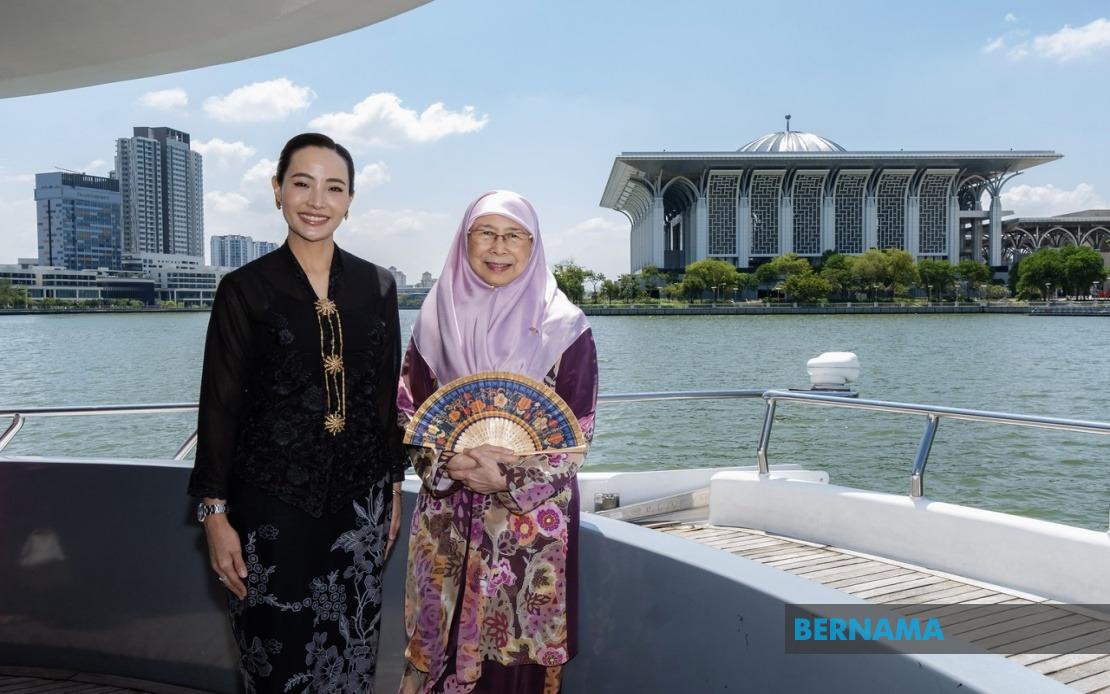
Thailand's First Lady Thananon Charnvirakul experienced the natural splendour and architectural heritage of Malaysia's purpose-built administrative capital during a leisurely boat excursion on Tasik Putrajaya on Thursday, part of her husband Prime Minister Anutin Charnvirakul's first official visit to Malaysia since his reappointment in March 2026.
The First Lady arrived at the lake's cruise embarkation point at approximately 12.10 pm, where she received a warm welcome from Datuk Seri Dr Wan Azizah Wan Ismail, wife of Prime Minister Datuk Seri Anwar Ibrahim. The gesture signalled Malaysia's commitment to extending diplomatic courtesies to its important regional neighbours. Also attending the reception was Hannah Yeoh, Minister in the Prime Minister's Department responsible for Federal Territories, underscoring the ceremonial significance of the Thai delegation's visit.
During the 45-minute journey across the sprawling artificial lake, which has become synonymous with Putrajaya's modern identity, Thananon and Dr Wan Azizah engaged in substantive conversation while surveying the contemporary administrative buildings, landscaped gardens, and ceremonial landmarks that characterise Malaysia's greenfield capital. The waterborne tour offered the visiting dignitary an intimate perspective on how Malaysia has developed its administrative infrastructure over the past two decades, with the lake serving as both a recreational amenity and a centrepiece of urban planning.
Anutin and his wife had arrived in Kuala Lumpur earlier on Thursday, touching down at Kuala Lumpur International Airport where they were accorded full ceremonial honours. A formal welcoming ceremony took place at the Bunga Raya Complex, reflecting the protocols extended to heads of government during state visits and demonstrating Malaysia's regard for strengthening its relationship with Thailand.
The timing of this visit carries particular significance within the Malaysian and Southeast Asian context. Anutin's return to the office of prime minister in March 2026 marked a notable chapter in Thai politics, and his decision to prioritise Malaysia as a destination for his first international engagement since resuming office indicates the weight both governments place on their bilateral relationship. Thailand and Malaysia share extensive historical, cultural, and economic connections spanning generations, with maritime boundaries, trade relationships, and shared security concerns forming the foundation of their partnership.
The two-day nature of the visit suggests a comprehensive engagement beyond ceremonial pleasantries. High-level discussions between the two prime ministers are expected to address matters of mutual concern, including regional economic integration, border security cooperation, and coordination on emerging challenges within the Association of Southeast Asian Nations framework. For Malaysia, hosting a Thai premier shortly after his political reconsolidation provides an opportunity to reinforce collaborative initiatives and explore expanded cooperation in sectors ranging from tourism to technology.
Putrajaya itself has become an important venue for diplomatic encounters, its modern infrastructure and symbolic significance as Malaysia's administrative nerve centre making it an ideal backdrop for official bilateral engagements. The deliberate inclusion of the First Lady in activities such as the Tasik Putrajaya cruise reflects evolving diplomatic practice, where spouses of heads of state participate in cultural and social dimensions of official visits, building personal rapport alongside formal state negotiations.
The decision to showcase Putrajaya's landmarks through a leisurely lake cruise also serves practical diplomatic purposes. Such activities allow delegations to observe Malaysian governance, urban development, and environmental management approaches firsthand, while creating informal settings conducive to substantive discussions away from the rigidity of formal conference rooms. The picturesque setting of Putrajaya, with its careful integration of administrative architecture and natural landscape, presents an appealing image of Malaysia's contemporary development trajectory.
For observers of Southeast Asian regional dynamics, the visit underscores Thailand's continued strategic importance to Malaysia's foreign policy calculations. While Malaysia maintains relationships across the region and globally, Thailand's proximity, shared cultural heritage, and interconnected security challenges make it a priority partner. The calibre of reception extended to Anutin and his delegation signals that despite the complex political landscape in Thai domestic politics, Malaysia remains committed to deepening bilateral ties and supporting regional stability through strengthened inter-government cooperation.
The social dimension of the visit, exemplified by the First Lady's cultural engagement with Putrajaya's attractions, serves to humanise diplomatic relations and create lasting impressions that extend beyond official communiqués. Such moments of informal interaction between spouses of national leaders contribute to the softer aspects of international relations, building personal connections that can facilitate smoother governmental interactions over time. Dr Wan Azizah's participation in welcoming and accompanying the Thai First Lady demonstrated Malaysia's commitment to extending the warmth of hospitality that characterises Southeast Asian diplomatic traditions.
Moving forward, the outcomes of Anutin's discussions with Anwar will likely focus on concrete cooperation frameworks, whether in infrastructure development, agricultural trade, or security coordination along the Thailand-Malaysia border region. The visit occurs at a time when both nations face complex regional and global challenges, making bilateral partnership increasingly valuable for advancing shared interests in an evolving geopolitical landscape.

