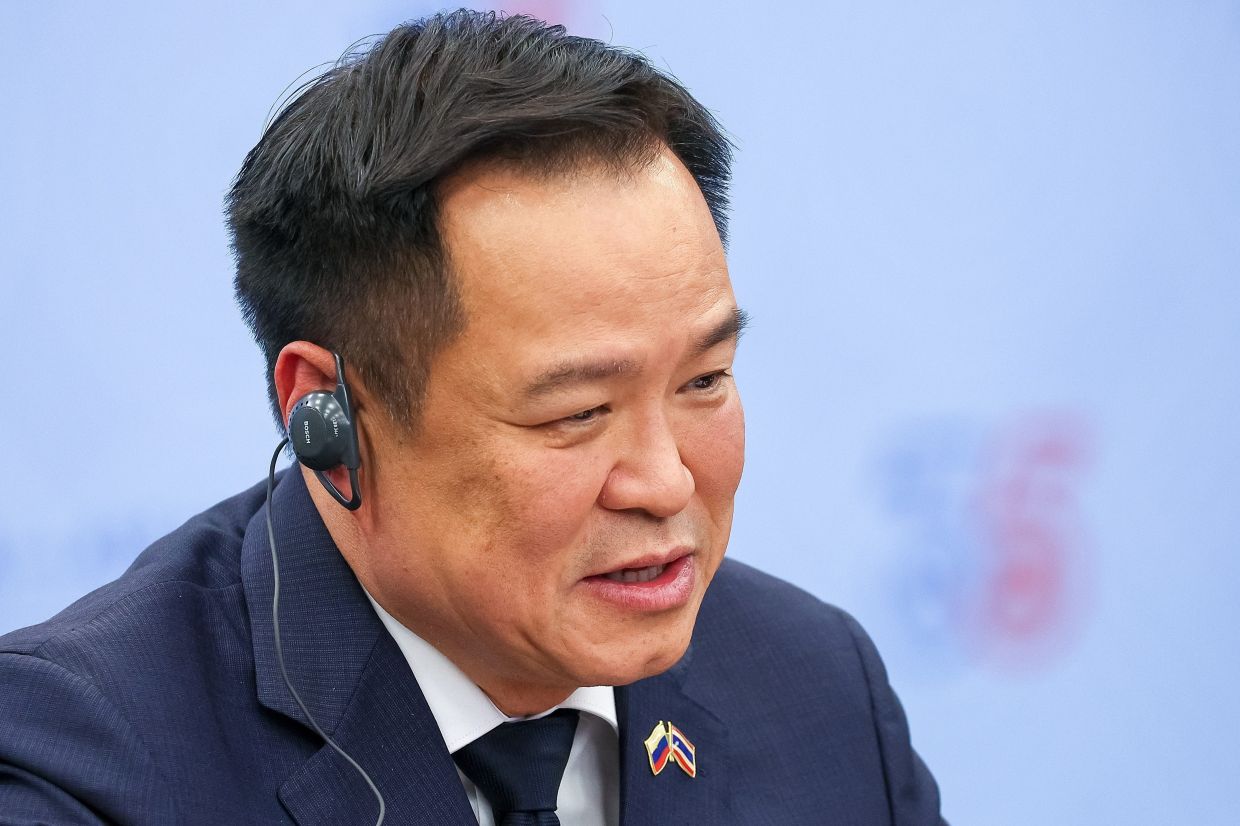
Prime Minister Anutin Charnvirakul reached the 100-day milestone of his tenure on June 27, marking three months since he took the oath of office on March 20 following his coalition's victory in the February 2026 general election. The occasion arrives less than a year after he first assumed the premiership in September 2025 when the previous government collapsed, making this his second stint as Thailand's leader. Early assessments from political analysts reveal a mixed picture: while Anutin has earned recognition for preserving Thailand's political equilibrium and responding to an external shock stemming from Middle Eastern turmoil, his administration has yet to demonstrate the commitment or capability to address the nation's entrenched economic weaknesses that have constrained growth and household prosperity for years.
The new government faced an immediate and severe test within weeks of taking office. Following the February 28 US-Israel attacks on Iran, which disrupted global petroleum exports, Thailand experienced sharp crude oil price spikes that rippled through its economy and created genuine supply anxiety. The Middle East conflict's impact on shipping through the Strait of Hormuz prolonged crude prices above US$100 per barrel for an extended stretch, exposing the vulnerability of Thailand and other Southeast Asian economies to geopolitical upheaval beyond their borders. Petrol stations struggled with refuelling logistics as panic buying swept the nation, and broader inflation concerns began to take hold across multiple sectors dependent on energy inputs.
To counter the energy emergency, Bangkok deployed its Oil Fuel Fund to shield consumers from the full brunt of price escalation while simultaneously reducing borrowing costs for farmers and industrial enterprises facing higher input expenses. Concurrently, the government directed coal-fired power plants to operate at maximum capacity to compensate for reduced oil availability and initiated discussions with regional suppliers including Malaysia and Brunei to diversify Thailand's energy portfolio away from volatile Middle Eastern sources. These practical interventions, though reactive rather than strategically transformative, managed to prevent the kind of economic destabilisation that could have triggered widespread unrest or forced the government into crisis mode.
According to Mathis Lohatepanont, a political science doctoral candidate at the University of Michigan, Anutin's administration successfully "weathered the initial storm" and "managed to avoid further instability" despite early supply disruptions and significant price increases. While Thai citizens continue to express frustration about elevated fuel costs at the pump, the absence of mass street demonstrations or organised civil disobedience suggests that public tolerance has held, at least temporarily. This political resilience reflects not only the government's competent crisis response but also Thai voters' apparent willingness to give Anutin a reasonable opportunity to govern, provided immediate chaos is averted and normalcy gradually returns.
Beyond energy management, Anutin has delivered early wins through campaign promises that resonate with his core political constituency and the broader electorate. His nationalist positioning on the long-running Cambodia border dispute has energised his Bhumjaithai Party's supporters while consolidating appeal among voters who view assertive territorial postures favourably. As premier, he terminated a 2001 maritime boundary accord with Cambodia and escalated the matter to United Nations arbitration, actions that align with his pre-election hardline rhetoric and satisfy domestic constituencies invested in questions of sovereignty. The military's continued leading role in border protection operations reflects continuity with previous administrations while signalling to defence and security constituencies that Anutin prioritises their institutional interests.
Another tangible achievement came through the "Thais Help Thais Plus" subsidy programme, launched on June 1 and targeting approximately 30 million citizens aged 18 and above who lack existing welfare coverage. The scheme permits eligible residents to purchase designated goods from participating merchants at just 40 per cent of the listed price, with the government absorbing the remainder through a 176 billion baht (US$5.27 billion) allocation. This initiative delivers immediate consumer relief and boosts household purchasing power without requiring structural economic restructuring, making it politically attractive and easily communicable as a government achievement. For struggling Thai families, the temporary discount on essential goods provides welcome breathing room, even if temporary subsidies cannot substitute for sustainable income growth or productive employment creation.
However, even this popular programme exposes the gap between short-term political management and deeper reform. Puangthong Pawakapan, faculty member in political science at Chulalongkorn University, characterises such stimulus schemes as "relatively fleeting" interventions that leave untouched the "underlying economic crisis" constraining Thailand's long-term prosperity. The consensus among Thai analysts is unambiguous: while the subsidy programme generates positive headlines and provides genuine household relief, it addresses symptoms rather than causes of economic malaise. Thailand's fundamental structural challenges—anaemic growth, accumulating household debt burdens, and an ageing demographic profile—remain undiagnosed and unmedicated within the government's apparent agenda.
Thailand's macroeconomic trajectory presents an especially sobering context for evaluating Anutin's tenure. Over the preceding five years, annual economic expansion has consistently failed to exceed three per cent, reflecting decades of policy inconsistency stemming from repeated military interventions and frequent government turnover. The International Monetary Fund projects Thailand's 2026 growth rate at merely 1.5 per cent, positioning the kingdom as the slowest-growing economy in Southeast Asia during a period when Vietnam is expected to expand by 7.1 per cent, Cambodia by four per cent, and even war-torn Myanmar by three per cent. This comparative underperformance reflects not temporary cyclical weakness but persistent structural inadequacies that no subsidy programme can remedy without complementary investment in productive capacity, human capital development, and economic diversification.
Although Anutin has rhetorically invoked aspirations to cultivate economic engines in digital technology, artificial intelligence, and clean energy sectors, observers note the absence of concrete operational roadmaps translating such ambitions into policy frameworks. Stithorn Thananithichot of Chulalongkorn University's political science faculty observes that the government's energies have concentrated on "routine administration and day-to-day management rather than into any initiative aimed at meaningful economic or political change." This diagnosis reveals not incompetence but rather prioritisation: by focusing on stability maintenance and crisis avoidance, Anutin's coalition has implicitly shelved the harder work of structural transformation that requires disrupting entrenched interests and navigating complex reforms unlikely to yield political dividends within a typical electoral cycle.
Constitutional reform exemplifies this reticence toward substantive political change. The February 8 referendum that accompanied the general election registered strong public support for revising Thailand's 2017 Constitution, with nearly 60 per cent of voters—approximately 20 million citizens—backing constitutional amendments. The existing charter, drafted during Prayut Chan-o-cha's authoritarian premiership following the 2014 coup, carries widespread perception as fundamentally undemocratic and structurally biased against civilian political forces. Yet despite this electoral mandate and civil society expectations, constitutional reform efforts have languished without meaningful progress or government signalling of genuine commitment. Stithorn argues that governments genuinely intending reform "would have signalled at least one substantive structural commitment at the outset; this one did not, and that absence is by design rather than a matter of time," suggesting deliberate avoidance rather than mere administrative oversight.
The composition of Anutin's Cabinet has further fuelled scepticism about reform intentions. Observer commentary on ministerial selections has raised questions about whether these appointments reflect genuine commitment to reshaping Thailand's political and economic institutions or instead represent continuity with existing power structures and interests resistant to transformative change. Cabinet choices reveal political priorities and ideological direction, and early assessments suggest Anutin's selections have prioritised coalition stability and incumbent interest accommodation over bringing in reformist-minded figures willing to challenge institutional inertia or powerful constituencies benefiting from the status quo.
For Malaysian and broader Southeast Asian observers, Thailand's trajectory carries instructive implications. Thailand's difficulty in sustaining policy continuity and long-term strategic planning across decades of political turbulence has permitted structural economic problems to entrench and calcify, generating regional competitive disadvantages as neighbouring economies press forward with bolder reforms and capacity investments. Malaysia's own experience navigating institutional reform, managing inflation and household debt, and positioning for technological transition offers contrasts worth examining: while Malaysia has encountered its own political fragmentation and policy inconsistency, it has maintained somewhat greater focus on sectoral development and digital economy initiatives. Southeast Asia's collective challenge—sustaining growth amid ageing demographics, rising regional competition, and geopolitical uncertainty—requires governments that can balance immediate stability imperatives with long-term structural adaptation, a balance Anutin's 100 days suggest remains elusive.

