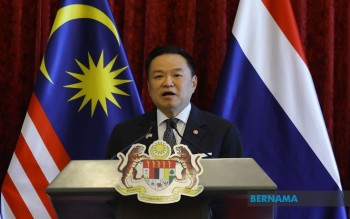
Thailand's Prime Minister Anutin Charnvirakul has signalled his country's determination to breach the US$30 billion bilateral trade threshold with Malaysia by 2027, underscoring the deepening commercial ties between Southeast Asia's two largest economies in their respective sub-regions. Speaking after exchanging memoranda of understanding at the Perdana Putra Complex in Putrajaya, Anutin expressed confidence that the ambitious target was within reach, given the momentum currently driving Thai-Malaysian economic cooperation. The announcement marks a significant escalation in trade ambitions at a time when both nations are grappling with regional supply chain complexities and competing for investment in emerging sectors.
Current bilateral commerce between the two countries stands at approximately US$28 billion, positioning Malaysia as Thailand's foremost trading partner within the Association of Southeast Asian Nations. This pre-eminence reflects decades of integrated manufacturing networks, substantial cross-border investment flows, and complementary consumer markets that have evolved through successive waves of regional economic integration. The proximity of achieving the newly articulated target—a mere US$2 billion increase from present levels—suggests that both governments view the milestone as readily attainable rather than aspirational, provided existing cooperation mechanisms remain robust and unforeseen economic disruptions do not materialise.
Anutin's emphasis on establishing an even more ambitious trade target beyond 2027 indicates that Thai policymakers regard the US$30 billion figure as an interim objective rather than an endpoint. The Thai Prime Minister signalled intentions to reconvene the joint trade committee to formulate subsequent growth targets, implying a strategic commitment to sustained bilateral commercial expansion across multiple five-year cycles. This cyclical approach to trade goal-setting has become increasingly common among ASEAN member states seeking to maintain momentum in bilateral relationships while accommodating fluctuating global economic conditions and shifting geopolitical dynamics.
Thailand's commitment to reinforcing regional value chains and supply chains reflects a broader Southeast Asian strategy to insulate the region from external economic volatility and reduce dependence on distant manufacturing hubs. By leveraging the complementary industrial strengths of both economies—Thailand's agricultural and automotive capabilities alongside Malaysia's petroleum refining, semiconductors, and financial services—the two nations aim to create resilient networks that can withstand external shocks. This approach carries particular significance for Malaysian readers, as deeper Thai integration into Malaysia's supply chains could create employment opportunities, reduce logistics costs, and enhance the competitiveness of Malaysian exporters in regional markets.
The Thai Prime Minister identified three strategic pillars guiding bilateral commercial engagement going forward: food security, energy security, and digital economy development including high-technology industries. Food security assumes heightened importance given Thailand's position as a major regional food producer and Malaysia's substantial food import requirements, particularly for protein and staple crops. Energy security reflects both nations' interest in establishing diversified fuel sources and exploring renewable energy partnerships, while the digital economy focus acknowledges the transformational potential of artificial intelligence, e-commerce platforms, and semiconductor manufacturing for sustained competitive advantage in the region.
Malaysian Prime Minister Datuk Seri Anwar Ibrahim reciprocated Anutin's optimism, committing his government's resources toward achieving the agreed target. Anwar indicated that two key ministries—the Ministry of Foreign Affairs and the Ministry of Investment, Trade and Industry—would shoulder primary responsibility for coordinating efforts to expand bilateral commerce. This institutional assignment reflects Malaysia's recognition that achieving meaningful increases in bilateral trade requires sustained high-level political commitment backed by dedicated bureaucratic machinery capable of removing tariff barriers, facilitating regulatory alignment, and attracting investment to joint ventures in targeted sectors.
Anwar's emphasis on treating economic and trade fundamentals as foundations for broader diplomatic collaboration underscores a pragmatic approach to regional statecraft. By anchoring the bilateral relationship in tangible commercial interests rather than relying solely on diplomatic goodwill or historical ties, both leaders acknowledge that sustainable partnerships require mutual economic benefit. The Malaysian Prime Minister's reference to tourism as an additional collaboration avenue suggests recognition of the vibrant cross-border tourist flows that complement merchandise trade and generate substantial foreign exchange earnings for both nations.
Anutin's two-day official visit to Malaysia, commencing July 9, marks his first journey to the country since his reappointment as Thai Prime Minister in March 2026. The deliberate scheduling of this visit early in his renewed tenure signals that deepening ties with Malaysia ranks among his administration's initial priorities, reflecting the centrality of Malaysian relations to Bangkok's broader ASEAN and regional economic strategies. The bilateral meeting at Perdana Putra enabled both leaders to comprehensively review progress achieved under existing cooperation frameworks and identify emerging opportunities for expanded collaboration.
The memoranda of understanding exchanged during the ceremony represent formal commitment mechanisms that typically establish committees, timelines, and accountability structures for implementing agreed initiatives. Such instruments carry particular significance in ASEAN contexts, where the regional emphasis on consensus and non-interference often necessitates explicit documentation of bilateral commitments. For Malaysian stakeholders in sectors ranging from agriculture to advanced manufacturing, these instruments provide clarity regarding the official framework within which bilateral commercial negotiations will unfold over the coming years.
Regional observers note that elevated Thai-Malaysian trade targets coincide with broader ASEAN efforts to strengthen intra-regional commerce and reduce reliance on extra-regional markets for critical inputs. The US$30 billion target, while substantial, remains modest compared to trade volumes between ASEAN nations and major global economic powers, suggesting considerable untapped potential within the bloc. For Malaysia, deeper commercial integration with Thailand could facilitate efforts to establish production networks serving both Southeast Asian and global markets, particularly in sectors where complementary skills and resource endowments create natural advantages.
The emphasis on digital economy and high-technology industries reflects both nations' recognition that traditional competitive advantages rooted in labour costs face erosion as automation advances and developing nations elsewhere offer comparable or lower-cost alternatives. By pivoting toward technology-intensive sectors, Thailand and Malaysia position themselves to capture higher-value portions of regional and global value chains. This strategic reorientation carries implications for Malaysian workforce development, as expanding opportunities in digital and high-tech industries will likely require sustained investment in technical education and skills training.

