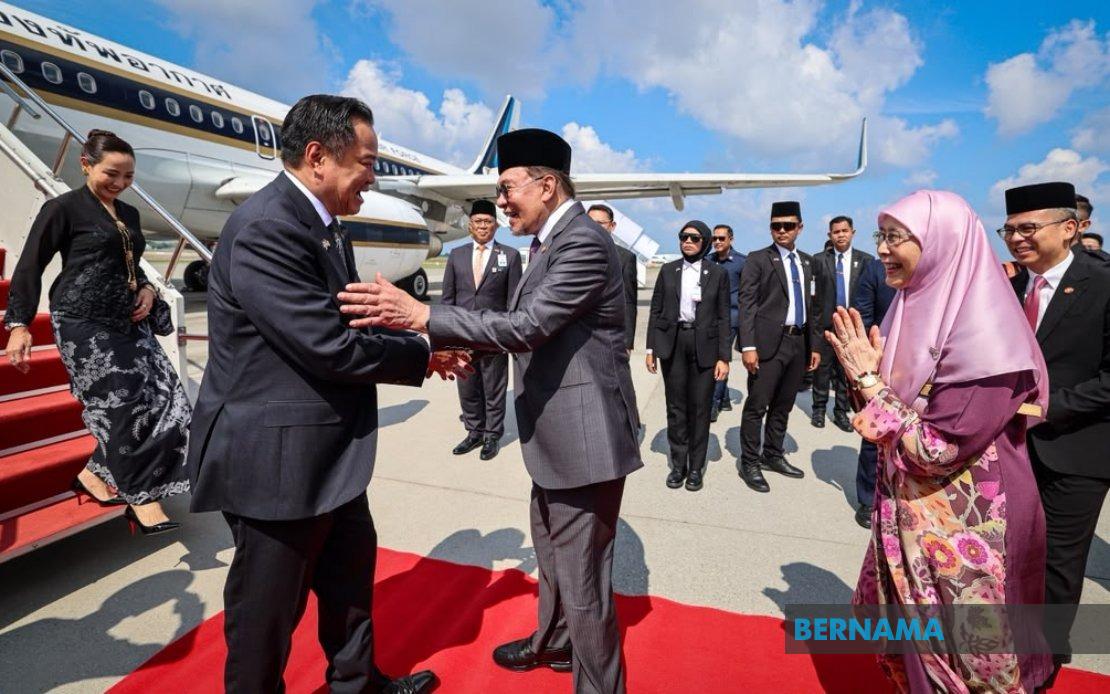
Thailand's Prime Minister Anutin Charnvirakul touched down at Kuala Lumpur International Airport on July 9 to begin a two-day official visit to Malaysia, arriving with his spouse Thananon Charnvirakul as guests of Prime Minister Datuk Seri Anwar Ibrahim. The special aircraft carrying the Thai delegation landed at the Bunga Raya Complex at 11.11 am, where Anwar extended a warm personal reception. The visit represents a significant moment in Malaysia-Thailand diplomatic relations, coming at a time when both nations are seeking to deepen economic and strategic cooperation across multiple sectors.
The ceremonial aspects of Anutin's arrival underscored the formal nature of the engagement and Malaysia's commitment to honouring its important neighbour. A full official welcome ceremony was staged, complete with a 34-member honour guard provided by the First Battalion of the Royal Ranger Regiment under the command of Major Muhammad Nur Addeen Mustaza. The ritual included the playing of both national anthems, a tradition that reflects the diplomatic protocol extended to visiting heads of government. In addition to Prime Minister Anwar, his wife Datuk Seri Dr Wan Azizah Wan Ismail attended the welcoming party, alongside Communications Minister Datuk Fahmi Fadzil, who served as the receiving minister overseeing the visit logistics.
Following the ceremonial reception, Anutin was introduced to members of Malaysia's Cabinet and senior government officials, a gesture designed to facilitate relationship-building beyond the executive level. This encounter provided an opportunity for Thai leadership to interact directly with Malaysia's top bureaucratic and ministerial echelon, potentially laying groundwork for future collaborative initiatives spanning multiple governmental portfolios.
The visit itself carries particular significance as Anutin's first journey to Malaysia since his reappointment as Thailand's Prime Minister in March 2026. His decision to prioritize a Malaysia visit during this period signals Bangkok's recognition of the bilateral relationship's importance in Thailand's foreign policy calculations. Officials from Wisma Putra, Malaysia's Ministry of Foreign Affairs, indicated that the primary objective centres on consolidating existing bilateral ties and expanding cooperation in sectors of shared concern.
During his stay, Anutin will participate in a bilateral meeting with Anwar at Perdana Putra, Malaysia's seat of executive power, where both leaders are expected to conduct a comprehensive review of the Malaysia-Thailand relationship's current state. These discussions will likely touch upon existing cooperation frameworks, pending initiatives, and emerging opportunities for partnership. A particularly notable element of the visit involves the signing and exchange of a memorandum of understanding focused on agricultural cooperation, demonstrating both countries' commitment to leveraging comparative advantages in the agricultural sector and strengthening supply chain integration.
The visit includes a formal luncheon hosted by Anwar at the Seri Perdana Complex in honour of Anutin and his delegation, providing an informal setting for extended discussions and social engagement that typically accompanies high-level state visits. Such occasions often facilitate candid exchanges on bilateral matters that might not occur in formal negotiating settings.
On the second day of the visit, July 10, both Prime Ministers will undertake a joint trip to Bukit Kayu Hitam in Kedah, where they will jointly inaugurate a critical border infrastructure project. The project involves opening a road link connecting Malaysia's Immigration, Customs, Quarantine and Security Complex in Bukit Kayu Hitam with Thailand's corresponding Customs, Immigration and Quarantine Complex in Sadao. This infrastructure development carries substantial implications for facilitating bilateral trade and people-to-people movement, reducing transit times and administrative friction at the land border crossing.
From an economic perspective, the timing of Anutin's visit arrives against a backdrop of increasingly robust Malaysia-Thailand trade relations. In 2025, Thailand ranked as Malaysia's sixth-largest global trading partner and second-largest among fellow ASEAN member states, with bilateral trade reaching RM118.57 billion, equivalent to approximately US$27.73 billion. These figures underscore the commercial depth of the relationship and its significance within Malaysia's broader trade portfolio.
More recent data from the first quarter of 2026 reveals a continuation and strengthening of this upward trajectory. Between January and March 2026, bilateral trade climbed to RM31.33 billion, representing US$7.90 billion in value, compared with RM27.35 billion or US$6.15 billion during the corresponding period in 2025. This growth rate, exceeding 14 percent year-on-year, suggests sustained demand for goods and services flowing between the two economies and indicates robust market confidence in the bilateral commercial relationship's future.
For Malaysian readers and policymakers, Anutin's visit carries implications beyond immediate bilateral matters. As a significant ASEAN actor, Thailand's engagement with Malaysia influences broader regional dynamics and intra-ASEAN cooperation frameworks. The emphasis on agricultural cooperation and border infrastructure development suggests a pragmatic focus on sectors where geographic proximity and complementary economic structures create natural opportunities for mutual benefit. The road link between the border complexes, for instance, could serve as a model for similar infrastructure projects elsewhere in Southeast Asia, demonstrating how neighbouring countries can collaborate to reduce logistics costs and enhance competitiveness in regional trade networks.
The visit also reflects broader Southeast Asian trends toward deepening intra-regional integration and moving beyond traditional diplomatic courtesies to substantive economic partnership. As ASEAN members navigate complex global trade dynamics, including shifting supply chains and evolving trade relationships with major powers, bilateral relationships like Malaysia-Thailand become increasingly important as anchors for regional stability and prosperity. Anutin's visit thus represents not merely a courtesy call between neighbouring governments, but rather a deliberate effort to strengthen mechanisms for cooperation that benefit both nations' citizens and contribute to regional economic resilience.

