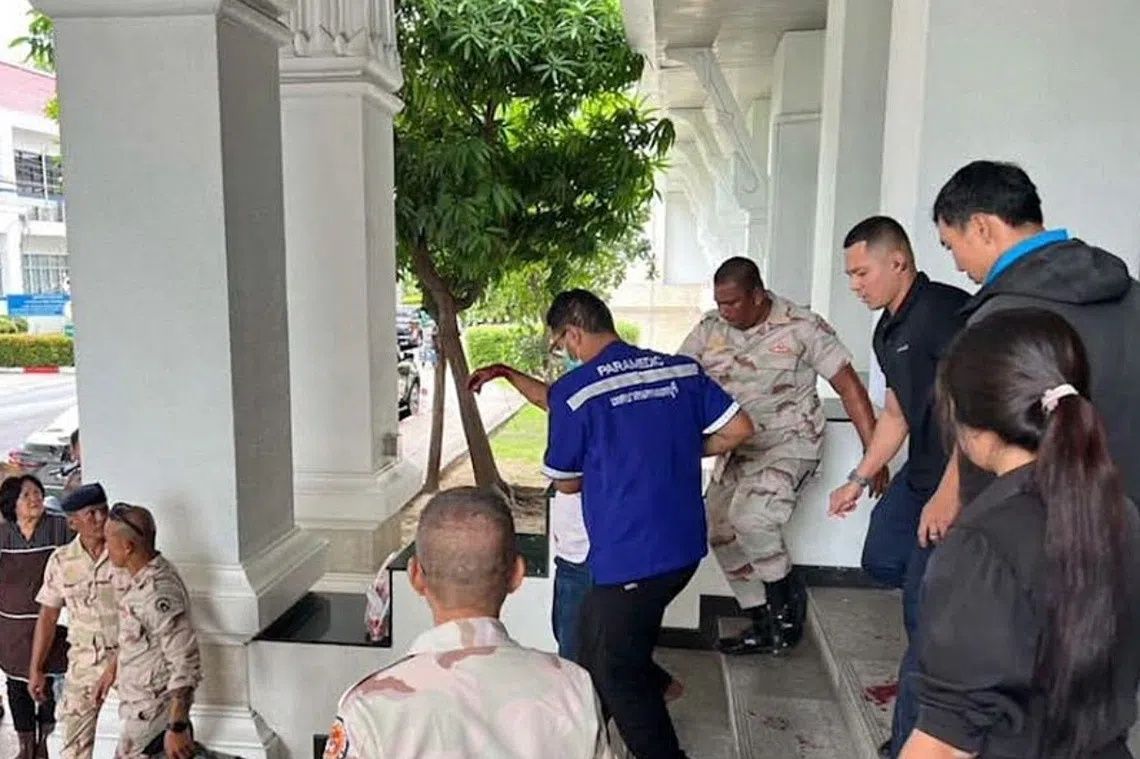
Thailand confronted a fresh security crisis Monday when a gunman opened fire at a local government office on Bangkok's outskirts, leaving at least two officials wounded and prompting his swift arrest by authorities. The incident occurred as the country remained traumatised by Friday's mass shooting at Debsirin Nonthaburi School, during which a 14-year-old boy killed nine people and injured more than 20 before taking his own life. The timing of the latest attack has intensified scrutiny on Thailand's firearms regulations and raised serious questions about why shootings of this magnitude continue to occur with alarming frequency.
Provincial police commander Major General Dejrapee Kongdee confirmed that the suspect, identified as a former lawmaker, had been apprehended after targeting a senior provincial official and his driver at the government office. Both victims sustained injuries serious enough to require hospitalisation, though officials have not disclosed the extent of their wounds or their current condition. The swift response by police in apprehending the shooter contrasted sharply with the prolonged response time during Friday's school rampage, where the teenager managed to kill multiple victims before authorities fully contained the situation.
Friday's school shooting represents Thailand's deadliest mass shooting event in nearly four years, a sobering statistic that underscores a troubling pattern of gun violence in the kingdom. The teenage gunman first killed his grandparents before proceeding to Debsirin Nonthaburi School, where he methodically shot classmates, teachers and staff in what eyewitnesses described as a horrifying rampage lasting several hours. The scale of casualties—nine killed and over 20 wounded—shocked the nation and sparked immediate calls from civil society groups and parents' organisations for comprehensive firearm reform.
The psychological toll on Thailand's education system became evident Monday as school children cautiously returned to classrooms nationwide. Many institutions implemented enhanced security measures including metal detectors and mandatory bag checks, transforming ordinary school environments into fortified spaces. Teachers reported finding anxious and traumatised students struggling to concentrate, with some schools bringing in counsellors to help children process their fears and grief. The spectacle of young students undergoing security screening before entering school has become a grim symbol of Thailand's failure to adequately address gun violence.
Prime Minister Anutin Charnvirakul used the crisis to reiterate his government's commitment to tightening gun control measures, signalling that legislative action would follow. Thailand currently operates under firearms regulations dating back several decades, which critics argue contain numerous loopholes and fail to sufficiently restrict access to weapons among certain demographic groups. The prime minister's statement suggests recognition that existing frameworks are inadequate to prevent determined individuals from obtaining guns, though specifics about proposed reforms remain unclear. Such policy shifts typically face resistance from rural communities where firearms ownership remains culturally embedded and economically justified for pest control and protection of livestock.
The back-to-back attacks also expose vulnerabilities in Thailand's ability to predict and prevent gun violence before it occurs. Unlike some developed nations with sophisticated threat assessment programmes, Thai law enforcement agencies rely primarily on reactive measures rather than proactive identification of at-risk individuals. Mental health services remain underfunded and inaccessible in many regions, particularly rural areas where the school shooting and government office attack both took place. Experts suggest that integrated approaches combining firearm regulation, mental health intervention and community reporting mechanisms could significantly reduce future incidents.
For Southeast Asian observers, Thailand's gun violence crisis carries regional implications. The kingdom serves as a regional hub for tourism, foreign investment and diplomatic activity, and sustained violence threatens its international reputation and economic stability. Neighbouring countries including Malaysia, Vietnam and Indonesia face similar challenges managing firearms in societies where illegal weapons circulate and mental health infrastructure remains underdeveloped. Thailand's policy response will likely influence how other regional governments approach similar challenges, making its next legislative moves consequential beyond Thai borders.
The economic and social costs of this violence extend far beyond the immediate casualties. Families of victims face lifelong trauma and financial hardship, schools must divert resources toward security rather than educational quality, and the tourism industry may see international visitors reconsider travel plans. Communities affected by the violence require long-term support including counselling, compensation schemes and community rebuilding programmes, yet Thailand's government has historically struggled to provide adequate post-crisis assistance. The accumulating burden of successive crises without meaningful prevention creates a dangerous cycle where public trust in state institutions erodes.
Looking forward, civil society organisations and parent groups are mobilising to push for substantive gun control measures that go beyond symbolic security theatre. Proposed reforms include stricter licensing requirements, comprehensive background checks, mandatory safety training and restrictions on high-capacity weapons. However, political resistance remains significant, with rural lawmakers arguing that firearms bans disproportionately affect agricultural communities and legitimate sporting hunters. Bridging this divide requires political courage and willingness to engage in genuine dialogue between security advocates and rural constituencies, something Thai policymakers have historically found challenging to achieve.

