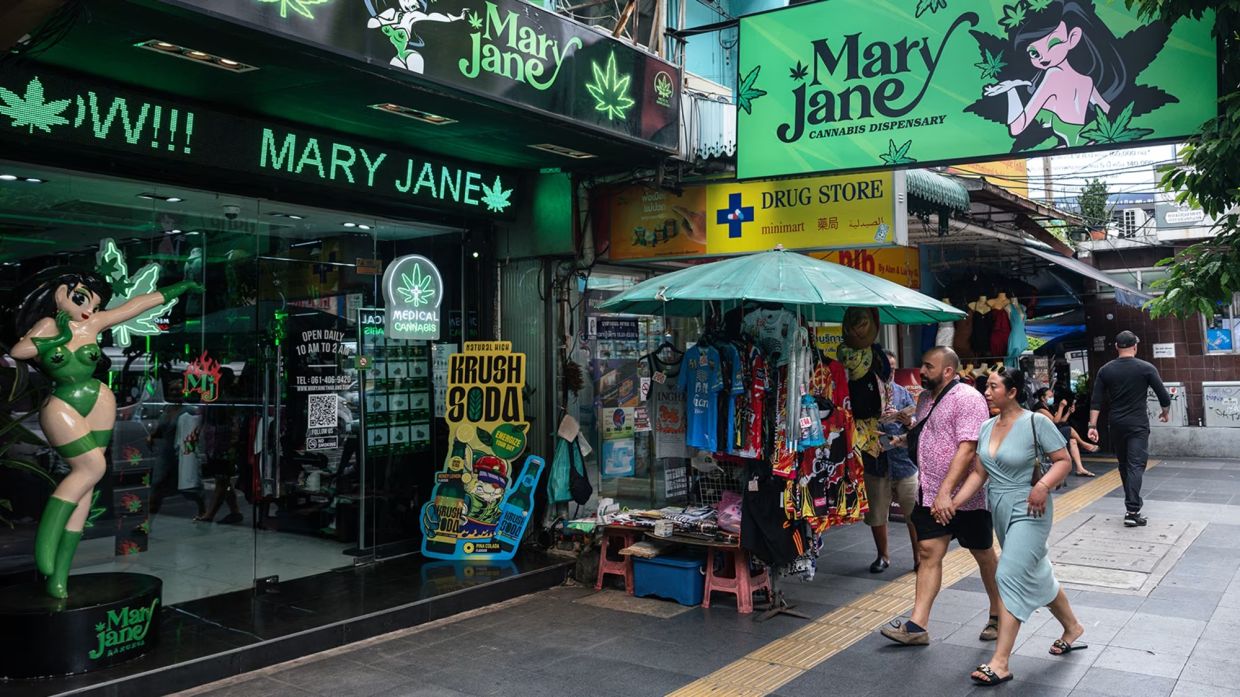
Thailand's experiment with cannabis liberalisation is unravelling, forcing policymakers to confront mounting evidence that the current regulatory framework has created dangerous gaps allowing uncontrolled distribution of the drug. The House Public Health Committee convened on June 18 to examine whether cannabis should be reclassified as a narcotic, reflecting escalating tensions between medical and anti-drug advocates pushing for tighter controls and business operators warning that reversal would devastate farmers and legitimate enterprises.
The debate exposes fundamental flaws in Thailand's approach since it decriminalised cannabis in June 2022. While cannabis extracts exceeding 0.2 per cent THC technically remain classified as narcotics under existing law, the practical reality has diverged dramatically from legal intent. Unregistered cultivation and informal direct sales have proliferated, creating grey market conditions where enforcement becomes nearly impossible and criminal elements exploit regulatory ambiguity. The committee chair, Sakoltee Phattiyakul, ordered officials to compile inventories of licensed cannabis shops in Bangkok and FDA-certified products, acknowledging that authorities lack basic clarity about what is actually being sold legally.
Dr Tewan Thaneerat from the Department of Thai Traditional and Alternative Medicine outlined the government's current approach, whereby cannabis operates as a controlled herb under the 1999 Protection and Promotion of Thai Traditional Medicine Wisdom Act. The department has worked with the FDA, Department of Health Service Support and the Office of the Permanent Secretary for Public Health to draft a comprehensive cannabis and hemp bill intended to bring the sector under rational regulation aligned with international standards. The June 2025 Public Health Ministry regulations represented an attempt to establish controls over research, sales, processing and exports, yet these measures appear insufficient to contain the spread of unregistered operations.
The political impasse surrounding comprehensive legislation has proved decisive in allowing chaos to flourish. A draft cannabis law was submitted to the Cabinet under the previous government but never reached Parliament before dissolution. The current Public Health Ministry remains committed to advancing the bill, which is undergoing public hearings expected to conclude by late July before Cabinet resubmission. This timeline highlights how institutional delays have created a governance vacuum that business interests and black market operators have exploited.
Medical professionals and public health advocates argue forcefully that cannabis should be returned to narcotics classification immediately, at least until dedicated legislation takes effect. Ekkapop Sittiwantana, deputy chairman of the House Public Health Committee, contended that reclassification would provide breathing room to establish proper plant registration systems and eliminate loopholes currently exploited by informal sellers. Associate Professor Smith Srisont, representing doctors, academics and civic groups opposed to drug-related harms, questioned why cannabis was removed from the Narcotics Code in the first place, noting that practical evidence already demonstrates negative public health consequences. He highlighted a critical vulnerability: while cannabis flowers are classified as controlled herbs, other plant parts remain outside criminal sanction when cultivated, creating obvious incentive structures for regulatory circumvention.
The FDA indicated that its oversight system technically covers production sites, processing plants, imports and licensed retail outlets for certified products. Officials reported that initial inspections found most tested products met labelling standards and complied with material testing requirements. However, this finding provides misleading reassurance because it addresses only the narrow segment of the market operating through formal channels. The agency itself acknowledged that the principal problem remains sales occurring outside legally supervised distribution networks—precisely the issue regulatory agencies cannot quantify or effectively manage.
Cannabis operators and the Thai Cannabis Future Network presented an alternative narrative, arguing that legitimate businesses face impossible circumstances competing against black market sales, illegal imports and legal uncertainty. The network raised serious allegations regarding official misconduct, including assertions that some authorities demanded payments or applied pressure related to cannabis licensing. They also described problems where medical prescriptions necessary for farming operations had become prohibitively expensive or were allegedly being traded through non-medical channels, suggesting bureaucratic capture of the regulatory system. This testimony indicates that even businesses attempting legal compliance encounter obstacles stemming from institutional dysfunction rather than principled policy disagreement.
The network's broader argument centres on cannabis's traditional and economic significance within Thai communities, contending that limiting the substance solely to mainstream medical applications fails to acknowledge its cultural role and potential agricultural benefits. They warned that returning cannabis to narcotics classification would devastate farmers and small operators who invested in legal cultivation believing government signals indicated long-term liberalisation. This perspective reflects genuine anxieties about unequal impacts: while large investors and international operators could absorb regulatory reversals, smallholder farmers face potential financial ruin. The network demanded that future legislation incorporate broad public participation rather than serving narrow commercial interests.
The committee's next phase involves compiling comprehensive harm assessments and surveying affected populations, signalling that policymakers recognise the need for evidence-based regulation rather than ideological positioning. Sakoltee indicated that the committee would consider draft proposals from multiple sources, not solely the Public Health Ministry's version, potentially creating space for genuine deliberation. He emphasised that future law must include distance requirements between cannabis shops and educational institutions, acknowledging concerns that easy access facilitates youth consumption.
Thailand's cannabis crisis reflects broader tensions within Southeast Asian drug policy as the region navigates diverging approaches to narcotics reform. While some countries pursue strict prohibition, Thailand attempted managed liberalisation without establishing institutional capacity for effective oversight. The outcome demonstrates that permissive frameworks require robust regulatory infrastructure, which Thailand manifestly lacks. For Malaysian policymakers and regional observers, Thailand's experience offers a cautionary lesson: decriminalisation or liberalisation without simultaneously building enforcement capability and closing definitional loopholes inevitably creates chaos that harms both public health and legitimate economic activity.
The resolution of Thailand's cannabis impasse will reveal whether governments can establish balanced regulatory frameworks serving genuine public health, economic development and social equity. The current deadlock—where medical advocates seek temporary reclassification, operators resist reversal, and policymakers struggle to enact comprehensive legislation—may produce compromise through delayed formal law while informal regulations attempt damage control. However, sustained legal ambiguity will likely perpetuate the worst of both prohibition and liberalisation: black market proliferation alongside enforcement corruption, with vulnerable populations and small farmers bearing the heaviest costs. Whether Thailand's Parliament can deliver coherent cannabis legislation by late 2025 remains uncertain, but the urgency of decision-making grows as access expands and public health concerns accumulate.

