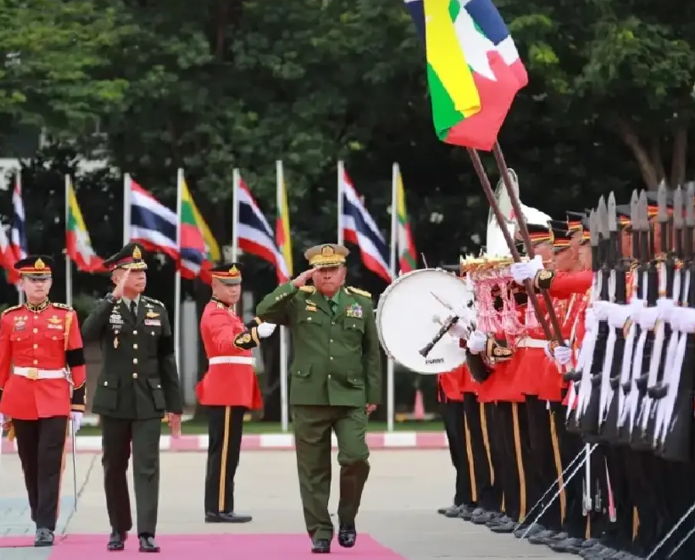
Thailand's military leadership rolled out formal courtesies for Myanmar's armed forces commander on Thursday, signalling accelerating diplomatic normalisation between the two neighbours. The visit by Ye Win Oo—the military leader of Myanmar's post-coup government—represents his inaugural foreign trip since taking the post, underscoring how the regime that seized power in 2021 is systematically rebuilding its standing in the region after nearly half a decade of pariah status. Thai military chief Ukris Boontanondha received him at a Bangkok hotel, with talks expected to centre on the fraught 2,400-kilometre shared border where conflict-related instability has become an acute concern for both capitals.
Ye Win Oo assumes command of Myanmar's armed forces following elections conducted in early 2026—a carefully orchestrated exercise in military rebranding that placed coup leader Min Aung Hlaing in the civilian presidency while consolidating institutional power. The lieutenant general's ascent to military supremacy reflects continuity within the junta's upper echelons; he previously served as a spymaster for Myanmar's ruling establishment and remains a trusted custodian of the generals' interests. His international itinerary departure underscores how Myanmar's military is leveraging the electoral interlude to reset relationships with regional partners who share immediate security imperatives along their common frontier.
The military coup of February 2021 dethroned Aung San Suu Kyi's democratically elected government, triggering an armed conflict that has claimed an estimated 100,000 lives and displaced millions. The junta's subsequent campaign has drawn extensive documentation of mass killings, torture networks, sexual violence as weapons of warfare, and arbitrary mass detention. United Nations investigators last week released findings that Myanmar's military continues escalating aerial bombardment of civilian areas, adding fresh credibility to international concerns about the regime's conduct. Yet the junta has dismissed such allegations as one-sided and factually baseless, maintaining that security operations remain justified against what it portrays as insurgent threats.
Thailand's embrace of Myanmar's military hierarchy this month—including earlier hosting Min Aung Hlaing for full ceremonial honours—reflects a pragmatic calculation by Bangkok regarding regional stability. Thai Prime Minister Anutin Charnvirakul personally extended red-carpet treatment, with Foreign Minister Sihasak Phuangketkeow defending the decision on transparently realpolitik grounds: "It's not about legitimacy, it's about reality." This formulation captures the dilemma confronting regional powers: Myanmar's military governs a neighbouring territory with which engagement appears inescapable given geography and commerce, even as the regime's human rights record remains internationally indefensible.
Neighbouring states share Myanmar's border anxieties. The protracted civil war has destabilised the frontier, spawning refugee outflows, drug trafficking networks, and cross-border armed clashes involving ethnic militias and regime forces. Thailand, Laos, and other ASEAN members have tacitly adopted a posture of normalisation partly out of necessity; managing the Myanmar crisis through isolation has proven ineffective, whereas diplomatic channels might offer leverage over border security, repatriation logistics, and conflict de-escalation. This calculation separates regional governments from Western democracies and human rights coalitions, which have maintained targeted sanctions against Myanmar's military leadership and rejected the legitimacy of the electoral exercise.
International divisions over Myanmar's path forward have hardened along familiar geopolitical fault lines. Democracy advocates and watchdog organisations have dissected the 2026 elections as theatrical stagecraft designed to perpetuate military autocracy under constitutional camouflage. The vote deliberately excluded Suu Kyi's National League for Democracy, imprisoned its senior figures on contestable charges, and constructed electoral rules that predetermine outcomes. Human rights groups argue that regional engagement implicitly validates this facade, lending the junta undeserved credibility. The Special Advisory Council for Myanmar this week declared that Thailand's diplomatic pivot constitutes abandonment of democratic principles, characterising the Ye Win Oo visit as compounding Bangkok's credibility damage.
Yet Thailand and its diplomatic peers occupy an uncomfortable middle ground between principled rejection and strategic silence. ASEAN consensus-building requires deference to member sovereignty, limiting the bloc's institutional capacity for moral clarity on Myanmar. Meanwhile, the military regime has proven willing to exploit regional ambitions for legitimacy, leveraging visits and ceremonial exchanges to project normalisation domestically and internationally. Each diplomatic courtesy strengthens the junta's narrative that it has successfully weathered international censure and earned restoration to ordinary great-power relations.
The border challenges that animate Thai-Myanmar military dialogue remain substantive. The ongoing civil war has created ungoverned spaces where armed groups operate with minimal restraint, generating spillover risks for Thai national security. Cross-border displacement has strained Thai border provinces economically and socially. Drug production and trafficking networks flourishing amid conflict create parallel governance structures that undermine Thai law enforcement. These concrete security imperatives explain why Thai officials prioritise engagement over estrangement, even at the cost of appearing to acquiesce in the junta's repression.
Ye Win Oo's elevation to military command represents consolidation of the coup generation's control. Unlike transitions that might bring reformist voices to senior positions, his appointment guarantees continuity of hardline management. His background as intelligence operative signals emphasis on internal security and monitoring rather than institutional modernisation. This personnel architecture casts doubt on whether regional engagement might gradually encourage institutional evolution toward greater restraint. Conversely, it suggests that the junta views diplomatic opening as compatible with—rather than requiring accommodation to—its current operational framework.

