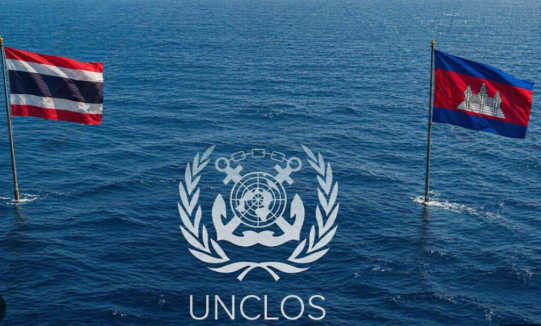
Thailand has formally accepted Cambodia's request to pursue compulsory conciliation under the 1982 United Nations Convention on the Law of the Sea, or Unclos, to address their longstanding maritime boundary dispute in the Gulf of Thailand. The Thai Ministry of Foreign Affairs submitted its official response on June 19, following Cambodia's notification transmitted on June 2. However, Bangkok has been emphatic in clarifying that this process operates distinctly from litigation, and that whatever recommendations emerge will carry no legal force binding the two nations to any particular outcome.
The conciliation mechanism represents a significant development in efforts to resolve one of Southeast Asia's most persistent maritime disputes. The Gulf of Thailand contains substantial natural gas and hydrocarbon reserves, making the boundary delimitation economically significant for both nations. Rather than viewing this as capitulation, Thai officials have framed acceptance as a pragmatic step that maintains bilateral relations while adhering to international legal frameworks that both countries have ratified.
In orchestrating Thailand's participation, Deputy Prime Minister and Foreign Minister Sihasak Phuangketkeow was designated as the country's Agent in proceedings, while Songchai Chaipatiyut, Thailand's ambassador to Kuwait and a former Department of Treaties and Legal Affairs official, assumes the role of Deputy Agent. This high-level appointment signals the seriousness with which the Thai government approaches the matter, even as it downplays the binding nature of outcomes. Thailand additionally appointed two conciliators: Judge Albert J Hoffmann of South Africa and Judge Rudiger Wolfrum of Germany, both of whom the Foreign Ministry characterised as internationally recognised experts in maritime law.
The conciliation structure requires the four conciliators selected by Thailand and Cambodia to jointly choose a fifth member within thirty days of Thailand's formal response. This fifth conciliator will chair the overall commission and guide its work. The commission is anticipated to complete its assessment and formulate recommendations within approximately twelve months, though both parties may mutually agree to extend this timeline. This timeframe differs markedly from traditional litigation, which can consume years of proceedings before resolution.
Bangkok has been careful to educate stakeholders about the distinctive character of compulsory conciliation as distinct from contentious litigation. Thai officials stress that conciliators function not as advocates for either side but as neutral specialists tasked with absorbing arguments from both nations, contextualising the historical development of claims, and facilitating identification of solutions acceptable to both parties. This framing positions the process as exploratory rather than adjudicatory, which may explain Thai acceptance despite initial hesitation about the scope of Cambodia's submission.
A core tension evident in Thailand's response concerns the range of issues the conciliation should address. Cambodia's original notification reportedly encompassed not merely maritime boundary delimitation but also provisional arrangements for joint resource development and equitable sharing of hydrocarbon extraction. Thailand has consistently maintained that conciliation should remain narrowly confined to establishing the precise maritime boundary, leaving questions of joint development or resource allocation for separate bilateral negotiations. This distinction matters substantially because joint development frameworks might constrain Thailand's unilateral options in disputed zones.
The Foreign Ministry has articulated the position that conciliation findings will take the form of a report containing recommendations rather than binding judgements. Both nations retain full discretion whether to incorporate these recommendations into future agreements. This interpretation aligns with Unclos Annex V, which explicitly provides that conciliation commission reports, conclusions, and recommendations carry no binding force on the parties involved. Thai officials have emphasised repeatedly that such recommendations merely furnish a foundation upon which the two countries can build continued bilateral negotiations rather than superseding direct diplomatic engagement.
Thailand's approach reflects a broader strategic calculation about maintaining negotiating flexibility while appearing cooperative internationally. By accepting conciliation, Bangkok demonstrates commitment to peaceful dispute resolution mechanisms endorsed by the United Nations, which carries weight among Southeast Asian neighbours and major powers. Simultaneously, by insisting that recommendations remain non-binding and that ultimate resolution depends on bilateral talks, Thailand preserves freedom to accept or reject specific recommendations based on national interest calculations that may shift over time.
Context for this dispute extends to May, when the Thai Cabinet approved terminating the 2001 memorandum of understanding with Cambodia, commonly referenced as MoU 44 in Thailand. This framework had governed approaches to overlapping continental shelf claims for twenty-five years without achieving substantive progress toward boundary agreement. Prime Minister Anutin Charnvirakul characterised the cancellation as administrative adjustment rather than hostile act, attributing the termination to stalled negotiations rather than bilateral conflict. Thailand framed the decision as intended to recalibrate cooperative mechanisms, not to terminate discussions, and signalled willingness to anchor future talks in Unclos provisions applicable to both parties.
Cambodia's subsequent invocation of compulsory conciliation responded to Thailand's termination of their joint framework, though Phnom Penh publicly characterised the step as pursuit of peaceful resolution through established international law rather than as escalation or punishment. This diplomatic posture reflects Cambodia's desire to leverage international institutions while maintaining rhetorical commitment to amicable settlement. The initiation of formal conciliation proceedings paradoxically coexists with Thailand's acceptance, creating an unusual dynamic where both nations simultaneously pursue international process while verbally emphasising non-binding character and continued preference for bilateral resolution.
For Malaysian observers and policymakers, this dispute carries relevance beyond bilateral Thai-Cambodian relations. The Gulf of Thailand maritime issues intersect with broader Southeast Asian questions about managing overlapping claims, exercising sovereign rights over hydrocarbon resources, and applying Unclos frameworks in contested waters. Malaysia itself navigates comparable disputes and maintains strong interest in establishing precedents for peaceful resolution mechanisms that preserve flexibility for all parties. The Thai-Cambodian conciliation may offer lessons regarding balancing international law adherence with national interest protection.
The coming months will reveal whether conciliation genuinely advances boundary resolution or primarily serves as face-saving mechanism allowing both nations to claim progress while deferring substantive decisions. The quality and independence of the conciliators will substantially influence whether recommendations achieve credibility sufficient to influence final negotiations. Whether either party ultimately accepts recommendations remains an open question, but the mere fact of formal conciliation proceedings represents meaningful movement in a dispute that has festered for decades without resolution through traditional diplomacy.

