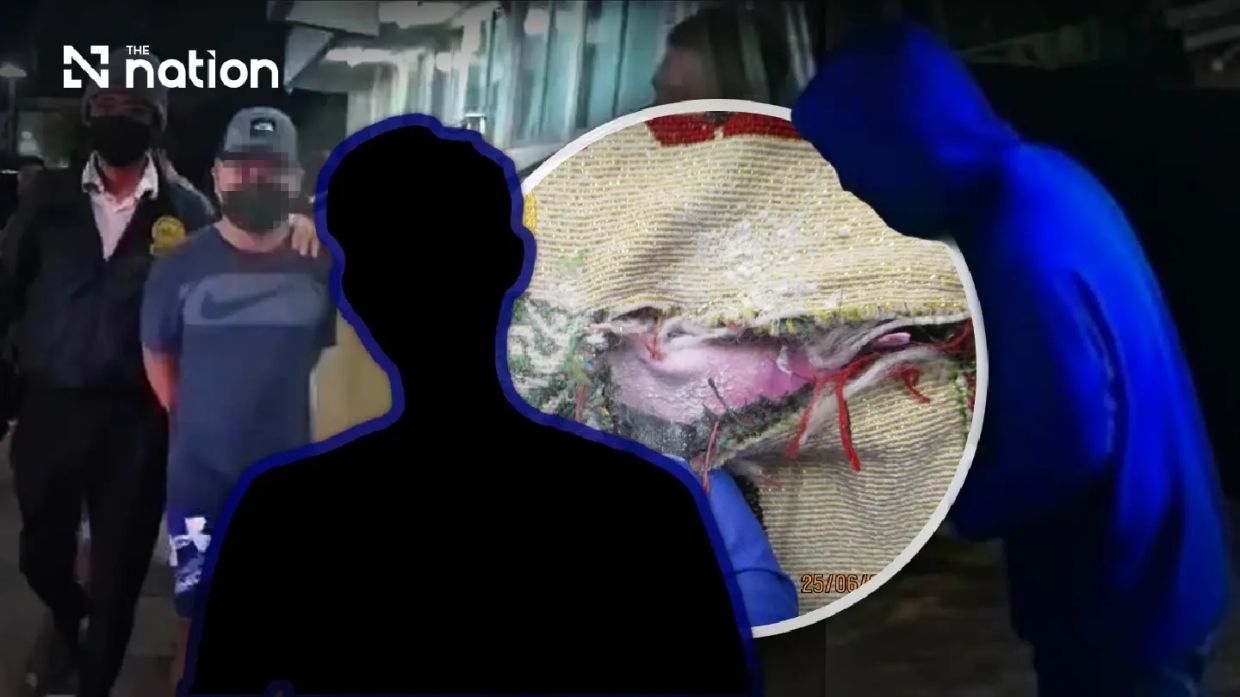
Thai law enforcement has intensified its crackdown on a transnational drug trafficking operation following the arrest of Ekkawit in Phayao province overnight. The suspect is believed to have served as a key intermediary in a smuggling pipeline that recruited commercial airline crew members to transport heroin across borders. Deputy Metropolitan Police Bureau commissioner Pol Maj Gen Theeradej Thamsuthee confirmed the arrest, signalling a significant expansion of investigative efforts into what authorities now characterise as a sophisticated international narcotics network.
According to police accounts, Ekkawit operated under the online alias "Rin Rin" and functioned as a crucial link in the distribution chain. His role centred on acquiring an elephant-print fabric bag and delivering it to a man known as Uthai, who was detained earlier in the investigation. Uthai subsequently passed the concealed heroin package to a female flight attendant identified as Mina, who was commissioned to carry the contraband to Australia. This layered approach to smuggling—using multiple intermediaries separated by operational roles—reflects a deliberate effort to compartmentalise knowledge and reduce the risk of network-wide exposure.
During preliminary interrogation, Ekkawit acknowledged receiving THB100,000 for his involvement and claimed he had completed similar missions on two or three previous occasions. His admissions paint a picture of a repeat operator rather than a first-time participant, suggesting the network had successfully executed multiple transnational deliveries before law enforcement intervention. The defendant also provided crucial information regarding the identity concealed behind the profile "Rose Rose," the person who allegedly recruited Mina and orchestrated key aspects of the operation from a distance.
Investigators uncovered the operational framework through which Rose Rose coordinated the smuggling process. According to police findings, Rose Rose instructed Ekkawit to purchase the elephant-print bag, which Ekkawit acquired in Chiang Mai. Upon obtaining the bag, Ekkawit would notify Rose Rose and position the item at a predetermined kilometre marker location. An associate would then collect the bag, transport it across the border to Laos, and arrange for the heroin to be concealed within the fabric. Ekkawit maintained that this concealment occurred in Laos, though police expressed scepticism regarding this claim, suspecting the procedure may have taken place elsewhere.
The financial mechanics of the arrangement reveal a sophisticated money-movement scheme designed to obscure the flow of payments. After heroin was inserted into the bag, Rose Rose would instruct Ekkawit to retrieve the package along with THB100,000 in compensation, both left at the agreed kilometre marker. Ekkawit would then coordinate with Uthai for the next stage, compensating him with THB60,000 deposited via cash deposit machine—a method that creates some digital trail while maintaining partial anonymity. This stratified payment system suggests operational experience and awareness of modern law enforcement surveillance techniques.
Relationship analysis conducted by narcotics investigators revealed that Ekkawit and Rose Rose share family ties and both originate from Phayao province. Photographs examined by police showed the two individuals travelling together, indicating a personal connection that likely predated their involvement in drug trafficking. This familial element may explain the trust placed in Ekkawit for handling valuable contraband and managing financial transactions within the network. The provincial connection also suggests the organisation may have developed local supply chains or logistical advantages rooted in regional geography.
Uthai, who had been questioned separately regarding his own participation, claimed to have executed the delivery assignment five or six times previously. However, police remain unconvinced by his testimony, believing his account had been rehearsed and optimised before his arrest to minimise culpability. Investigators discovered that Uthai had maintained a rental room in Phra Nakhon Si Ayutthaya province for at least five to six months, leading authorities to suspect he may have undertaken more courier missions than officially acknowledged. This discrepancy between claimed and suspected activity suggests a pattern of underreporting by the accused.
The flight attendant Mina represents a critical recruitment target for the operation. By leveraging commercial airline personnel with legitimate international travel credentials, the network minimised detection risks compared to conventional smuggling methods. Rose Rose employed direct contact to approach Mina, though the precise nature of recruitment—whether through coercion, financial incentive, or existing criminal connections—remains under investigation. The targeting of commercial crew members indicates the organisation possessed knowledge of airport security vulnerabilities and international customs procedures.
Police have established that Rose Rose, despite operating under an anonymous online account, occupied a coordinating role rather than the apex of the hierarchy. Narcotics investigators have compiled detailed information about the individual behind the profile, though they believe a more senior organiser remains unidentified and insulated from operational details. This structural arrangement—with Rose Rose managing daily operations and recruitment while reporting to an unseen superior—represents a classic compartmentalised network design intended to protect leadership from direct connection to drug trafficking activities. The existence of this higher-level figure significantly complicates investigative scope.
Ekkawit has been transported to Phayao for on-site identification of locations connected to the smuggling operation before his transfer to the Narcotics Suppression Bureau (NSB). Officials indicated he was expected to arrive at NSB headquarters on Friday evening, July 10, 2026, where Deputy National Police Chief Pol Gen Samran Nuanma announced plans to personally conduct advanced questioning. This direct involvement by senior leadership underscores the case's significance within national law enforcement priorities and the cross-border implications for Thai-Australian cooperation.
The expanding investigation reveals how international heroin networks have evolved to exploit legal travel frameworks and personnel within legitimate commercial aviation. The use of commercial flight attendants as couriers represents an adaptation to heightened scrutiny of conventional smuggling corridors. As authorities pursue remaining network participants—particularly Rose Rose and the suspected senior organiser—the case illuminates vulnerabilities in aviation security and the necessity for enhanced screening and intelligence-sharing protocols among regional law enforcement agencies. For Malaysia and other Southeast Asian nations, the case underscores how sophisticated drug networks exploit porous borders and multiple jurisdictions to facilitate transnational trafficking operations.

