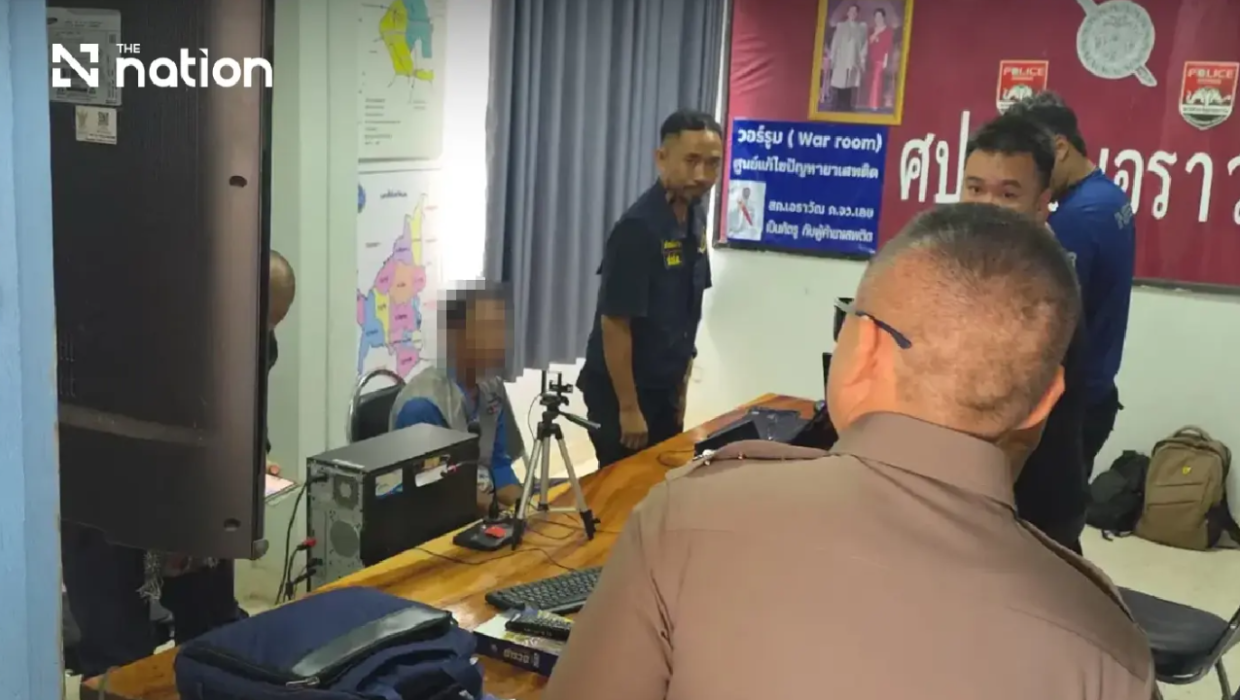
A husband-and-wife team detained in northeastern Thailand's Loei province has become central to an expanding investigation into what authorities believe is a sophisticated international drug trafficking network. The arrests came as Thai police and narcotics agencies traced connections between the couple and the case of a Thai Airways flight attendant arrested at Melbourne Airport in Australia, accused of carrying approximately one kilogram of heroin in her luggage.
The investigation began with the detention of the flight attendant, identified in local reports as Mina, whose arrest at Melbourne sparked immediate cooperation between Thai and Australian law enforcement. Rather than treating the case as isolated, Thai authorities recognised the seizure as potentially part of a larger smuggling scheme and began working backwards to identify those responsible for dispatching the contraband. This approach reflects growing international recognition that couriers like flight attendants often represent just the visible component of larger networks operating across multiple borders.
On Thursday, July 2, officers from Chiang Khan Police Station in Loei initiated surveillance and tracking operations after identifying Athit, 43, and his wife Thatsaphon, 42, as suspects. When authorities initially visited a property in That subdistrict linked to the pair, they were not present. Rather than abandoning the search, investigators pursued intelligence suggesting both had found work in the region, a methodical approach that illustrates how modern narcotics investigations operate by tracking patterns of movement and employment.
Police eventually located Athit at Wat Tham Pha Mak Ho temple in Wang Saphung district, where he was engaged in roof repair work. His apprehension and subsequent questioning proved significant when he reportedly admitted to participating in parcel deliveries on multiple occasions. According to initial police reports, Athit confessed to being compensated for sending six parcels destined for Bangkok through various courier services operating in the Chiang Khan area. The financial arrangement allegedly involved receiving 8,000 baht, approximately US$240, for each delivery from a Lao national contact, with the most recent transaction occurring on June 28, 2026.
Thatsaphon's detention followed discovery of a black Mitsubishi Triton pickup bearing Loei province registration parked within a rubber plantation in Erawan district. The presence of the vehicle in this location, combined with other investigative threads connecting her to the operation, led authorities to take her into custody for questioning at Erawan Police Station. During preliminary interrogation, she denied any knowledge of or involvement in the alleged smuggling activities, positioning herself as uninformed about her husband's activities—a defence that investigators will attempt to verify or refute as the inquiry develops.
The modus operandi emerging from police statements reveals the compartmentalised nature of modern drug trafficking operations. Rather than concentrating all functions within a single actor or location, the network appears to have recruited individuals at different points in the supply chain, each possessing limited knowledge of the overall operation. Athit's role involved physical delivery of parcels through legitimate parcel services, providing a veneer of legality while obscuring the contraband's true nature and destination. This layering of responsibilities across different individuals and jurisdictions makes detection and prosecution more challenging and reflects sophisticated understanding of law enforcement techniques.
The Office of the Narcotics Control Board (ONCB) has now assumed primary responsibility for ongoing interrogations and expansion of the investigation. The agency's focus has shifted toward identifying higher-level participants—those who orchestrated the operation, financed activities, and determined what goods would be smuggled and through which routes. Such individuals typically remain insulated from street-level operators like Athit and Thatsaphon, making their identification a substantially more complex investigative undertaking requiring careful analysis of financial transactions, communications records, and coordination with international partners.
The connection to Lao nationals featured prominently in police statements, reflecting Thailand's ongoing challenges with cross-border trafficking. The porous and economically disparate frontier between Thailand and Laos, combined with limited enforcement capacity in neighbouring regions, has historically made the area attractive to smuggling operations. Drug networks exploit existing kinship ties, cultural similarities, and economic desperation across the border, leveraging these relationships to move contraband through seemingly legitimate channels. The identification of a Lao contact as the payments provider suggests this case exemplifies broader regional patterns rather than representing an isolated incident.
Security cooperation between Thailand and international partners, particularly Australia, provided crucial momentum for this investigation. The ONCB secretary-general acknowledged in public statements that the breakthrough depended substantially on coordinated intelligence sharing and investigative cooperation across borders. Such arrangements, though increasingly standard among developed nations, remain inconsistently implemented within Southeast Asia, where resource constraints, jurisdictional complexities, and varying legal frameworks can impede seamless information exchange. This case demonstrates both the potential and necessity of such cooperation in addressing transnational organised crime.
Thailand's narcotics suppression strategy now emphasises not merely intercepting drugs at airports and borders but systematically dismantling the networks facilitating their movement. The ONCB has outlined intentions to intensify investigation, strengthen foreign law enforcement partnerships, monitor financial flows supporting trafficking operations, and identify and interdict transport corridors before contraband reaches international departure points. This approach acknowledges that addressing transnational drug networks requires intervention at multiple levels simultaneously—disrupting supply sources, interdicting shipments, freezing financial channels, and incapacitating key participants throughout the operation's entire structure.
For Malaysia and other Southeast Asian nations, the case carries pertinent implications. Regional air routes, particularly those connecting major hubs like Bangkok and Kuala Lumpur to international destinations, remain attractive to smugglers exploiting airline staff. The infiltration of flight crews by trafficking organisations represents an ongoing concern for aviation security and law enforcement across the region. Malaysia's own airport security protocols and cooperation frameworks with neighbouring countries face regular testing from increasingly sophisticated smuggling attempts leveraging insider connections and international networks.
The investigation also underscores persistent vulnerabilities in cross-border enforcement. Despite Thailand's stated commitment to combating narcotics trafficking, the involvement of individuals from multiple jurisdictions and the operation's apparent longevity prior to detection highlight gaps in surveillance and coordination. Similar vulnerabilities likely exist throughout Southeast Asia, where porous borders, corrupt officials, and limited investigative resources provide traffickers substantial operational space. Enhanced regional cooperation mechanisms, technology sharing, and capacity building remain essential for meaningfully disrupting these networks.
As the ONCB pursues its expanded investigation, the ultimate test will involve identifying and successfully prosecuting the organisational structures directing these operations rather than remaining satisfied with apprehending low-level participants. The case will likely consume considerable investigative resources while demonstrating to regional and international partners Thailand's commitment to addressing a significant public health and security challenge. However, the fundamental question remains whether such investigations represent genuine progress in degrading trafficking networks or merely create temporary disruptions that these adaptable organisations quickly circumvent through modified procedures and personnel rotations.

