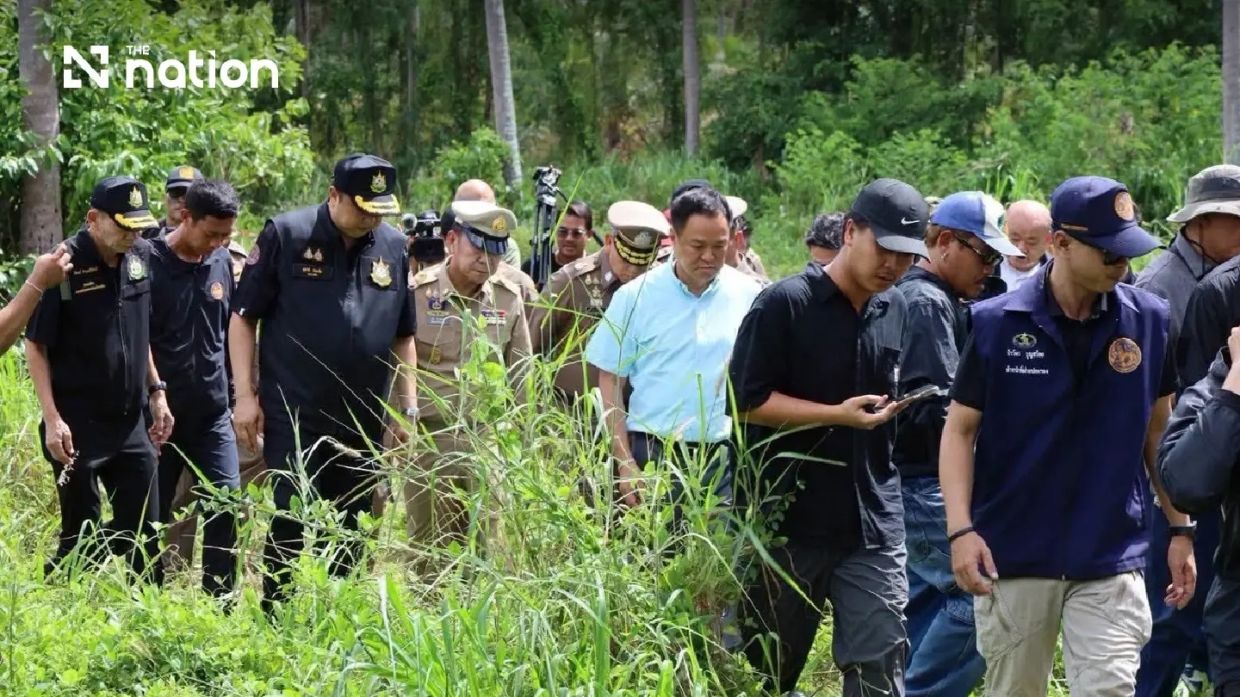
Prime Minister Anutin Charnvirakul has ordered a comprehensive security strengthening across Chonburi province following the recovery of five bodies connected to what investigators are treating as a series of linked killings. The discovery of the remains of two Russian siblings and three members of a Thai family has prompted the government to act swiftly to contain the damage to Thailand's international standing and reassure visitors about their safety within the kingdom's borders. On Saturday, August 1, the prime minister personally visited the investigation sites alongside national police chief Pol Gen Kitrat Phanphet, conducting what amounted to a crisis management exercise designed to demonstrate governmental responsiveness to a tragedy that threatens one of Southeast Asia's most popular tourism destinations.
The prime minister's appearance at the two burial sites in Chonburi reflected the severity with which Bangkok is treating the case. At approximately 2pm, Anutin inspected the location near a motorway where the bodies of the Russian siblings had been interred, followed by a visit to a nearby area where three Thai nationals—identified as a father, mother, and daughter—were reportedly killed and concealed in a communal grave. Investigators had recovered these remains the previous night, and the discovery prompted immediate high-level political engagement. The visible distress displayed by Anutin as he reviewed the sites and received operational updates from law enforcement officials signalled the gravity of the situation and the personal impact the case has made on the country's leadership.
The government's primary concern extends beyond the immediate loss of life to encompass the broader implications for Thailand's standing as a secure destination for international tourism. Anutin acknowledged openly that the incident has inflicted reputational damage on the country and particularly on Chonburi and Pattaya, both of which command international recognition as major tourism hubs generating substantial foreign exchange revenue. He articulated a determination to restore public and international confidence, recognising that tourism operators and promotional agencies across Thailand face potential loss of bookings if the situation is perceived as symptomatic of systemic security failures rather than isolated criminal aberration. The prime minister framed the restoration of confidence as an urgent national priority requiring coordinated governmental action and enhanced police capabilities.
Anutin's statement acknowledged a particularly damaging dimension to the case: the killing of Thai citizens alongside foreign visitors. He stressed that the incident could not be dismissed merely as an international security concern but represented a broader failure to protect residents of the kingdom. This dual focus—emphasising harm to both foreign nationals and Thai people—reflected a strategic effort to position the government's response as comprehensive rather than preferentially focused on foreigners. By highlighting the deaths of three Thai family members, Anutin attempted to reframe the incident as a general public safety crisis affecting all residents rather than a specific threat to tourism, thereby broadening the appeal for public cooperation and support for enhanced police measures.
The prime minister extended formal apologies to Russian nationals, acknowledging that the deaths had occurred within Thailand despite efforts by the Russian government to encourage tourism from its citizens. This diplomatic gesture carries significance within the context of Thailand's engagement with major source markets for international visitors. Russia represents a substantial pool of tourists willing to travel long distances for beach and entertainment experiences, and the loss of Russian confidence in Thailand's safety could have ripple effects across the broader European market. Anutin's personal apology and expression of regret constituted an attempt to preserve bilateral relations and maintain tourism flows from a strategically important market during a period of broader geopolitical sensitivity.
To address the immediate security concerns, Anutin instructed relevant authorities to escalate patrol intensity and inspection activities, particularly in areas where serious crimes might be concealed or repeated offences committed. This directive reflected police intelligence suggesting that the alleged perpetrators possessed detailed knowledge of the geographic area, selecting locations for the killings and body disposal with evident familiarity. The prime minister's assessment that the offenders were likely highly acquainted with Chonburi implied that the crimes were not random acts but targeted operations by individuals with local knowledge and perhaps established criminal networks. The instruction to intensify patrols and inspections thus targeted the prevention of recurrent incidents in areas where criminal activity might concentrate.
Anutin characterised the case as exceptionally brutal and hypothesised that the perpetrators may have intended not only robbery but also murder to prevent victim identification and evidentiary trails leading to prosecution. This assessment suggested premeditated criminal planning rather than spontaneous violence, elevating the perceived threat level and justifying the government's more aggressive security posture. The prime minister further speculated that the sophistication of the alleged crimes and the selection of burial sites indicated high familiarity with the area and potentially coordination among multiple individuals with shared knowledge of discrete locations suitable for concealment of evidence.
Investigators have reported that two principal suspects had previously served prison sentences before their alleged involvement in the current case, a detail that intensified public criticism and political pressure for stringent consequences. Anutin instructed police to pursue the investigation with full intensity and ensure that identified suspects faced court proceedings. Reports suggested that four individuals may have been involved specifically in the Thai family killings, whilst two suspects had been taken into custody in the broader investigation. The involvement of multiple perpetrators across different incidents suggested a potential network of criminal activity or at minimum a series of independently committed but temporally proximate offences.
Public discourse surrounding the case has included calls for capital punishment, prompting questions about whether the government would seek maximum penalties for convicted individuals. Anutin responded by acknowledging that Thai law retained the death penalty as an available sentence, though its imposition remained entirely within judicial discretion rather than governmental mandate. He clarified that the government, whilst overseeing the Department of Corrections and Royal Thai Police, could not direct courts to impose specific sentences but was obligated to ensure that judicial decisions, once rendered, were executed in accordance with the rule of law. This explanation attempted to manage public expectations regarding potential outcomes whilst maintaining the principle of judicial independence.
The prime minister expressed the view that individuals convicted of exceptionally grave crimes should not become examples encouraging others to commit similar offences and used direct language asserting that such perpetrators should not remain burdens upon Thai society. However, he emphasised that any sentence, including capital punishment, would necessarily follow the complete judicial process encompassing investigation, prosecution, trial, and final appellate court determinations. This qualification underscored the tension between public demands for swift and severe punishment and the requirements of Thai criminal procedure, which mandate due process and evidentiary presentation before the courts can render judgments. Anutin indicated that existing legislation already provided substantial penalties for serious criminal offences and expressed scepticism regarding the necessity for immediate legislative review, suggesting that the legal framework was adequate to address the case if evidence supported convictions.
The incident illustrates the vulnerability of Southeast Asian tourism economies to security crises that can rapidly erode international confidence and generate substantial economic consequences across hotel, transportation, and hospitality sectors. Thailand's response—combining high-level governmental acknowledgement of the problem, direct law enforcement engagement, public apologies to affected nations, and commitments to enhanced security measures—represents the standard crisis management approach employed by tourism-dependent economies when serious crimes undermine market confidence. The effectiveness of these measures will ultimately depend on the pace and transparency of the investigation, the quality of evidence presented to courts, and the perception within international markets that the incidents represent aberrations rather than symptoms of systemic insecurity. For Malaysian observers, the case serves as a reminder of the operational challenges faced by regional law enforcement in addressing transnational tourism security issues and the political sensitivity surrounding crimes involving foreign nationals within the Southeast Asian tourism corridor.

