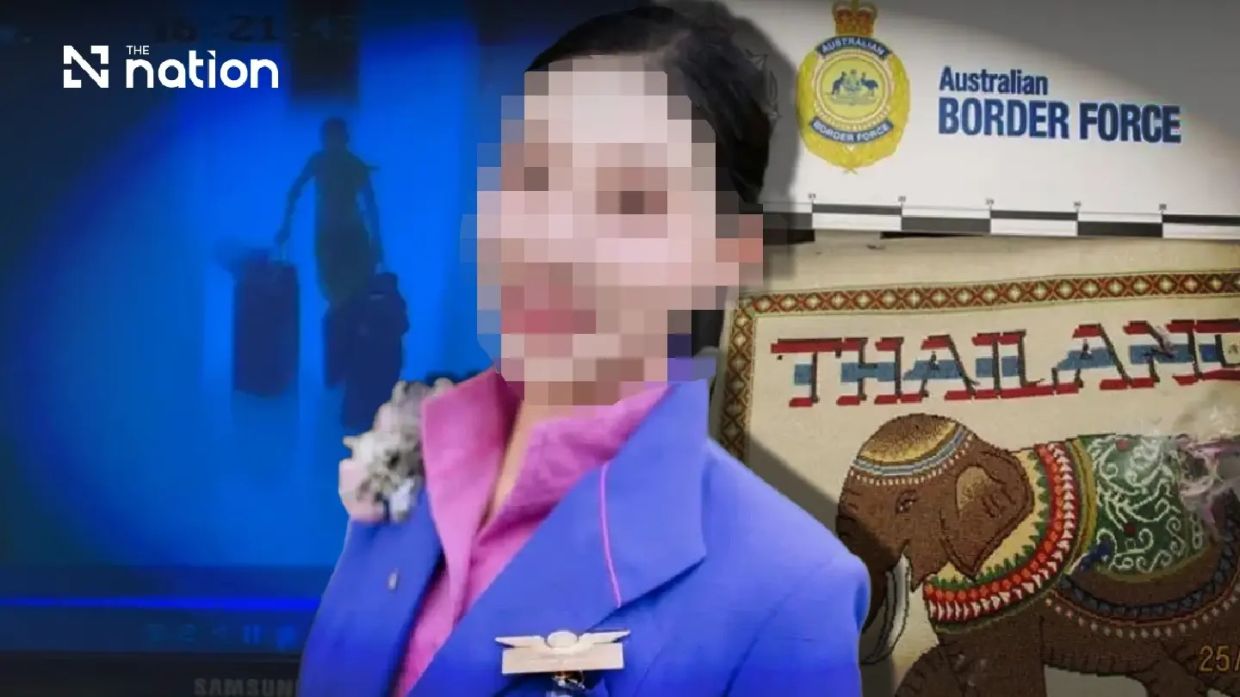
A Thai flight attendant detained in Melbourne with nearly a kilogramme of heroin remains under investigation by Thailand's narcotics authorities, who are now focusing their inquiry on a sprawling criminal network believed to span multiple countries and originate from the notorious Golden Triangle drug-producing region. The woman, arrested at Melbourne Airport, has not yet been formally charged despite the severity of the seizure, with Thai officials suggesting she may have been ensnared by sophisticated international scammers rather than acting as a knowing participant in a major smuggling operation.
The Office of the Narcotics Control Board (ONCB), working alongside Thai security agencies and international partners including Australian Federal Police, has broadened its investigation beyond the flight attendant's individual case to encompass a complex criminal enterprise. Deputy ONCB secretary-general Areepak Ngernbamroong disclosed that related arrests in Bangkok resulted in the seizure of over 26 kilogrammes of heroin, indicating the operation operates at a scale far exceeding a simple courier arrangement. The Department of Special Investigation has now assumed primary responsibility for the Bangkok-based portion of the inquiry, reflecting the Thai government's assessment that this represents organised criminal activity spanning borders rather than isolated smuggling attempts.
Authorities have identified a disturbing pattern in how the network recruits couriers. Criminal operators establish fake social media profiles and send mass messages to flight attendants and frequent international travellers, offering substantial payments in exchange for carrying packages across borders. The scheme exploits the mobility and access these individuals enjoy while promising compensation sufficient to overcome initial reservations. According to Metropolitan Police Bureau deputy commissioner Pol Maj-General Theeradet Thumsuthee, this recruitment methodology suggests the network possesses sophisticated understanding of target demographics and the psychological levers required to persuade otherwise law-abiding citizens to participate in narcotics trafficking.
The investigation has uncovered a receiving operation in Australia where a Thai national using the name "Dear" has allegedly coordinated multiple heroin deliveries. Thai authorities have provided Australian Federal Police with several pieces of evidence connecting the flight attendant's case to this individual, who has reportedly resided in Australia for approximately a decade, though her citizenship status remains unclear. Significantly, investigators believe this is not Dear's first involvement in receiving contraband shipments; similar incidents apparently occurred previously using identical operational procedures, suggesting the presence of an established, repeating logistics chain rather than spontaneous criminal activity.
The mechanism of the alleged smuggling operation reveals careful operational planning. A delivery rider transported a parcel containing elephant-patterned bags to the flight attendant in Bangkok. According to her boyfriend's statement to investigators, the bags were physically inspected before being placed in luggage, and the suitcase subsequently passed through an X-ray machine without detection of irregularities. The heroin was discovered only when the luggage was scanned at Melbourne Airport, suggesting either exceptional concealment methods or the possibility that the flight attendant remained genuinely unaware of the contraband's presence until interception occurred.
Payment arrangements surrounding the operation remain inconsistent and incompletely documented, which investigators view as potentially exculpatory evidence. Australian police identified a payment of 8,800 baht (approximately US$264) on the flight attendant's phone, yet Thai investigators cannot locate corresponding bank transfers. Witness statements reference two separate transfers of 1,700 baht each, supposedly triggered upon parcel receipt and air ticket availability, yet these transactions do not appear in the woman's banking records. The absence of corroborating financial documentation creates ambiguity about whether the flight attendant consciously accepted payment or whether financial compensation occurred through channels unknown to her.
The Lao connection to the smuggling network underscores how drug distribution from the Golden Triangle has shifted its transit routes in response to intensified Thai law enforcement operations. The region straddling Thailand, Laos, and Myanmar traditionally served as a primary source for heroin destined for Southeast Asia and beyond. However, as Thai authorities concentrated border interdiction efforts in the mountainous north, trafficking organisations adapted by routing narcotics through the north-eastern provinces, particularly exploiting the long, poorly monitored Mekong River border zones at Nakhon Phanom, Bueng Kan, Loei, and Nong Khai. The relatively narrow river width combined with the extensive border length makes continuous surveillance impractical, creating persistent gaps through which contraband filters into Thailand.
Once narcotics enter Thailand, they are typically packaged and transferred sequentially among different criminal cells, each cell handling only a portion of the supply chain to compartmentalise risk and limit individual exposure should arrests occur. This cellular structure complicates investigation efforts and allows organisations to continue operating even after law enforcement disrupts individual segments. The delivery rider who transported the elephant-patterned bags acknowledged conducting similar deliveries on three or four prior occasions, indicating the flight attendant represented merely one potential final courier in a much larger distribution network capable of identifying and recruiting numerous willing or manipulated carriers.
The apparent targeting of flight attendants represents a strategic criminal calculation. International airline personnel possess legitimate reasons for frequent travel, experience navigating airports and customs procedures, and often enjoy relative freedom in their movement across borders compared to ordinary passengers. Organised criminal syndicates recognise that recruiting airline employees dramatically increases operational success rates compared to attempting to move contraband through conventional passenger channels. The sophistication of the recruitment methodology—via personalised social media outreach offering seemingly generous compensation—suggests these organisations employ dedicated personnel focused exclusively on identifying and cultivating potential couriers.
Thai authorities have elected to provide the flight attendant with legal support rather than pursuing aggressive prosecution, signalling confidence in her potential defence and suggesting initial investigation findings may support claims of manipulation rather than knowing conspiracy. The ONCB has already forwarded evidence to the Thai embassy and consulates in Australia to assist her legal proceedings. This approach reflects an evolving Thai enforcement philosophy prioritising the dismantling of large transnational organisations over the conviction of individual couriers potentially manipulated into participation. By treating this flight attendant as a potential victim of criminal deception, Thai and Australian authorities hope to establish cooperation that could yield intelligence regarding the broader network's structure, leadership, and operational methods.
The case illuminates the persistent vulnerability of Southeast Asian populations to sophisticated international criminal networks exploiting economic disparities and technological connectivity. For Malaysian readers, the incident carries particular relevance given Malaysia's significant role in regional aviation and its own challenges with transnational drug smuggling. The apparent success of this network in recruiting airline employees across multiple countries suggests similar operations may be targeting Malaysian carriers and personnel. The case also demonstrates how enforcement efforts, however intensive, struggle against adaptive criminal enterprises capable of identifying new transit routes and recruitment strategies whenever authorities intensify pressure on existing operations. International cooperation among Thailand, Australia, Malaysia, and other nations increasingly represents the only viable response to organisations operating seamlessly across borders and exploiting the movement of legitimate commercial and personnel traffic to conceal narcotics shipments.

