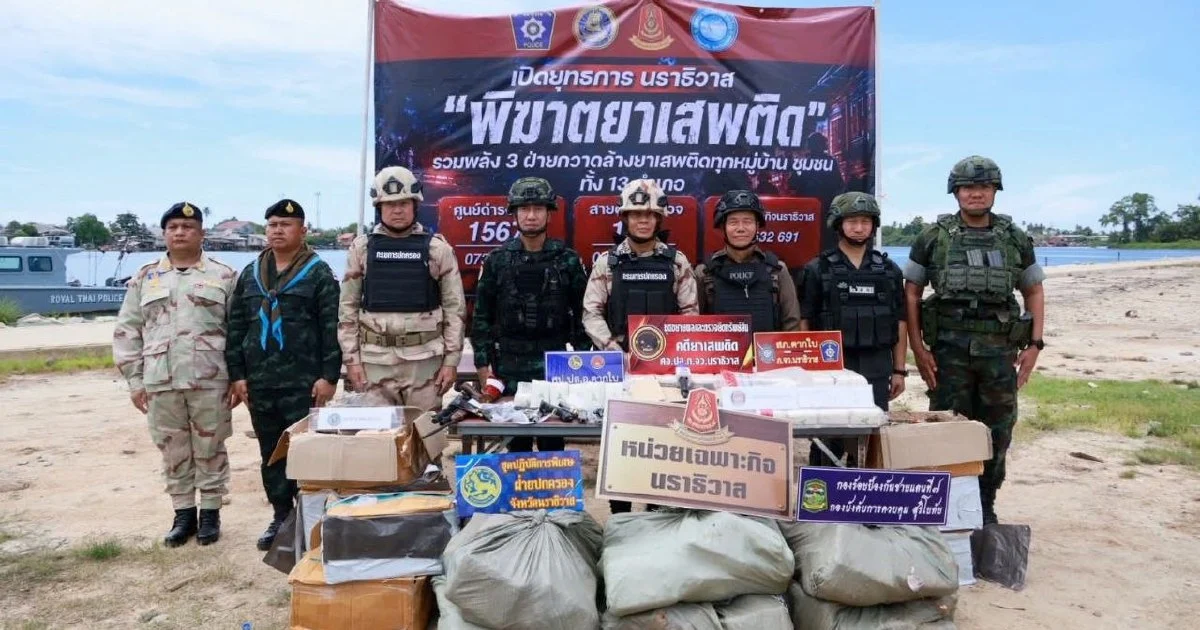
Thai authorities have successfully dismantled a significant drug trafficking operation spanning the volatile Narathiwat province, arresting 233 individuals suspected of involvement in organised narcotics distribution networks. The extensive month-long enforcement campaign represents a substantial blow to trafficking organisations operating across the Thailand-Malaysia border region, with investigators identifying numerous suspects believed to maintain active connections with Malaysian criminal counterparts engaged in the illegal drug trade.
The operation in Narathiwat, a province that has long served as a critical transit point for contraband flowing between Thailand and Malaysia, underscores the persistent challenge authorities face in combating transnational drug smuggling. The scale of the arrest—involving over two hundred suspects—signals intensified efforts by Thai law enforcement to disrupt supply chains that funnel narcotics through the porous border regions separating the two nations. Thai officials have indicated that many of those detained harbour established relationships with Malaysian-based trafficking groups, suggesting sophisticated networks coordinating cross-border movements of illegal substances.
The crackdown carries particular significance for Malaysian law enforcement and border security agencies, as it reveals how deeply integrated local criminal networks have become with larger trafficking operations originating in or transiting through Thailand. Narathiwat's geography, comprising mountainous terrain and numerous remote crossing points, creates inherent difficulties for authorities seeking to prevent drug movements. Thai security forces mounted coordinated operations across multiple locations throughout the province, targeting storage facilities, distribution points, and command centres suspected of coordinating trafficking activities.
Malaysian readers should recognise this operation as evidence of intensifying criminal activity along shared border zones. The involvement of Malaysian traffickers in Thai-based networks demonstrates how regional drug markets remain interconnected despite enhanced enforcement measures. Intelligence sharing between Thai and Malaysian authorities has improved over recent years, yet the sheer number of arrests suggests that trafficking organisations continue adapting their methods to circumvent detection, developing new routes and operational procedures to maintain profitability.
The Narathiwat province operation aligns with broader regional trends showing Southeast Asian drug markets remain lucrative despite significant law enforcement investments. Thai authorities have prioritised anti-narcotics work, recognising that methamphetamine and heroin trafficking through the north and northeast generates enormous criminal profits. The involvement of Malaysian-linked syndicates indicates that once substances reach Thailand's distribution networks, they frequently move southward toward Malaysian population centres, where demand remains substantial.
For Malaysian policymakers and enforcement officials, the Thai operation provides important intelligence regarding trafficking methodologies and operational structures. Many arrested individuals will likely undergo interrogation regarding their Malaysian contacts, potentially yielding leads for domestic law enforcement investigating smuggling networks. The timing of such operations typically involves coordination between regional agencies, suggesting that information exchange protocols between Thai and Malaysian authorities functioned effectively during this crackdown.
The cross-border nature of these trafficking operations fundamentally complicates enforcement responses. Criminals operating in the Narathiwat-Malaysia corridor exploit jurisdictional gaps, using Thai territory for processing, storage, and initial distribution before moving products southward. This arrangement allows syndicates to distribute operational risk across multiple countries, insulating leadership from direct exposure to any single nation's law enforcement apparatus. The Thai arrests represent disruption at the lower and middle operational levels rather than comprehensive dismantling of upper management controlling broader trafficking networks.
Regional security analysts observe that Southeast Asian narcotics markets have become increasingly centralised around methamphetamine production, with the Golden Triangle remaining the primary manufacturing region. From production facilities in Myanmar, processed drugs move through Thailand via established networks, with Narathiwat serving as a critical redistribution node. Malaysian traffickers purchasing Thai-sourced narcotics then introduce supplies into local markets or facilitate further onward movement to Singapore and other regional destinations, creating integrated supply chains spanning multiple nations.
The arrested individuals will face prosecution under Thai drug laws, which impose severe penalties including lengthy imprisonment for trafficking offences. Some suspects may face charges related to possession of precursor chemicals used in methamphetamine manufacturing, suggesting the operation targeted production infrastructure alongside distribution networks. Thai authorities have provided limited additional detail regarding quantities of narcotics seized or estimated street values, though operations of this scale typically result in seizures measuring hundreds of kilograms and disruptions valued at millions of ringgit equivalent.
Malaysian enforcement agencies should leverage intelligence emerging from this Thai operation to enhance domestic counter-narcotics effectiveness. Understanding how Malaysian traffickers interface with Thai-based networks provides actionable intelligence regarding likely trafficking routes, distribution patterns, and operational contacts. Enhanced coordination with Thai counterparts, potentially including joint task forces operating across the border region, could yield improved interdiction results and complicate criminal logistics further.
The operation illustrates how regional drug markets remain resilient despite sustained enforcement pressure. While arrests disrupted this particular network temporarily, criminal organisations possess both capital and motivation to reconstitute operations quickly. Traffickers respond to enforcement by developing alternative routes, recruiting replacement personnel, and adapting operational security measures. Sustainable reduction in trafficking requires complementary strategies addressing demand reduction, precursor chemical trafficking, and financial flows underlying narcotics commerce—elements that enforcement operations alone cannot address comprehensively.
Looking forward, authorities throughout the region must anticipate that traffickers will likely shift tactics in response to this Thai operation. Routes previously utilised may become temporarily avoided whilst criminals test alternative pathways and distribution arrangements. The arrested individuals represent replaceable assets within larger criminal enterprises; their removal from circulation creates operational inconvenience rather than terminal disruption unless subsequent investigations systematically dismantle command structures directing these networks. Sustained enforcement pressure requires continued cooperation between Thai and Malaysian authorities and investment in community-based intervention approaches reducing demand for illicit narcotics throughout Southeast Asia.

