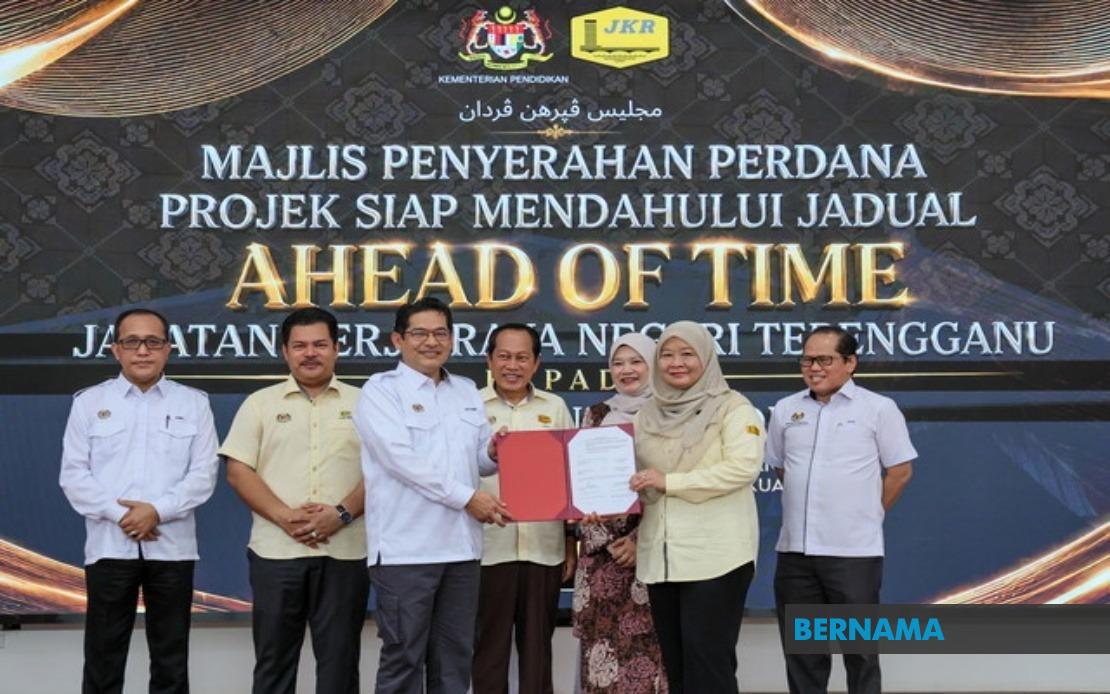
The Ministry of Education's project portfolio in Terengganu has achieved a significant milestone with the completion of 14 facilities ahead of their scheduled deadlines, representing RM34 million in value. Deputy Works Minister Datuk Seri Dr Ahmad Maslan announced this accomplishment during a handover ceremony at Sekolah Menengah Kebangsaan Tok Jembal in Kuala Nerus, emphasizing that the achievement reflects the Public Works Department's broader commitment to delivering quality educational infrastructure on time or earlier across the state.
The Terengganu operations of the JKR are managing an expansive portfolio of 111 education projects totalling RM302 million during the current year, a scale that underscores the magnitude of infrastructure investment flowing into the state's schools. This substantial undertaking encompasses diverse facility types, from covered multipurpose halls developed under both the 12th and 13th Malaysia Plans to targeted interventions addressing overcrowding in high-density schools. The breadth of this agenda requires sophisticated coordination across departmental levels and with external stakeholders, yet the achievement of early completion demonstrates effective execution capability.
According to Ahmad Maslan, the exceptional performance stems from three interconnected factors that have systematically improved project delivery timelines. The most prominent is the adoption of modular construction methodologies and the Industrialised Building System, which represent a departure from traditional on-site construction approaches. These techniques allow components to be manufactured off-site under controlled conditions, then assembled rapidly at their final location, thereby reducing weather delays and coordination complications that typically characterize conventional building projects in Malaysia's humid tropical climate.
The second critical factor is the institutional efficiency embedded within the JKR's organizational structure. Officers operating at district, state, and federal headquarters have coordinated to ensure smooth implementation flows without bureaucratic friction that often impedes project advancement. This vertical alignment, coupled with a shared commitment to meeting educational calendar deadlines, created the organizational momentum necessary to compress timelines without sacrificing quality standards or safety protocols. The minister emphasized that schools must be ready for students arriving at the beginning of the academic year, establishing an immovable deadline that has concentrated institutional focus.
Contractor selection represents the third pillar of success, with Ahmad Maslan explicitly stating that the JKR consciously avoided engaging firms with problematic track records. This disciplined approach to vendor management reflects lessons learned from earlier infrastructure disappointments across Malaysia, where contractor inexperience or financial instability has previously derailed projects. By prioritizing proven performers with demonstrated capacity and reliability, the department reduced execution risk and enhanced the probability of meeting or beating timelines.
The statistical outcomes validate this multi-faceted approach. Between January 2025 and August 2026, the Terengganu JKR completed 37 projects valued at RM85 million, accumulating a combined early completion record of 2,697 days. This translates to an average of 72 days early completion per project, or roughly two-and-a-half months ahead of contractual dates. Such consistent ahead-of-schedule performance represents a marked improvement over typical Malaysian infrastructure outcomes and suggests that the structural innovations implemented are producing measurable, replicable results.
Education Minister Fadhlina Sidek officially accepted the handover of these completed facilities, recognizing that early project delivery directly enhances the teaching and learning environment. When facilities become available before the scheduled opening date, schools gain opportunity to conduct testing, staff training, and curriculum-appropriate configuration before students arrive. This buffer period optimizes the utilization of newly constructed spaces and ensures that educational quality is maximized from day one of student occupation.
These accomplishments assume heightened significance within Malaysia's broader education policy framework, particularly the government's commitment to achieving single-session schooling by 2030. Currently, numerous Malaysian schools operate double or even triple sessions, with students attending during morning, afternoon, and evening periods due to insufficient physical capacity. This practice creates pedagogical challenges and strains teacher workload. Delivering additional classrooms and facilities on schedule is therefore instrumental to dismantling this unsustainable system. Every month of early completion represents progress toward that nationally-mandated timeline.
The Quick Win Cakna MADANI Initiative exemplifies how policy objectives translate into infrastructure action. This programme specifically targets rapid classroom expansion through modular and IBS construction, designed to accommodate Year One cohorts expected to enter the school system during the 2027 school session. By frontloading facility development, the government is preparing the educational system to absorb the demographic wave without resorting to the multiple-shift arrangements that have historically constrained educational quality in Malaysia.
The JKR's statement emphasizes that accelerated completion timelines reflect enhanced governance efficiency and transparent resource allocation, values aligned with the MADANI Government's stated principles. Infrastructure projects historically suffer from opacity and delay in Malaysia, making the Terengganu achievement noteworthy from an institutional credibility perspective. When government agencies deliver on promises and do so economically, public confidence in administration strengthens, potentially improving cooperation on subsequent civic initiatives.
Closer integration between the JKR and the Ministry of Education, as articulated in official statements, promises to sustain this momentum. The two institutions now share explicit commitment to ensuring that educational infrastructure remains safe, sustainable, and sufficiently abundant to support Malaysia's human capital development objectives. This partnership-oriented framing moves beyond transactional contractor-client relationships to collaborative stewardship of educational assets.
The implications for other states merit consideration. Terengganu's model demonstrates that early completion is achievable within Malaysia's regulatory and climatic constraints through deliberate methodology selection, institutional discipline, and vendor management. State governments facing similar educational infrastructure backlogs might examine whether adopting comparable approaches could accelerate their own facility delivery, thereby advancing the single-session school timeline and freeing teachers from the exhausting multiple-session arrangements that have long characterized Malaysian education.

