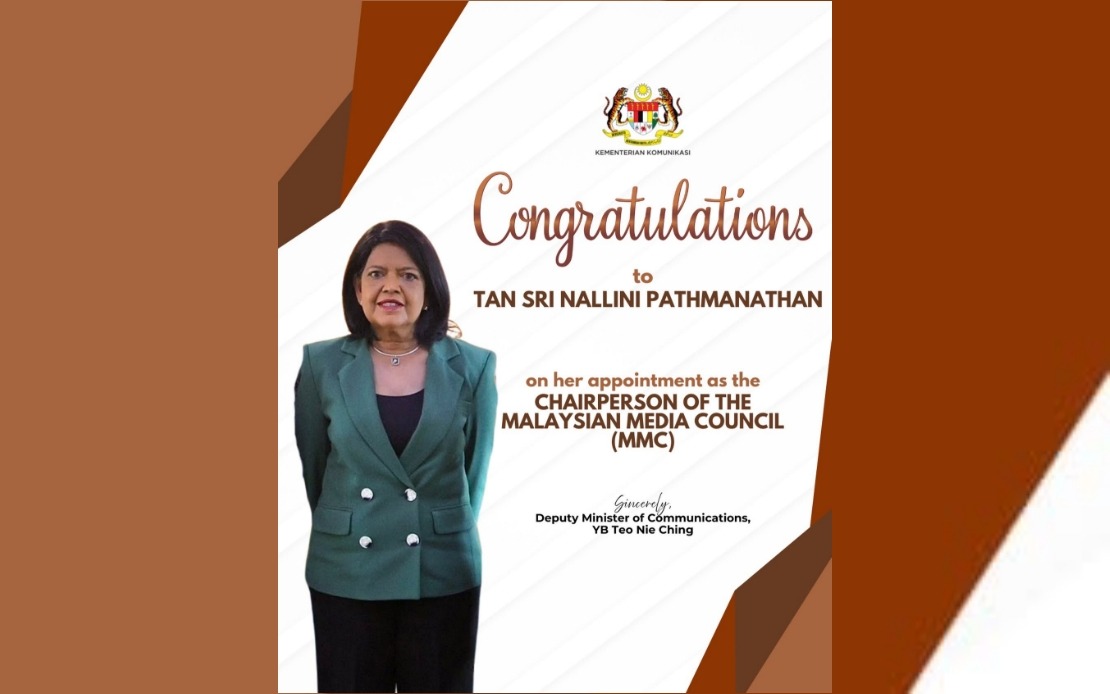
The Malaysian Media Council has taken a significant step toward establishing independent media oversight with the appointment of Tan Sri Nallini Pathmanathan as chairperson. Deputy Communications Minister Teo Nie Ching has publicly endorsed the decision, underscoring the suitability of the former Federal Court judge for leading the self-regulatory body that was formally established under the Malaysian Media Council Act 2025. The unanimous endorsement by the MMC Board members at their May 26 meeting reflects confidence that Nallini possesses both the judicial temperament and principled commitment to press freedom necessary for guiding Malaysia's media industry during a pivotal phase in its governance.
Teo's support for Nallini's appointment carries particular weight given her position overseeing communications policy and her direct involvement in shepherding Malaysia's media regulation framework. Through a detailed Facebook statement, the Deputy Minister articulated the reasoning behind her confidence, focusing not merely on Nallini's judicial seniority but specifically on the philosophical positions she has adopted from the bench concerning fundamental freedoms and constitutional interpretation. This approach signals that the government recognizes the MMC's role as fundamentally distinct from state-controlled regulation, requiring leadership that has consistently advocated for broader interpretations of constitutional protections rather than restrictive applications of the law.
A particularly telling example of Nallini's judicial philosophy concerns her dissenting judgment in a citizenship case involving an illegitimate child born to a Malaysian father and foreign mother. In that narrow 4-3 decision, she penned a minority opinion advocating for a purposive and compassionate reading of Malaysia's constitutional citizenship provisions. Her willingness to stand apart from the majority in articulating a more inclusive interpretation of constitutional rights demonstrates the intellectual independence and humanistic orientation that Teo believes the MMC requires. This dissent carries symbolic importance beyond its immediate legal implications, suggesting a judge willing to challenge established interpretations when principles of fairness and constitutional purpose demand it.
Equally significant is Nallini's dissenting judgment in a landmark case concerning online news portals and liability for user-generated comments. In that instance, she ruled that news portal platforms should not bear legal responsibility for commentary posted by their subscribers. This position directly addresses one of the most contentious issues in contemporary media regulation, particularly relevant to Southeast Asian contexts where governments have sometimes employed user-comment liability as a mechanism to constrain digital journalism. Nallini's judicial stance on this matter indicates an understanding that media freedom in the digital age requires protecting platforms from being weaponized as instruments of censorship through excessive liability exposure.
The establishment of the Malaysian Media Council itself represents a culmination of decades of advocacy within Malaysia's media sector. Teo emphasized that the council emerged after five decades of sustained campaigning, formal petitions, and policy discussions among journalists, industry bodies, and civil society advocates. This extended timeline underscores that self-regulation was not hastily imposed but rather represents a hard-won commitment following prolonged dialogue about the appropriate framework for media governance. The fact that implementation finally occurred in 2025 reflects both persistence by the journalism profession and a governing consensus that self-regulatory structures offer preferable outcomes to continued reliance on traditional state-administered oversight mechanisms.
The distinction between self-regulation and state intervention carries profound implications for democratic societies, particularly in the Malaysian context where press freedom has periodically faced constraints. Teo articulated this clearly, noting that journalists occupy a constitutionally unique position as the so-called fourth estate of democracy. Because of this essential democratic function, any appearance of governmental control over media oversight naturally invites suspicion of suppression, regardless of the actual intentions behind particular regulatory decisions. The psychological and political reality of media regulation means that public perception of impartiality becomes nearly as important as institutional independence itself. Self-regulatory bodies can mitigate these concerns by placing governance authority directly in the hands of industry practitioners rather than government appointees.
Nallini's appointment as MMC chairperson carries significance extending beyond Malaysia's borders. Within Southeast Asia, media regulatory frameworks remain contested terrain, with several governments maintaining substantial direct control over journalistic institutions. Malaysia's investment in self-regulatory structures, guided by a jurist with established credentials supporting press freedom, positions the country as a potential model for other regional democracies considering transitions away from state-administered media oversight. The success or failure of Nallini's leadership will likely influence broader regional conversations about optimal governance structures for balancing media accountability with editorial independence.
The Malaysian Media Council Act 2025 creates the legal infrastructure enabling this institutional shift, establishing MMC as the formal body responsible for setting standards, addressing complaints, and maintaining professional ethics within the media industry. Operating as a self-regulatory entity means the council develops its own codes of conduct, investigates grievances through internal mechanisms, and maintains discipline without direct governmental involvement in case determinations. This structure mirrors self-regulatory models employed in several Commonwealth democracies and European countries, where press councils have functioned as alternatives to statutory regulation for decades.
Teo's public endorsement of Nallini addresses potential skepticism from journalist organizations who might question whether genuine independence can be achieved under any appointment structure involving government awareness or blessing. By emphasizing Nallini's specific track record of constitutional jurisprudence favoring expansive interpretation of press freedoms, Teo attempts to assure the journalism community that the chairperson appointment reflects genuine commitment to the self-regulatory principle rather than a governmental strategy to install a compliant figurehead. This messaging becomes critical given historical instances where theoretically independent bodies have functioned as instruments of state policy when leadership failed to prioritize institutional independence.
The timing of this appointment coincides with Malaysia's broader digital media transition, where online journalism increasingly dominates news consumption patterns while traditional print and broadcast sectors face sustainability challenges. An effective self-regulatory structure requires leadership capable of addressing contemporary issues including algorithmic accountability, digital monetization ethics, and the interface between user-generated content and editorial responsibility. Nallini's judicial engagement with online media liability issues suggests she appreciates these modern challenges rather than approaching media regulation through outdated frameworks designed for broadcast-era concerns.
Moving forward, the MMC's effectiveness will depend partly on how comprehensively the industry embraces its authority and partly on how consistently Nallini's leadership resists potential governmental pressure to circumscribe media freedom. The council's ability to adjudicate complaints while refusing to become an instrument of political control will determine whether Malaysia's self-regulatory experiment succeeds in protecting journalist interests while maintaining public confidence in media accountability. Nallini's judicial record suggests she possesses both the intellectual tools and principled commitment necessary for this balancing act, though institutional success ultimately depends on sustained professional support from journalists themselves and ongoing public commitment to media independence as a democratic necessity.