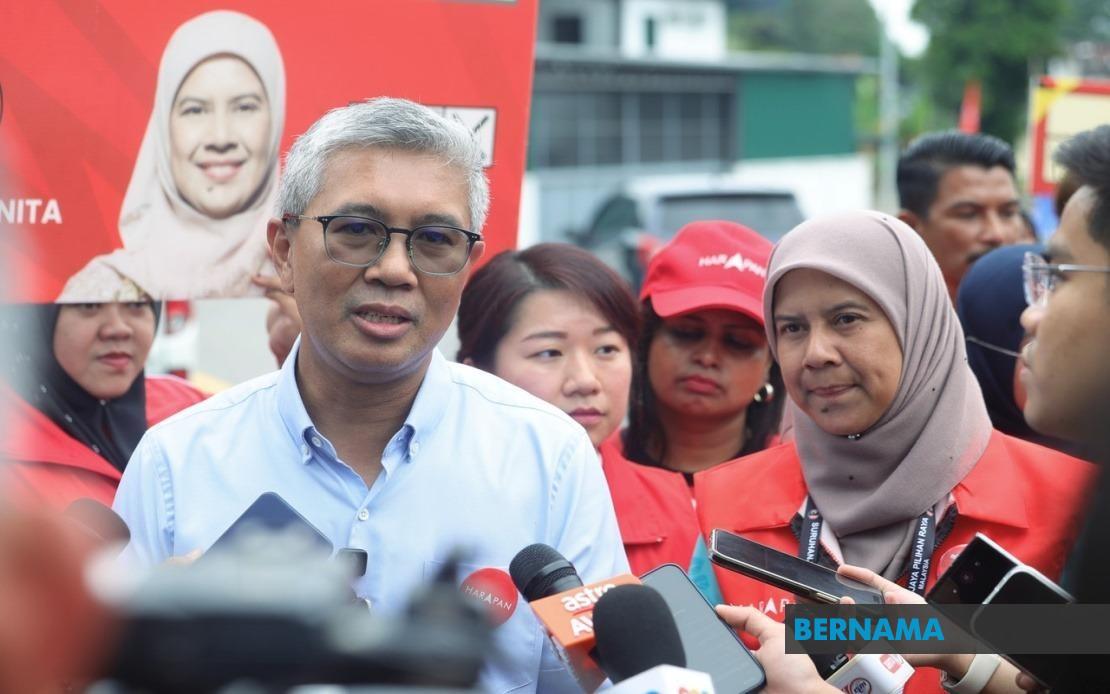
Voter sentiment in Kuala Pilah's Pilah state constituency is running decisively in favour of Pakatan Harapan's candidate, according to Tengku Datuk Seri Zafrul Tengku Abdul Aziz, Senior Political Advisor to the Prime Minister. Speaking after a campaign walkabout with incumbent state assemblyman Datuk Noorzunita Begum Mohd Ibrahim, Tengku Zafrul attributed the positive reception to the coalition's track record in governance and the sustained efforts of its grassroots machinery across the constituency.
On-ground surveys and local feedback mechanisms conducted before and during the campaign have revealed consistently high levels of voter acceptance and appreciation, Tengku Zafrul explained. Residents have responded favourably to the assistance and development initiatives delivered by Noorzunita Begum throughout her tenure as their representative. Yet despite these encouraging indicators, the political advisor cautioned against complacency, emphasising that continuous grassroots engagement and service delivery remain essential to consolidating support through the election period.
The campaign strategy adopted by the PH team emphasises direct voter interaction and responsiveness to community concerns. During the walkabout, Tengku Zafrul and Noorzunita Begum engaged with residents across multiple areas to discuss pressing local issues, gather development proposals, and address grievances. This ground-level approach aims to demonstrate the coalition's commitment to hearing and acting on the concerns of ordinary constituents, particularly younger voters seeking professional employment pathways and improved economic prospects.
Negeri Sembilan's broader economic trajectory provided context for Tengku Zafrul's remarks about the state's governance performance. The state has attracted total investments valued at RM19 billion while maintaining reserves exceeding RM1 billion, metrics he presented as evidence of effective administration under Menteri Besar Datuk Seri Aminuddin Harun. This economic stability and investment inflow, Tengku Zafrul argued, must be sustained through continued political stability and the re-election of PH representatives at the state level.
Development priorities for Kuala Pilah have been framed around youth employment and economic opportunity creation. Tengku Zafrul, serving as an ex-officio member of the PKR Political Bureau, highlighted the need to generate high-quality professional positions for Generation Z that would enable young people to build sustainable careers without necessitating migration to major urban centres. This focus reflects broader concerns across rural and semi-rural Malaysian constituencies about youth unemployment and outward migration draining local talent pools.
The government's MADANI framework has been invoked as the policy foundation for addressing regional economic disparities. Tengku Zafrul acknowledged that certain areas experience indirect economic spillover effects from larger metropolitan zones, but stressed that the administration is actively developing strategies to attract direct investment and expand economic opportunities more equitably across Negeri Sembilan. Kuala Pilah, positioned between Seremban and Bahau in central Negeri Sembilan, possesses untapped potential that targeted investment could unlock.
In the electoral contest for Pilah state constituency within the 16th Negeri Sembilan State Election, Noorzunita Begum faces a straight fight against Barisan Nasional candidate S. Leza Md Yasin. The binary contest format means voter choice between these two candidates will determine the seat's outcome, with little room for vote splitting. According to the Election Commission's electoral roll updated on June 4, Pilah has 18,034 registered voters comprising 17,775 ordinary voters and 259 police personnel and their spouses.
The constituency's electoral profile shows near-perfect gender balance among voters. Male voters constitute 8,925 individuals, representing 49.49 per cent of the total electorate, while female voters number 9,109, constituting 50.51 per cent. This demographic symmetry suggests that campaign messaging and voter engagement strategies must resonate across gender lines without significant skewing toward particular voter groups. Both campaigns have likely structured their outreach with this balanced composition in mind.
Noorzunita Begum's campaign has entered its eighth day with substantial ground coverage already achieved. The incumbent representative reported that her machinery had visited most residential areas and planned to concentrate intensively on traditional villages during the following week. This phased approach prioritises ensuring that all societal layers, including less densely populated traditional areas, receive direct exposure to PH's development vision and campaign messages. The deliberate focus on traditional villages reflects recognition that these communities, though geographically dispersed, constitute a meaningful voting bloc.
During campaign interactions, youth employment emerged as a dominant concern among local residents. Noorzunita Begum noted high demand from young constituents for professional career opportunities, a sentiment consistent with national trends of youth unemployment and underemployment despite formal qualifications. This grassroots evidence of youth concerns has likely shaped the emphasis both she and Tengku Zafrul placed on Generation Z employment and career development during their public statements.
Noorzunita Begum reaffirmed her commitment to advancing public welfare across three constituencies: youth employment and economic opportunity, education provision and quality, and support for senior citizens. This three-tiered approach attempts to address concerns spanning the life cycle from young adults beginning careers through established professionals to pensioners and retirees. The emphasis on education particularly resonates in constituencies with substantial student populations and young families concerned about school quality and educational pathways.
Electoral timeline considerations structure the remaining campaign period. Early voting for the Negeri Sembilan State Election is scheduled for July 28, followed by general polling day on August 1. This compressed timeline means campaigns operate under accelerated schedules, necessitating intensive ground activity and rapid response to emerging voter concerns. The proximity of early voting dates means that undecided voters must be engaged urgently before those who vote early submit their ballots.
The Pilah constituency battle occurs within the broader Negeri Sembilan state election context, where overall state-level outcomes could influence constituency-level results through coattail effects. Voter decision-making in Pilah will be shaped not solely by local considerations but also by statewide political dynamics and voter perceptions of the state government's performance. The confidence Tengku Zafrul expressed about PH's prospects in Pilah reflects party assessment of broader state-level momentum favouring the ruling coalition.

