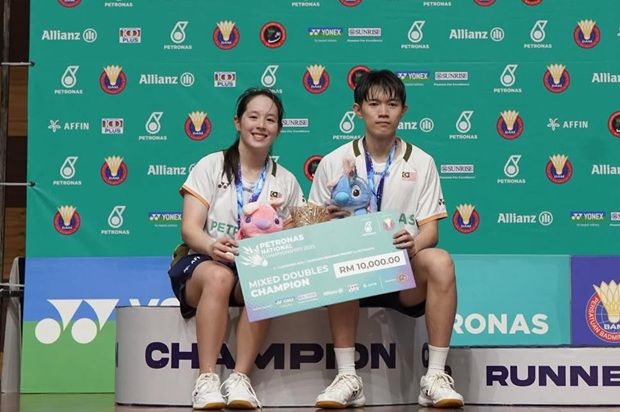
Clarissa San will begin what promises to be the most significant tournament of her badminton career next week with reassuring counsel from her new partner and coaching staff echoing in her mind: remain composed and savour the experience. The 20-year-old mixed doubles player from Selangor gets her opportunity to compete at the Japan Open, one of the world's most prestigious badminton stages, following an unexpected pairing reshuffle necessitated by injury circumstances within Malaysia's mixed doubles ranks.
The change came about after Toh Ee Wei, Clarissa's original partner, sustained an anterior cruciate ligament injury that has sidelined her from competition. Ee Wei is presently in Melbourne undertaking rehabilitation, leaving a vacancy that Chen Tang Jie has stepped into for the upcoming campaign. This development has thrust Clarissa into the international spotlight considerably faster than anticipated, yet she approaches the challenge with measured optimism and a determination to extract maximum learning value from the experience.
Clarissa has expressed genuine enthusiasm about the opportunity to partner with Tang Jie at one of the Badminton World Federation's marquee World Tour events. The prospect of playing alongside an established competitor at such a calibre of tournament represents a significant leap forward in her career trajectory. She remains intent on capitalizing on this opening by performing to the best of her current ability and gaining invaluable exposure to elite-level competition.
The guidance she receives daily from mixed doubles coach Nova Widianto and Tang Jie himself has centred on a consistent message: avoid allowing anxiety to compromise her performance. Both have emphasized the importance of mental resilience and enjoying the occasion rather than becoming consumed by external pressure. This supportive environment appears critical for a player making her debut at this level, where psychological composure often determines outcomes as much as technical skill.
Clarissa articulated her mindset heading into the tournament, noting that her coaches repeatedly encourage her to shed her apprehension and approach each match with a calm demeanor. She recognises that this tournament represents the first in a series of competitions she will contest alongside Tang Jie, making the Japan Open a starting point rather than an isolated event. Her objective extends beyond this single tournament to encompassing a broader partnership development strategy, with aspirations to achieve positive results while accumulating knowledge from every encounter.
The 20-year-old is deliberately tempering her expectations, acknowledging that competing in an event of the Japan Open's magnitude marks uncharted territory in her career. Rather than setting ambitious outcome-based targets, she has prioritized translating the technical fundamentals and tactical concepts she has refined during recent training sessions into match situations. This grounded approach suggests emotional maturity and realistic self-assessment from a player still early in her international career development.
Clarissa has praised Tang Jie's leadership and mentorship, describing him as fulfilling dual roles as both an experienced guide and an approachable senior figure. His willingness to provide corrective feedback when errors occur, coupled with his approachable demeanor, has created a supportive partnership dynamic rather than a purely transactional one. She emphasizes the absence of interpersonal friction, attributing this to Tang Jie's patience and constructive communication style, qualities essential when integrating a relatively inexperienced player into mixed doubles competition at the highest level.
Their opening-round assignment pits them against Taiwan's pairing of Yang Po-hsuan and Hu Ling-fang, a fixture that will provide an early barometer of how effectively Clarissa has acclimatized to her new partnership and the demands of tournament play at this echelon. The Taiwan combination represents the calibre of opposition she should expect throughout the draw, making this opening encounter particularly significant for her confidence trajectory.
Malaysia's other mixed doubles representatives competing at the Japan Open include Jimmy Wong and Cheng Su Yin, who must navigate past Japan's Yuichi Shimogami and Sayaka Hobara in their opening encounter. The independent pairing of Goh Soon Huat and Shevon Lai Jemie faces an American combination in Chen Zhi Yi and Francesca Corbett, while Wong Tien Ci and Lim Chiew Sien confront a stiffer test against China's fifth-seeded pair Guo Xinwa and Chen Fanghui. The broader Malaysian contingent therefore faces a challenging opening round, with multiple partnerships required to navigate past experienced opposition.
Clarissa's emergence as a Japan Open competitor reflects the depth of Malaysia's mixed doubles talent pipeline and the federation's ability to move replacements seamlessly into established slots. Her rapid integration into the professional tournament circuit demonstrates confidence in her readiness, though her own cautious optimism suggests she maintains realistic perspectives about the learning curve ahead. The tournament will serve as a significant measuring point for her development and her capacity to execute at international level.

