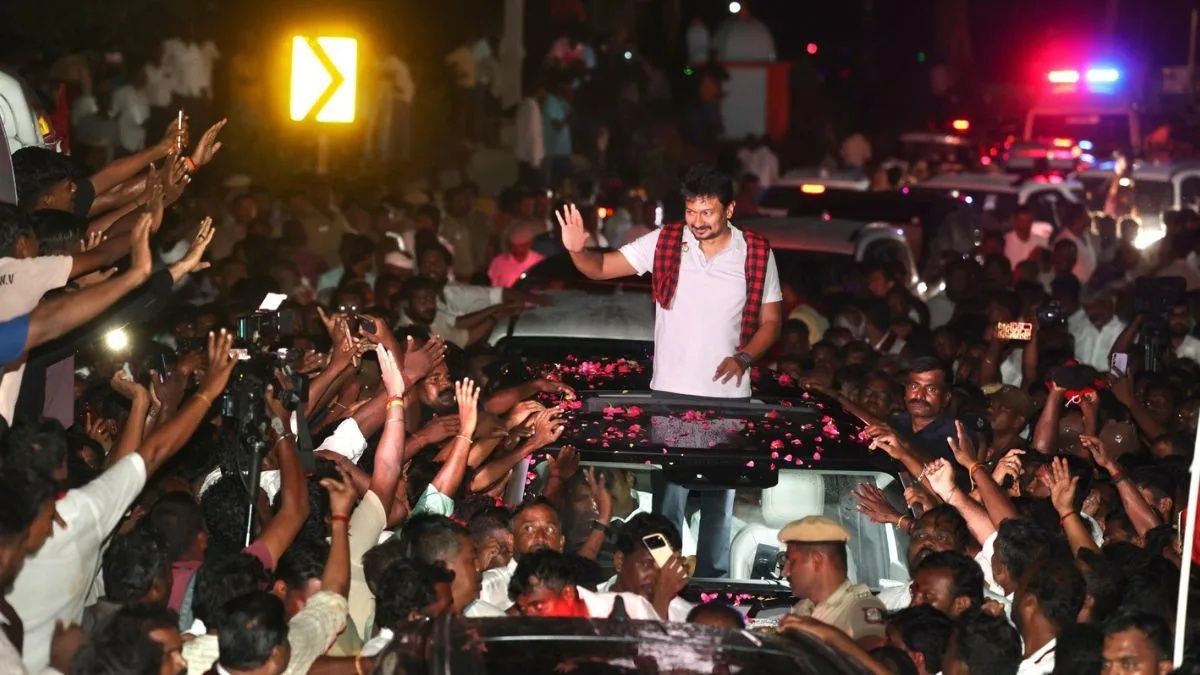
Udhayanidhi Stalin, the Leader of Opposition in Tamil Nadu, walked free on station bail late Tuesday evening after police detained him for extended questioning regarding comments he made that were perceived as offensive references to actress Trisha Krishnan. The former deputy chief minister's release came after several hours of interrogation at Sengipatti police station, where DMK party workers and supporters had gathered in significant numbers to welcome their leader, displaying placards and raising slogans critical of Chief Minister Vijay and his newly formed TVK government.
The controversy stems from remarks Stalin made during a DMK protest rally in Thanjavur, where he was addressing concerns about the Cauvery water dispute and Karnataka's planned Mekedatu dam project. When a supporter in the crowd shouted Krishnan's name—the actress is believed to maintain close connections with Chief Minister Vijay—Stalin paused, smiled, and responded with a statement about water. The exact phrasing of his comment, "Wherever water comes, whether it comes or not, water should come there," has become the focal point of intense political dispute, with opposition parties and the ruling establishment interpreting its meaning in starkly different ways.
The governing TVK party wasted little time in responding to what they characterised as inappropriate conduct. Beyond filing a formal police complaint, the party escalated the matter by approaching the National Commission for Women, framing Stalin's remarks as constituting verbal harassment and the objectification of a woman. This multi-pronged approach underscores the TVK's determination to maximise political advantage from the incident, transforming what might have been a localised dispute into a matter involving national-level institutions.
Stubborn political tensions in Tamil Nadu have been amplified by Vijay's emergence as a significant political force through the TVK, which rapidly gained prominence and disrupted the traditional two-party competition that had long characterised state politics. The arrest of Stalin, a prominent DMK figure and Vijay's principal political opponent, represents a sharp escalation in the increasingly bitter contest between these two parties. Such high-profile arrests create considerable friction in state politics and raise questions about the application of law enforcement powers during intensely polarised political periods.
During his press conference following release, Stalin firmly rejected allegations that his comments carried any hidden or inappropriate meaning. He contended that his arrest represented a deliberate distraction tactic employed by the ruling government to deflect attention from more substantive governance issues. Stalin emphasised that he harboured no disrespect toward any woman and that he had been speaking in support of agricultural interests when the exchange occurred. His characterisation of the government as a "circus" and his assertion that MVD legislators face automatic arrest whenever they enter the government's view reveal the depth of animosity between the two political camps.
The incident highlights broader tensions surrounding the intersection of entertainment, politics, and governance in Tamil Nadu. Trisha Krishnan's prominence in Tamil cinema and her perceived proximity to political leadership have drawn her into the state's turbulent political landscape, despite her primary profession lying outside political structures. This blurring of boundaries between film and politics is not unique to Tamil Nadu but has become particularly pronounced in recent years as entertainment celebrities increasingly engage with political movements and personalities.
The use of women's safety and dignity frameworks in what appears primarily to be a political dispute carries troubling implications. While such concerns deserve serious consideration, their deployment in overtly partisan contexts risks instrumentalising legitimate issues around harassment and objectification. The National Commission for Women's involvement, while procedurally appropriate given the formal complaint, underscores how state and national institutions can become entangled in localised political disputes that may not necessarily represent the most pressing examples of the issues they are mandated to address.
For Malaysian observers, the Tamil Nadu situation offers instructive parallels regarding political polarisation and the weaponisation of legal and institutional frameworks during intensely competitive electoral periods. The speed with which arrests can be ordered, the involvement of multiple institutions in pursuing a single complaint, and the use of national-level bodies to amplify localised political disputes suggest patterns that require careful monitoring in any democracy experiencing similar levels of political tension.
Stalin's release on station bail rather than immediate detention suggests that investigating authorities determined the evidence did not justify custodial remand. However, the initiation of formal proceedings against a sitting opposition leader during an election cycle remains significant. The case will likely proceed through courts as the controversy continues reverberating through Tamil Nadu's fractious political environment, with both parties attempting to shape public perception and derive maximum electoral advantage from the unfolding situation.

