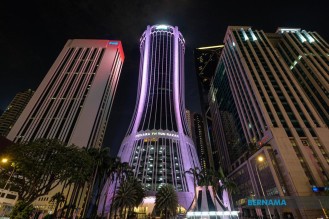
Tabung Haji's entire approval process for purchasing a 30 percent equity stake in Putrajaya Perdana Bhd in 2014 unfolded during a period when the construction company remained under the influence of fugitive businessman Low Taek Jho—commonly known as Jho Low—operating through his investment vehicle Utama Banking Group Bhd, according to evidence presented in parliament. Finance Minister II Datuk Seri Amir Hamzah Azizan disclosed this troubling timeline during the special parliamentary sitting on August 11 to examine the Royal Commission of Inquiry findings into Tabung Haji's stewardship and financial management, drawing from sworn testimony delivered in the SRC International criminal proceedings.
The chronology of approvals tells a narrative of accelerating institutional decisions. Between July and August 2014, SRC International—which court records identify as having operated under Jho Low's concealed direction through his banking interests—channelled RM170 million into Putrajaya Perdana's construction subsidiary across three separate transfers, Putrajaya Perdana director Datuk Rosman Abdullah testified under oath. Critically, the sale of Putrajaya Perdana by UBG to other hands remained incomplete until April 13, 2015, meaning the company's ultimate control remained tied to Jho Low's networks throughout the period when Tabung Haji was moving toward its investment commitment.
The sequence of institutional endorsements compressed into rapid succession during the critical months of 2014. Tabung Haji's Investment Panel granted approval on July 24; the board followed suit on August 25; ministerial consent arrived on August 27; and the binding sale and purchase agreement was inked on December 3. Each decision-making juncture fell squarely within the window when, according to sworn evidence, Jho Low's proxy retained operational control. Yet Amir Hamzah carefully distinguished between testimony given under oath and judicial findings, noting that no court has formally determined that Jho Low held beneficial ownership of Putrajaya Perdana at that critical juncture, though the sworn record stands uncontradicted.
The investment bore hallmarks of inadequate institutional governance and insufficient transparency. When the Investment Panel met on July 24, it explicitly requested that management pinpoint the ultimate beneficial shareholder behind the seller entity. No documentary evidence demonstrates that this fundamental query received a substantive response, yet the transaction proceeded regardless. A 2023 fact-finding assessment by Tabung Haji subsequently found that this critical gap in ownership verification was never resolved before commitments were made, representing a breach of standard governance safeguards that ought to protect a pension fund managing retirement savings of Malaysian pilgrims.
The financial mechanics of the transaction reveal further concerning patterns. Tabung Haji ultimately remitted RM193.5 million to Cendana Destini Sdn Bhd in December 2014 to secure its stake, predicated on two explicit representations: that Putrajaya Perdana would be relisted within twelve months and would generate RM86 million in profits during 2015. Neither commitment materialised. The company never returned to the stock market, and profitability targets evaporated, yet these broken promises apparently sparked no immediate intervention or investigation by Tabung Haji's governance structures.
Valuation irregularities compounded the transaction's troubling aspects. Tabung Haji's own Research Division had initially rejected the proposed RM206 million valuation, estimating the 30 percent stake should command between RM124 million and RM155 million—substantially below what was eventually approved. When RM193.5 million received board clearance, no written documentation justified either the elevation in valuation or the concurrent expansion of the stake from 25 to 30 percent. This represents a departure from prudent investment practice, where fundamental assumptions underlying major commitments ought to withstand documentary scrutiny and be preserved for institutional record.
The due diligence process itself inverted normal institutional safeguards. Tabung Haji conducted its formal due diligence only after securing all approvals and signing the binding agreement—essentially after the critical decisions had already crystallised. Investment Panel members and board directors never reviewed these due diligence findings before the transaction became legally binding, meaning decision-makers proceeded without access to the detailed risk assessment that professional investment practice mandates precede commitment. The 2023 fact-finding review identified this pattern as systematic: four separate Tabung Haji investments failed to undergo required due diligence in any form, while Risk Management Department recommendations went systematically unaddressed across the portfolio.
Hidden pricing history further undermines the transaction's defensibility. The seller had originally acquired Putrajaya Perdana's entire equity for RM260 million in 2012, implying a valuation of approximately RM78 million for a 30 percent stake. Within merely two years, Tabung Haji accepted a valuation of RM193.5 million for an identical stake—an increase of almost three hundred percent in just twenty-four months, with no intervening operational transformation or market expansion justifying such appreciation. This glaring disparity was apparently never disclosed to decision-makers, suggesting a failure of institutional transparency that leaves fundamental questions about who benefited from the pricing elevation.
The subsequent deterioration vindicated the skepticism that institutional controls ought to have triggered. After both explicit promises collapsed, Tabung Haji invoked a put option clause in March 2018, demanding that the seller repurchase the shares for RM210.7 million. The seller failed to honour this contractual obligation, leaving Tabung Haji holding an asset whose value had evaporated entirely. By financial year 2024, the full RM193.5 million investment was written down as a complete loss—pension savings of Malaysian pilgrims essentially converted to ash through a transaction that governance frameworks ought to have prevented.
Tabung Haji has now escalated the dispute into court proceedings, having filed a writ of summons and securing a Mareva injunction freezing the seller's assets. Court-directed mediation was scheduled for August 11 itself, with formal trial proceedings set for June 23, 2027—meaning final adjudication remains years away. The extended legal timeline reflects both the complexity of the underlying transactions and the years of delay that have already elapsed since Tabung Haji recognised the investment's failure. For Malaysian pilgrims whose retirement funds were deployed into this arrangement, the prolonged legal process offers cold comfort: their capital remains locked in an expensive court battle rather than deployed toward the Hajj support mission that Tabung Haji was established to serve.
The broader governance implications extend beyond this single transaction. The systematic failures—unresolved beneficial ownership questions, approved valuations unsupported by written justification, due diligence divorced from decision-making, management recommendations ignored—suggest institutional culture where pension fund stewardship was not treated with appropriate gravity. That these failures occurred while a known controversial figure's interests permeated the company's ownership structure compounds the reputational damage to Tabung Haji and raises questions about whether adequate systems existed to identify and quarantine reputationally problematic investments. The Royal Commission's examination of these patterns may ultimately drive governance reforms across Malaysia's institutional investment structures.

