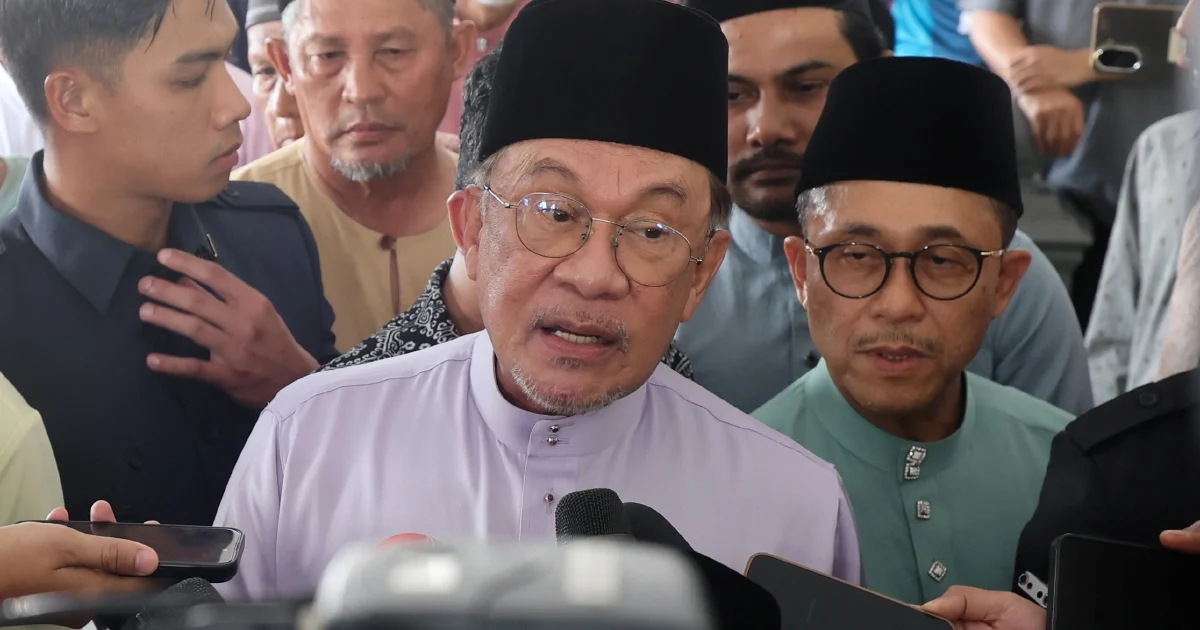
Prime Minister Datuk Seri Anwar Ibrahim has moved to address concerns about religious freedom in Malaysia, declaring that proposals to strengthen the Syariah court framework will not undermine the rights of non-Muslim communities. The assurance, made in Putrajaya, represents an attempt to allay anxieties about jurisdictional boundaries between religious and civil legal systems in the country.
The timing of Anwar's statement reflects a broader national conversation about Malaysia's dual legal structure, where Islamic courts operate alongside civil courts with distinct jurisdictions. The Prime Minister's clarification suggests that recent discussions about elevating Syariah court status have generated apprehension among non-Muslim constituencies, who constitute a significant portion of Malaysia's diverse population. His intervention underscores the government's awareness that constitutional safeguards for religious minorities remain a sensitive political issue.
Malaysia's constitutional framework historically protects the right of non-Muslims to freely pursue their religious beliefs and practices, enshrined in Article 11 of the Federal Constitution. This provision operates independently from Syariah court jurisdiction, which traditionally applies to Muslim personal law matters including family law, inheritance, and Islamic finance disputes. The distinction between civil and religious adjudication remains foundational to Malaysia's legal system, though actual implementation and public perception sometimes diverge.
The government's focus on strengthening Syariah courts reflects recognition of institutional capacity challenges and calls from Islamic scholars and Muslim community leaders to enhance legal certainty in Islamic jurisprudence. Proponents argue that a more robust Syariah court system better serves Muslim Malaysians seeking clarity on religious obligations in contemporary contexts, from fintech applications to inheritance disputes in increasingly complex family structures. However, such administrative improvements occasionally trigger broader discussions about institutional roles and religious authority expansion.
Anwar's reassurance carries significance beyond mere political communication. As Prime Minister of a multi-confessional nation where Islam holds constitutional primacy but religious pluralism remains operationally essential, his statements help calibrate expectations among both Muslim and non-Muslim communities. The government must navigate demands from Islamic constituencies for stronger religious institutions while maintaining the confidence of non-Muslim Malaysians that their fundamental freedoms remain protected. This balancing act defines much contemporary Malaysian governance.
Non-Muslim groups including Christians, Buddhists, Hindus, and Sikhs have historically expressed watchfulness regarding Syariah court jurisdiction, particularly when cases touch on matters affecting mixed-faith families or religious conversion disputes. Several high-profile cases involving child custody, estate distribution, and religious status determinations have highlighted jurisdictional friction points. Anwar's explicit commitment to preserving non-Muslim rights addresses these concerns directly, signalling government intent to proceed with institutional reforms without transgressing established boundaries.
The proposal to elevate Syariah court status likely encompasses measures to strengthen judicial independence, improve procedural efficiency, and enhance intellectual capacity within the Islamic legal system. Some jurisdictions have introduced specialised Syariah divisions handling specific domains, while others have strengthened appellate mechanisms. Such improvements theoretically operate within the existing constitutional framework and need not affect civil courts or non-Muslim constituencies. Nevertheless, public comprehension of these technical distinctions often lags behind legislative intent, creating perception gaps that require clarification.
Regional comparisons offer context for Malaysia's approach. Indonesia, despite its larger Muslim majority, maintains separate civil and religious court systems with defined jurisdictions, though integration challenges persist. Brunei recently expanded Syariah court authority into criminal matters, a decision absent from Malaysia's contemporary reform proposals. Singapore's approach emphasises strict separation of religious and civil adjudication. Malaysia's trajectory reflects its particular constitutional settlement and commitment to protecting minority rights within an Islamic framework.
The successful management of this constitutional duality has partly enabled Malaysia's relative stability and economic resilience compared to some neighbours experiencing religious tensions. Investors and international observers monitor Malaysia's religious governance as an indicator of institutional reliability. Political leadership that clearly articulates respect for constitutional protections thus serves economic and social interests beyond mere legal accuracy. Anwar's statement functions as reassurance to both domestic constituencies and external observers of Malaysia's continuing commitment to constitutional constitutionalism.
Moving forward, the government faces the technical challenge of strengthening Syariah institutions while maintaining transparent, well-publicised boundaries that prevent scope creep into civil matters or non-Muslim affairs. This requires not only legislative precision but also sustained educational efforts among judges, lawyers, and the public to ensure institutional actors understand and respect jurisdictional limits. Periodic declarations like Anwar's may become necessary as reforms progress, ensuring public confidence accompanies institutional evolution.

