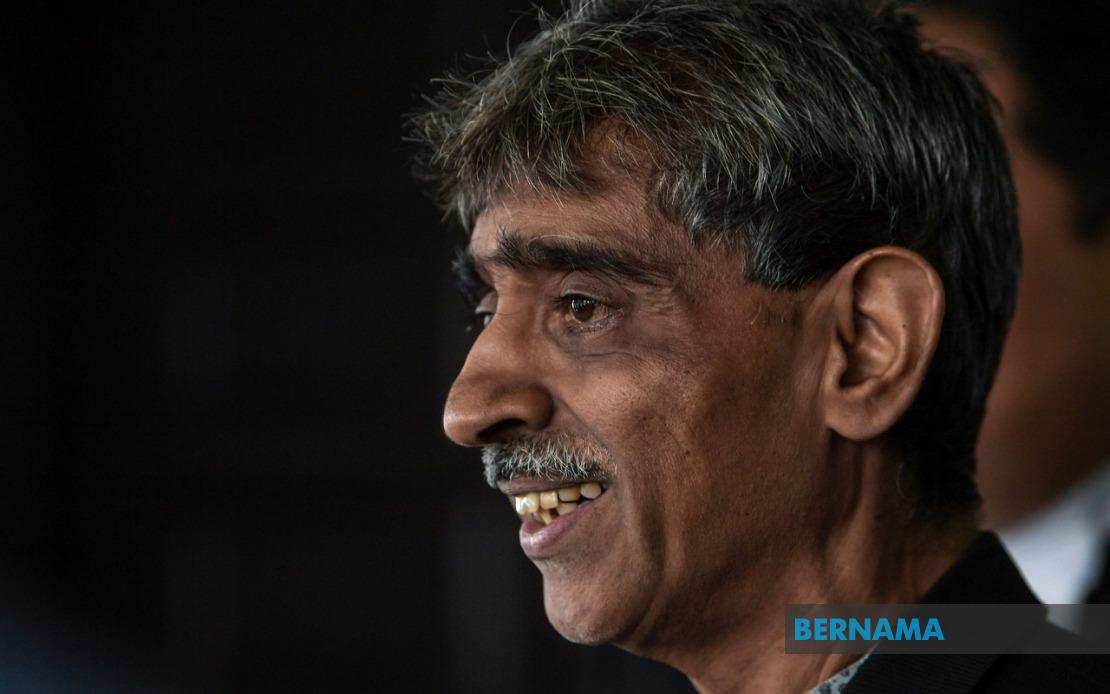
Criminal prosecutions stemming from the Tabung Haji Royal Commission of Inquiry must proceed swiftly once investigators have amassed sufficient evidence, regardless of the accused's standing or position, according to Mohamed Haniff Khatri Abdulla, a lawyer who participated in the inquiry proceedings. His intervention underscores growing pressure on Malaysian authorities to translate RCI findings into concrete legal consequences, a move he argues is fundamental to restoring confidence among the estimated 8.8 million depositors whose savings rest with the Islamic pilgrimage fund.
Mohamed Haniff Khatri contends that the interval between investigation completion and court action must be minimized to maximize public perception of accountability. He frames this not merely as a matter of justice for wrongdoing, but as an institutional necessity—prolonged delays between investigation conclusions and prosecutorial decisions risk undermining the legitimacy of whatever charges eventually materialize. His comments reflect a broader anxiety in Malaysian civil society that the inquiry's findings, while damaging to Tabung Haji's reputation, may languish in bureaucratic limbo without tangible consequences for those held responsible.
Yet the lawyer also counsels against premature expectations of rapid resolution. He acknowledges that investigations spawned by the RCI are inherently complex and wide-ranging, touching upon governance failures, questionable investment decisions, and potential criminal violations across multiple operational domains. The sheer scope of the undertaking—authorities have already summoned nearly 200 individuals for statements—means that prosecutions now under way should not be misinterpreted as a conclusion to the larger investigation. This layered approach requires careful public communication to prevent misunderstandings about the pace and completeness of accountability measures.
Mohamed Haniff Khatri advocates for a structural innovation to accelerate the prosecutorial pipeline: the Attorney General's Chambers should establish a dedicated task force within its ranks, comprising three Deputy Public Prosecutors with expertise in anti-corruption law and conventional criminal procedure. Such a unit would serve as a central intake point for investigation files submitted by both the Royal Malaysia Police and the Malaysian Anti-Corruption Commission, ensuring consistency and efficiency as cases move toward charging decisions. Given that these two agencies operate under different investigative protocols, a unified reviewing body could eliminate procedural inconsistencies that might otherwise complicate judicial proceedings.
Former Court of Appeal judge Datuk Yaacob Md Sam, who has presided over multiple RCI proceedings, reinforces a critical legal reality often overlooked in public discourse: RCI reports themselves carry no legal standing in criminal or civil courts. Under the Commissions of Inquiry Act 1950, findings and recommendations emerging from an inquiry cannot be deployed as admissible evidence, nor do they legally bind enforcement agencies to particular courses of action. This means the transition from the RCI's investigative phase to criminal prosecution represents a wholesale restart of the evidentiary gathering process, not merely a formalization of conclusions already reached.
Yaacob's perspective underscores a fundamental misalignment between public expectation and legal reality that has characterized many high-profile Malaysian inquiries. Depositors and taxpayers, having absorbed months of RCI hearings and documentation of institutional dysfunction, naturally assume that prosecution follows automatically. In fact, enforcement agencies must independently verify each alleged violation, locate witnesses willing to testify, and assemble documentary proof capable of surviving cross-examination. This parallel investigative track requires time and specialized expertise, explaining why even clear findings of misconduct can take months or years to translate into courtroom charges.
The complexity intensifies when considering Tabung Haji's organizational structure and decision-making hierarchies. Investment selections, fund allocations, and governance lapses often involve multiple decision-makers operating across different departments and time periods. Establishing individual criminal liability—rather than merely identifying institutional failure—demands that prosecutors prove specific mens rea, or criminal intent, on the part of identifiable persons. A board member's approval of a questionable investment, for instance, must be distinguished from a subordinate's independent misrepresentation of facts to secure approval. These distinctions are legally crucial but investigatively demanding.
Mohamed Haniff Khatri projects that the comprehensive investigation process will consume at least three to six additional months beyond current timelines, a forecast that reflects the empirical reality of major financial investigations in comparable jurisdictions. Malaysia's recent experience with probes into 1Malaysia Development Berhad demonstrated how even well-resourced investigations can extend beyond initial estimates when new leads emerge or when witnesses require extended interviewing. The Tabung Haji case involves fewer parties than 1MDB but compensates in sheer documentary volume, as decades of investment transactions must be audited for legitimacy.
Public communication strategy emerges as a critical variable in the equation. Both Mohamed Haniff Khatri and Yaacob emphasize that authorities must proactively manage expectations through staged announcements, explaining which investigative components have concluded and what evidentiary thresholds have been met for particular prosecutions. Without such transparency, the Malaysian public risks interpreting delayed prosecutions as evidence of institutional capture or political reluctance, a perception that would further erode confidence in both Tabung Haji itself and the enforcement mechanisms supposedly holding it accountable. Conversely, premature announcements of prosecutions based on incomplete evidence could trigger dismissals that discredit the entire accountability process.
The institutional stakes extend beyond Tabung Haji's balance sheet or depositor psychology. Malaysia's reputation as a jurisdiction capable of investigating and prosecuting white-collar financial crime remains contested internationally, particularly after the 1MDB controversies exposed gaps in asset tracing and transnational coordination. How authorities handle the Tabung Haji investigation will signal whether Malaysian institutions can effectively address institutional malfeasance without political interference or resource constraints undercutting investigations. Foreign investors and depositors evaluating Malaysia's financial safety will monitor not only whether prosecutions occur, but whether they demonstrate competence, impartiality, and adherence to evidentiary standards.
The involvement of both PDRM and MACC in the investigation introduces a need for coordination that Mohamed Haniff Khatri's proposed task force aims to address. Police investigations typically follow conventional criminal procedures emphasizing witness statements and forensic evidence, while MACC investigations often emphasize financial trails and patterns of unexplained wealth. Marrying these two approaches—conventional crime methodology with anti-corruption investigative techniques—requires neither agency to subordinate its standards but rather demands that prosecutors synthesize findings from both into coherent charging narratives. This cross-agency harmonization has proven challenging in previous Malaysian inquiries and remains a potential bottleneck.
For Malaysian readers, the implications are substantial. The Tabung Haji crisis directly affects millions of Muslim households who depend on the fund for pilgrimage financing and who view it as a trusted savings vehicle. Whether prosecutions materialize briskly or languish reflects broader questions about institutional accountability in Malaysia. The statements from Mohamed Haniff Khatri and Yaacob suggest that authorities face genuine investigative complexity rather than mere bureaucratic delay, a distinction worth understanding as prosecutions gradually emerge. Patience is warranted, but so is scrutiny of whether enforcement agencies are genuinely pursuing accountability or simply allowing the matter to fade.

