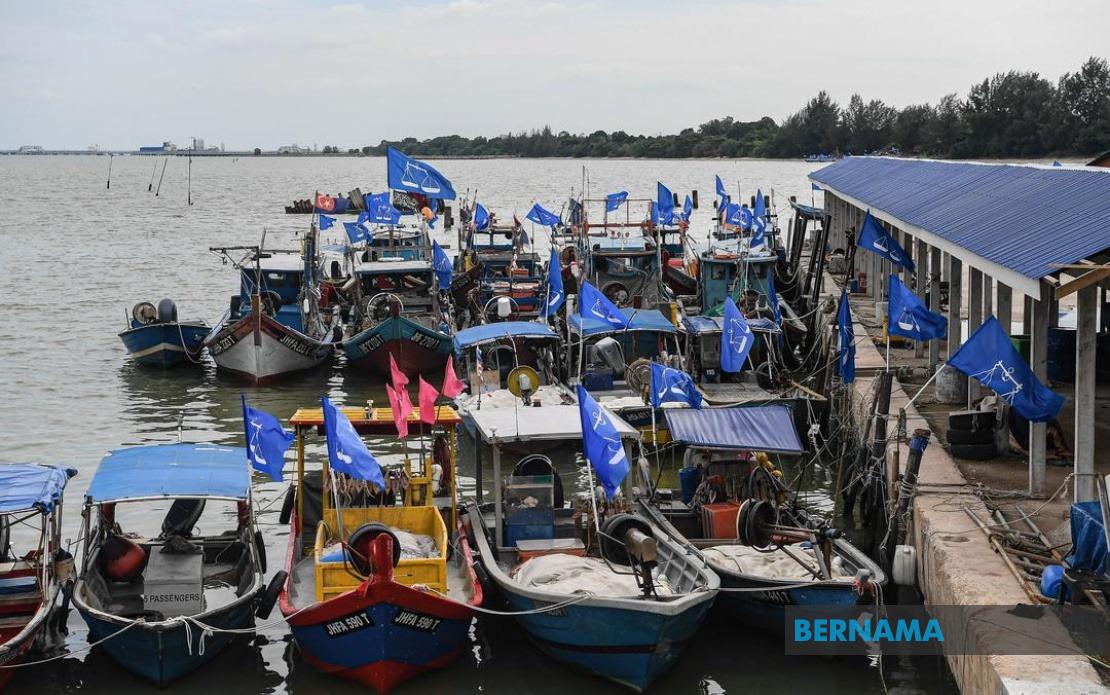
The coastal community of Sungai Rengit in Kota Tinggi has made infrastructure and security improvements a central campaign issue ahead of the 16th Johor state election, with traders and fishermen expressing mounting frustration over years of unresolved infrastructure challenges. Located in the Tanjung Surat state constituency, this strategic trading hub serves the broader Pengerang Integrated Petroleum Complex (PIPC) region and its industrial workforce, yet its temporary food court has become emblematic of chronic governance gaps affecting small business operators.
Nearly a decade of operating from an inadequate temporary site has worn down the resolve of Medan Selera Sungai Rengit traders, who were initially displaced to allow space for a development project. What was supposed to be a brief relocation has extended indefinitely, leaving vendors to conduct business from canopy-covered structures with basic plywood walls. The promised alternative premises, though already designated, remains unused because vendors argue the proposed location lacks sufficient parking and sits on a one-way road that would cripple customer access and sales—a critical distinction for small operators whose margins depend entirely on foot traffic and convenience.
Beverage trader Lai Swee Hong, who has operated in the area for three decades, articulated the core grievance: traders were told the temporary arrangement would last roughly eighteen months, yet no credible timeline for permanent relocation has materialised. The prolonged uncertainty has translated into deteriorating physical conditions that compound daily business challenges. Open stalls with minimal weather protection expose merchandise and equipment to Johor's humid tropical climate, while the absence of proper doors and security infrastructure invites criminal opportunism—a vulnerability that has metastasised into a recurring security crisis.
The security dimension has emerged as a parallel crisis eroding trader confidence and income stability. Food vendor Wini Fasiha Zawawi reported that theft cases have escalated since the preceding year, with multiple incidents of kitchen appliance theft undermining already-thin profit margins. Despite lodging police reports and escalating complaints through local authorities, tangible security interventions remain absent. Routine police patrols have failed to stem the thefts, leaving small operators in a state of perpetual financial jeopardy—losses that, while individually modest, accumulate across the trading community and represent a meaningful deduction from household incomes that serve as primary livelihood sources.
The fishing sector faces distinct but equally pressing challenges rooted in the cost-of-living crisis and operational expense inflation. Veteran fisherman Sin Hock Hwee, who has pursued maritime livelihoods for fifty years, underscored the role of fuel subsidies in sustaining the industry's economic viability. Rising fuel costs directly compress the profit window available to small-scale fishing operators, rendering many catches economically marginal even as diesel prices remain volatile. The existing fuel subsidy programme functions as a critical buffer against operational collapse, yet fishermen perceive it as under-threat and insufficient—a perception grounded in genuine uncertainty about government subsidy sustainability and adequacy.
Younger fishermen articulate complementary concerns centring on institutional infrastructure and representational voice. Hidayat Isa, a thirty-five-year-old fishing community member, emphasised the need for jetty facility upgrades and enhanced receptiveness to the grievances of emergent generations within the fishing sector. The generational dimension underscores a broader anxiety: that established fishing villages risk becoming economically obsolete without proactive investment in harbour infrastructure, supply-chain linkages, and market access systems that enable competitive participation in contemporary maritime commerce. Younger operators seek not merely subsidies but structural support enabling long-term sectoral viability and professional dignity.
The confluence of trader and fishery sector demands reflects underlying concerns about political representation and constituency development priorities. The Tanjung Surat state seat contest pits Pakatan Harapan candidate Faizul Abdul Ghani against incumbent Barisan Nasional assemblyman Aznan Tamin, presenting voters with a choice between continuity and alternative governance approaches. Both candidates will inherit a constituency where infrastructure deficiencies and security shortcomings have fossilised into defining grievances—issues that transcend partisan affiliation and demand demonstrable, executable remedies rather than rhetorical commitments.
The Sungai Rengit situation exemplifies broader challenges confronting Johor's intermediate towns—settlements that serve industrial and resource complexes yet remain peripheral to urban core development strategies. The temporary food court, originally conceived as a provisional measure, has inadvertently become a permanent fixture symbolising governance inertia and institutional neglect. This pattern—where interim arrangements calcify into indefinite structures—reflects systemic challenges in project implementation, inter-agency coordination, and accountability mechanisms across local government frameworks in Malaysia.
For traders and fishermen operating within intensifying cost-of-living pressures, the 16th Johor state election represents a potential inflection point where accumulated grievances can influence electoral outcomes. The Tanjung Surat constituency's 172 contending candidates across 56 state seats will need to demonstrate responsiveness to the specific infrastructure, security, and economic support priorities articulated by Sungai Rengit's working communities. The polling date of July 11, with early voting on July 7, presents these constituencies with an opportunity to translate their infrastructure demands and livelihood concerns into electoral leverage.

