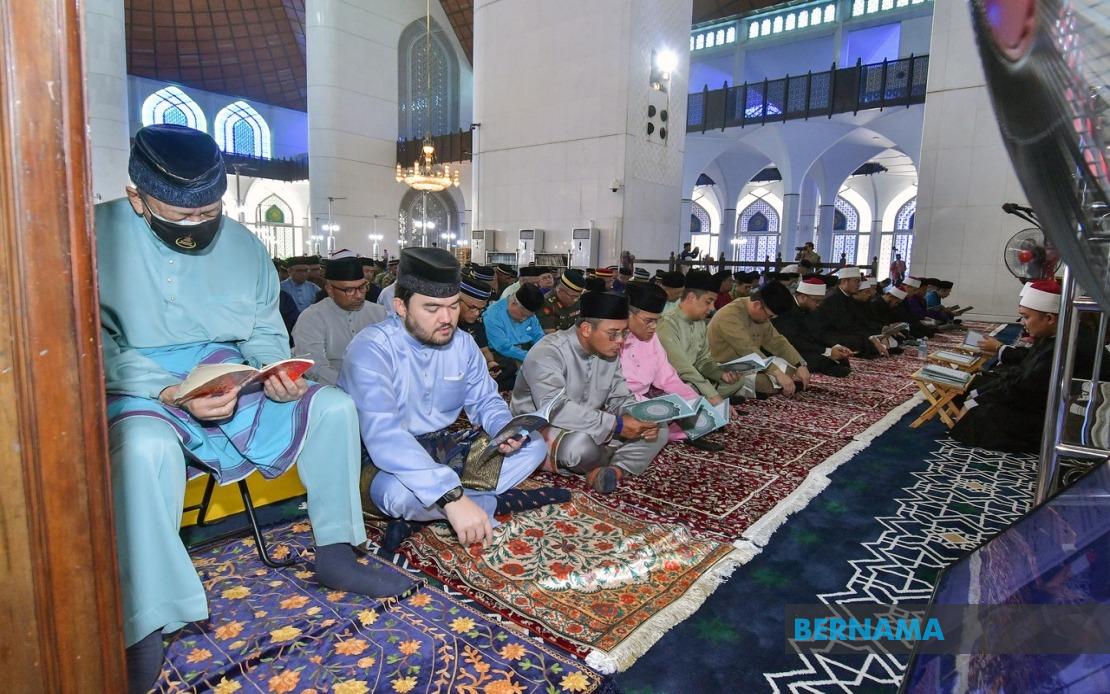
The Sultan of Selangor, Sultan Sharafuddin Idris Shah, participated in a Surah Yassin recitation and Friday prayers at Masjid Sultan Salahuddin Abdul Aziz Shah in Shah Alam on Wednesday, August 28, in a spiritual observance timed just before the state's National Day celebrations. The religious gathering underscored the integration of Islamic observance with the nation's patriotic calendar, reflecting the role of royal patronage in Malaysia's multicultural governance structure. The Raja Muda of Selangor, Tengku Amir Shah Sultan Sharafuddin Idris Shah, accompanied the Sultan, signifying the importance accorded to the occasion by the state's senior leadership.
Upon his arrival at the mosque, the Sultan received a formal welcome from Selangor Menteri Besar Datuk Seri Amirudin Shari and Dr Mohammad Fahmi Ngah, who chairs the State Islamic Affairs and Innovation Culture Committee. The presence of both state executive and religious administration officials demonstrated the coordinated approach Selangor adopts in matters combining governance and religious observance. Datuk Mohd Shahzihan Ahmad, director of the Selangor Islamic Religious Department (JAIS), and Datuk Salehuddin Saidin, chairman of the Selangor Islamic Religious Council (MAIS), also attended, highlighting the comprehensive involvement of the state's Islamic institutional apparatus in the event.
Approximately 1,000 worshippers participated in the Surah Yassin recitation, a significant gathering that included active members of security forces stationed across Selangor. The inclusion of personnel from law enforcement and defence agencies in religious observances reflects the integration of institutional participation in the state's spiritual calendar. Such turnout demonstrates both the religious significance of the Surah Yassin recitation, a traditional Islamic practice often performed during commemorative occasions or in moments of national reflection, and the broader participation of Selangor's diverse communities in shared spiritual moments.
Following the recitation, the Sultan performed the Friday prayers, a central weekly obligation in Islam that brings together the Muslim faithful. The sermon, delivered by Masjid Sultan Salahuddin Abdul Aziz Shah's Grand Imam Muhammad Farhan Wijaya, carried the title "Merdeka Daripada Belenggu Kerakusan" — Freedom from the Shackles of Greed. The choice of sermon topic provided a thematic bridge between religious instruction and national consciousness, interpreting the independence that Malaysia celebrates through Merdeka with reference to moral and spiritual liberation from destructive impulses.
The sermon's emphasis on freedom from greed offers particular relevance in contemporary Malaysian discourse, where governance, institutional integrity, and economic equitability remain central concerns in public conversation. By positioning national independence as fundamentally linked to spiritual and moral emancipation, the religious message reinforced the connection between patriotic observance and personal virtue. This approach reflects a theological understanding common across Southeast Asian Islamic contexts, where nationalism and faith are presented as mutually reinforcing rather than competing loyalties.
The timing of this religious gathering immediately preceding the state-level National Day celebrations carries symbolic significance. Selangor's state-level festivities were scheduled to commence at Kajang Stadium on Sunday, August 30, under the theme "Malaysia MADANI: Kesejahteraan Dinikmati" — Malaysia MADANI: Prosperity Enjoyed. The national theme of Malaysia MADANI, a policy framework emphasizing prosperity, harmony, and dignity, found spiritual grounding in the mosque gathering, suggesting that material and political development must be accompanied by moral and spiritual anchoring.
The state's decision to organize a pre-celebration religious observance involving the Sultan reflects broader patterns in Malaysian governance where royal figures maintain active engagement with religious institutions and observances. This involvement serves multiple functions: it legitimizes both the Islamic framework within Malaysia's constitutional monarchy and positions development and progress as compatible with religious devotion. For Selangor, Malaysia's most economically developed state and a critical engine of national growth, such messaging carries weight as the state navigates modernization while maintaining its commitment to Islamic principles.
The Surah Yassin recitation itself holds particular cultural resonance in Malaysian Islamic practice. Often recited during communal gatherings, religious celebrations, and moments of national significance, the Surah is understood to carry blessings and protective qualities. Its recitation by a broad cross-section of Selangor's population, including security personnel and state officials, underscored a shared spiritual practice that transcends professional and institutional boundaries. This collective participation also reinforced social cohesion in a state managing rapid urbanization and demographic diversity.
For Malaysian readers and observers of Southeast Asian politics, the event illustrates how established Islamic-majority nations integrate religious observance into state functions and national commemoration. Unlike purely secular national celebrations, Malaysia's approach incorporates spiritual dimensions that resonate with the Muslim majority while functioning within a constitutional framework that protects religious minorities. The Selangor event exemplifies this balance, presenting national identity and Islamic practice as complementary aspects of state identity rather than competing frameworks.
The comprehensive involvement of JAIS and MAIS in the gathering underscores how Selangor's religious institutions operate as arms of state governance and spiritual leadership. These bodies coordinate religious education, welfare, and observance across the state, making their presence alongside the Sultan and political executives a marker of integrated state function. As Malaysia continues navigating questions of Islamic governance, institutional reform, and development, events like these signal how traditional religious authority and modern bureaucratic structures coexist and reinforce one another.
Looking forward to the state celebrations, the pre-Merdeka religious observance sets a spiritual foundation for the festivities to follow. By commencing with prayer and Quranic recitation, Selangor positions its National Day celebrations as expressions of gratitude and moral reflection rather than purely secular patriotic performances. This approach maintains resonance with a population where religious identity constitutes a significant dimension of national belonging, even as the state continues its economic and developmental trajectory. The gathering thus represents continuity in how Malaysia manages the integration of faith, governance, and national identity as it approaches its upcoming independence anniversary.

