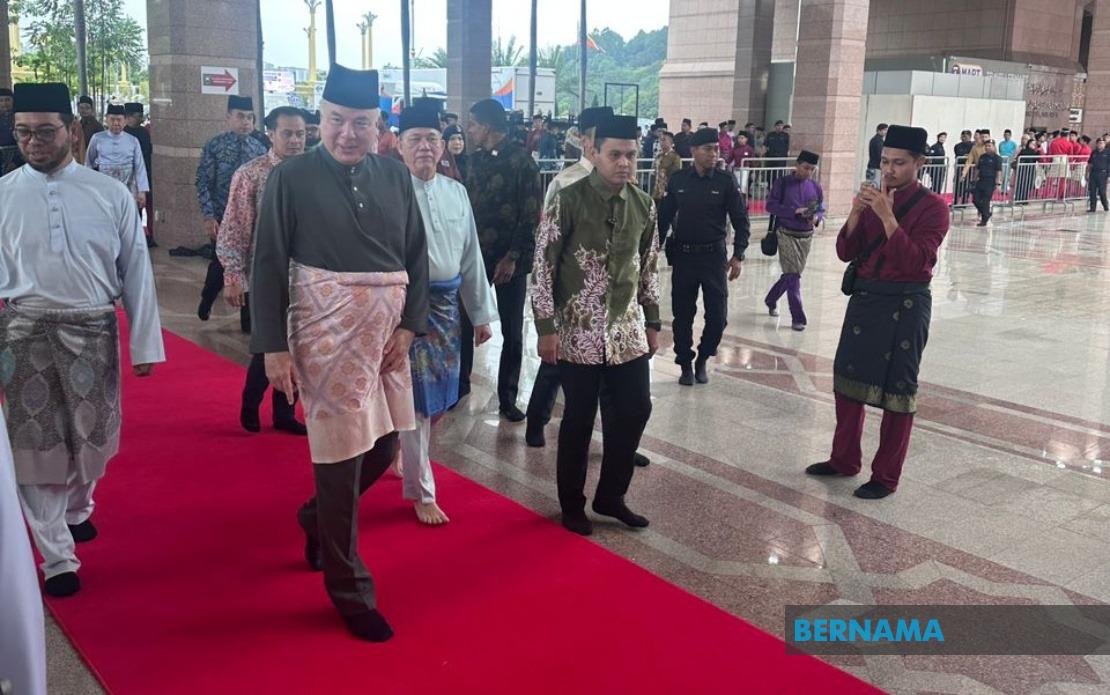
The Deputy Yang di-Pertuan Agong Sultan Nazrin Shah delivered a pointed message to Malaysia's leadership on Tuesday, cautioning that nations suffer irreparable damage when their stewards abandon careful thought in favour of emotional reactions and personal whims. Speaking at the National Level Maal Hijrah 1448 Celebration at the Putra Mosque in Putrajaya, the Perak ruler underscored that hasty policy-making without rigorous analysis inevitably shifts the burden of costly consequences onto ordinary citizens who bear no responsibility for such failures.
The timing of the remarks carried particular significance, delivered before an audience of approximately 5,000 attendees including Deputy Prime Minister Datuk Seri Fadillah Yusof and Minister in the Prime Minister's Department (Religious Affairs) Dr Zulkifli Hasan. The national-level commemoration, themed "MADANI Dihayati, Ummah Diberkati," provided an appropriate forum for reflections on governance rooted in Islamic historical principles. Sultan Nazrin positioned his comments not as abstract moralising but as practical guidance grounded in the lessons of the Hijrah, the Prophet Muhammad's strategic migration that fundamentally reshaped Islamic civilization.
The Sultan extracted a particularly instructive example from this seminal historical event: the Prophet's appointment of Abdullah bin Uraiqit as guide for the perilous desert journey. Despite Uraiqit's non-Muslim status at the time, the Prophet selected him based solely on demonstrated competence, integrity, and reliability in navigating the treacherous terrain. This precedent, Sultan Nazrin explained, reveals Islam's pragmatic recognition of human excellence transcending religious affiliation, provided such expertise serves rather than undermines the Muslim community's interests. The principle carries obvious contemporary relevance for Malaysian governance, where meritocratic appointment of qualified individuals across communal lines remains philosophically endorsed yet inconsistently practiced.
Beyond decision-making processes, Sultan Nazrin redirected attention to what he termed the eroding spirit of sacrifice within the Muslim ummah. He distinguished sharply between rhetorical invocations of sacrifice and its genuine manifestation as a lived commitment. True sacrifice, he explained, demands more than acknowledging loss; it requires consciously subordinating personal comfort and advancement to broader collective objectives. This quality has historically underpinned all transformative achievements, yet contemporary society increasingly prioritizes individual gratification over communal welfare. Sultan Nazrin expressed alarm at this cultural drift, warning that without revitalising the sacrificial spirit, Muslim societies lack the resilience necessary to navigate mounting global challenges.
The Sultan articulated a vision of national greatness fundamentally distinct from mere celebration of past glories. Rather, enduring strength emerges through extracting wisdom from historical experiences and leveraging those insights to construct superior futures. This conceptual framework carries implications for how Malaysia engages with its own complex history—not as settled narrative justifying present arrangements, but as pedagogical resource informing necessary adaptations. The distinction between nostalgia and learning represents a critical dividing line between stagnation and genuine progress.
Emphasis on sacrifice connected directly to Sultan Nazrin's broader argument regarding unity's foundational importance. He invoked the Medina Charter as historical precedent for harmonious coexistence among ethnically and religiously diverse populations. That seventh-century agreement succeeded precisely because wise, just leadership combined with mutual tolerance and civic reciprocity. The Sultan stressed that similar arrangements in contemporary Malaysia require ongoing commitment from citizens willing to cooperate despite cultural differences, operating under governance systems that apply justice equitably. This delicate equilibrium cannot survive either majoritarian domination or the erosion of shared institutional legitimacy.
The ruler's emphasis on prudent, informed judgment reflected a sophisticated understanding of governance's moral dimensions. Leaders' decisions must flow from careful analysis, broad consultation, and ethical reflection rather than reactive impulses shaped by momentary political pressures or personal resentments. Establishing such deliberative institutions and cultural expectations around decision-making represents an ongoing challenge in Malaysian politics, where competing partisan interests often overwhelm considerations of longer-term national welfare. Sultan Nazrin's framing located this concern within Islamic philosophical traditions valuing wisdom and consultation, potentially providing indigenous intellectual resources for governance reform.
Regarding Maal Hijrah's contemporary significance, Sultan Nazrin reframed the commemoration as something far more purposeful than ritualistic calendar notation or historical reminiscence. Rather, the occasion should catalyse serious self-examination, prompting honest assessment of communal shortcomings with genuine intention toward improvement. In this interpretation, Maal Hijrah becomes an annual reckoning point when heedlessness and drift can be acknowledged and redirected. The frame positions religious observance as intrinsically connected to ethical self-scrutiny and communal accountability rather than as separated devotional practice.
The Sultan's remarks carried implicit critique of contemporary political culture while stopping short of explicit condemnation of specific policies or actors. This rhetorical positioning allowed substantive concerns regarding decision-making quality, leadership ethics, and civic sacrifice to be aired in a formal national setting without personalised partisan dimension. However, the specificity of his warnings—against impulsive reactions, emotional responses, and reckless action prioritizing short-term interests—suggested underlying anxieties about recent governance episodes. Malaysian political observers will likely parse the address for coded references to particular ministerial conduct or policy directions.
For Southeast Asian observers, Sultan Nazrin's emphasis on balancing expertise with religious identity reflects broader regional tensions. Across the ASEAN community, nations grapple with integrating religious and ethnic pluralism into meritocratic governance structures. Malaysia's experience navigating these dynamics—with considerable success in certain domains and notable failures in others—offers cautionary lessons. The Sultan's invocation of historical Islamic precedents valuing competence regardless of religious background provides philosophical ammunition for those advocating more inclusive governance approaches across the region's Muslim-majority nations.
The address ultimately presented governance not merely as technical administration but as moral undertaking requiring wisdom, restraint, and subordination of narrow interests to collective flourishing. In contemporary Malaysian political context, where short-term factional advantage frequently trumps institutional stability and policy coherence, such exhortations from the constitutional monarchy carry particular weight. Whether subsequent policy adjustments reflect these principles remains to be seen, but Sultan Nazrin has clearly signalled that the nation's leadership will be held accountable to standards of thoughtful, sacrificial, inclusive governance rooted in both Islamic principles and universal human values.