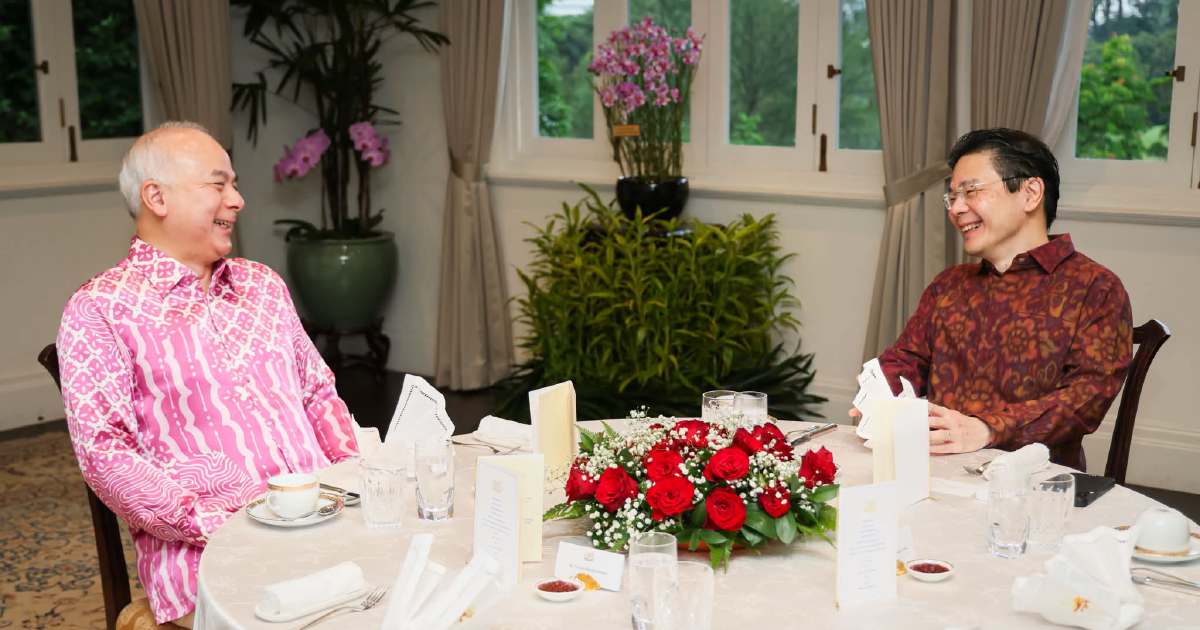
Singapore Prime Minister Lawrence Wong extended an official breakfast reception at The Istana for Sultan Nazrin Shah, the Deputy Yang di-Pertuan Agong, in a gesture that once again exemplified the robust diplomatic relationship maintained between Kuala Lumpur and Singapore. The high-level engagement reflects the two nations' commitment to nurturing the personal and institutional channels that have underpinned their partnership since Malaysia's independence.
The meeting between Wong and Sultan Nazrin represents more than ceremonial protocol. These encounters at the apex of government serve as crucial forums for discussing substantive policy matters that affect both populations. For Malaysia, such interactions with Singapore's leadership underscore the importance Putrajaya places on maintaining strategic alignment with its most economically integrated neighbour. Conversely, Singapore's consistent engagement with Malaysia's highest officials demonstrates its recognition that regional stability and prosperity depend on a functioning relationship with its larger neighbour to the north.
Bilateral initiatives between the two countries span multiple sectors, reflecting decades of accumulated institutional frameworks. Trade and commerce remain significant pillars, with Singapore serving as a major trading partner and investment gateway for Malaysian businesses seeking access to international markets. Additionally, the two nations maintain elaborate arrangements in areas including defence, transportation, telecommunications, and environmental management. The Johor Strait, that narrow waterway separating Singapore from Johor, has necessitated countless joint agreements covering everything from water supplies to maritime security—mechanisms that require continuous dialogue at governmental levels to function effectively.
Asean cooperation formed part of the breakfast discussion, representing a broader strategic context within which Malaysia-Singapore relations operate. Both nations play influential roles within the ten-nation bloc, and their partnership helps shape regional positions on everything from maritime security and climate action to economic integration and geopolitical positioning. Singapore's centrality in regional trade and finance, combined with Malaysia's demographic weight and natural resources, creates natural complementarities that have historically benefited the wider Southeast Asian community.
For Malaysian readers, these bilateral conversations carry particular significance given the intricate economic ties binding the two economies. Thousands of Malaysians commute daily across the Causeway for employment, while Malaysian enterprises increasingly establish regional operations in Singapore's business hubs. The stability and warmth of official relations directly influences the ease with which such cross-border transactions occur, from customs procedures to regulatory approvals.
The timing of Wong's receipt of Sultan Nazrin reflects Singapore's meticulous attention to diplomatic protocol. Hosting a member of Malaysia's royal household at the official presidential residence represents a carefully calibrated signal of respect and importance. In the Malaysian context, where the institution of the Agong carries profound constitutional and cultural significance, such courtesies reinforce that Singapore recognises and values Malaysia's governmental institutions.
The Deputy Yang di-Pertuan Agong's role includes ceremonial functions alongside opportunities to strengthen connections across various sectors of society. These official visits often provide opportunities for bilateral discussions extending beyond the formal agenda—permitting candid exchanges between leaders on emerging challenges or opportunities that may not fit neatly into scheduled diplomatic channels. Such conversations frequently generate follow-up working groups or ministerial-level discussions that advance concrete outcomes.
Regional cooperation through Asean remains an increasingly vital component of Malaysia-Singapore relations. As the grouping navigates complex geopolitical currents—including great power competition, climate imperatives, and post-pandemic economic recovery—the steadiness of bilateral relationships between member states becomes ever more critical. When Malaysia and Singapore function as effective partners, the entire Asean decision-making apparatus operates more smoothly, enabling the bloc to present coherent positions on transnational issues from the South China Sea to digital economy standards.
Looking forward, the breadth of potential collaboration between the two nations suggests that such high-level engagements will remain frequent fixtures in the diplomatic calendar. Emerging challenges including renewable energy transitions, digital infrastructure development, and cybersecurity present fresh domains where bilateral cooperation could yield mutual benefits. The Malaysian private sector, increasingly sophisticated and internationally oriented, stands to benefit from stronger institutional frameworks facilitating commerce and investment flows with Singapore.
The breakfast at The Istana thus represents not merely a ceremonial courtesy but a reaffirmation of two neighbouring nations' commitment to working through shared challenges while amplifying their combined influence within the regional and global contexts. For Malaysia-Singapore ties that have weathered numerous historical complexities, such sustained engagement at the highest levels continues to provide the necessary political foundation upon which deeper economic and social connections can flourish.

