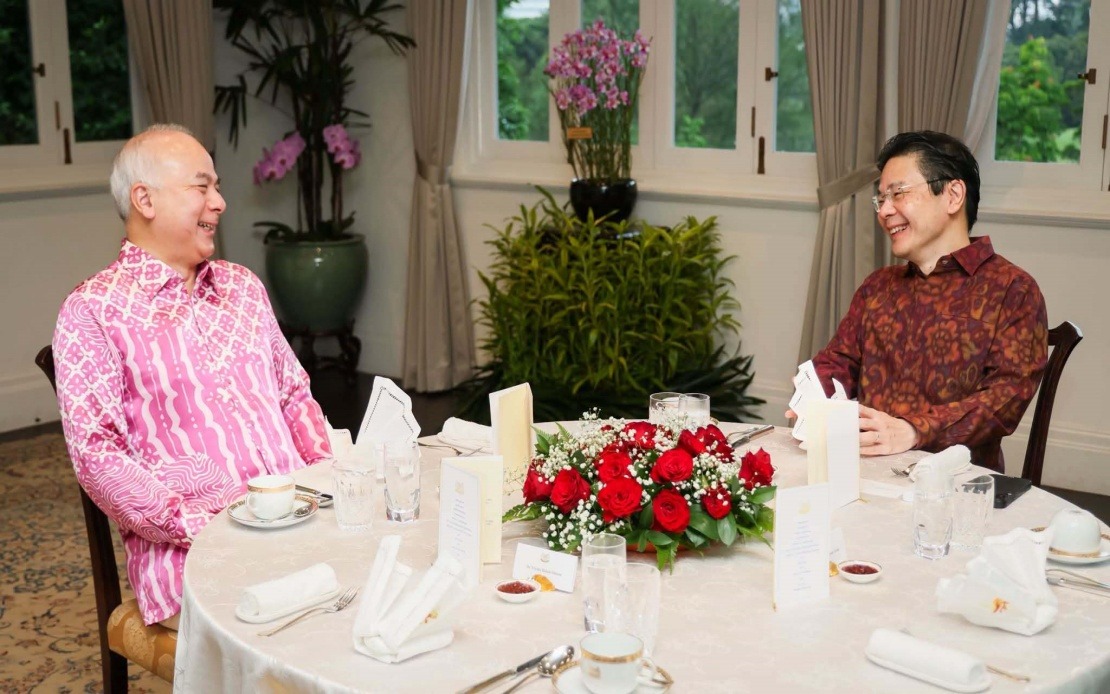
Singapore Prime Minister Lawrence Wong hosted Deputy Yang di-Pertuan Agong Sultan Nazrin Shah of Perak for a breakfast meeting at The Istana on Thursday, a ceremonial encounter that highlights the steadfast institutional bonds between Malaysia and Singapore. The engagement, while formal in character, underscores the depth of engagement between the two neighbouring countries at the highest levels of government, reinforcing their commitment to collaborative development across multiple sectors and regions.
Wong used the occasion to address the contemporary relationship between the two nations, articulating shared objectives and common ground. In remarks published on his Facebook account, he emphasised that Singapore and Malaysia are advancing together on a range of initiatives that benefit both societies. The focus of their discussions centred on reinforcing cooperation within the ASEAN framework, a mechanism increasingly vital as regional economies navigate geopolitical complexities and pursue collective prosperity.
The Prime Minister's characterisation of the bilateral relationship extended beyond mere diplomatic protocol. Wong highlighted the layered foundations upon which Malaysia-Singapore ties rest, noting that the two countries share not only geographical proximity but also historical narratives and genuine interpersonal connections. This framing reflects an understanding that successful regional partnerships require more than economic transactions or political agreements—they demand sustained cultural and social engagement that binds citizens across borders.
Wong expressed confidence in the trajectory of the bilateral relationship, signalling an optimistic outlook regarding future collaboration. His assertion that both nations will continue working in tandem to realise a shared vision carries implications for multiple areas including trade, infrastructure, digital connectivity, and security cooperation. For Malaysian observers, such statements from a neighbouring leader carry particular weight in assessing regional stability and the prospects for joint initiatives that could enhance Southeast Asian competitiveness globally.
Sultan Nazrin's presence in Singapore coincided with his participation in the 55th UM-National University of Singapore Inter-University Tunku Chancellor Golf Tournament, which ran from July 29 to 30, 2026. As Chancellor of Universiti Malaya, Sultan Nazrin maintains an active institutional role in Malaysia's premier educational establishment, and his involvement in academic exchange programmes reflects the educational dimension of bilateral cooperation. The tournament itself represents the enduring connection between two leading universities in the region, with roots extending back decades.
The scholarly ties between Universiti Malaya and the National University of Singapore represent one of the oldest formal institutional relationships between the two countries, predating contemporary ASEAN frameworks. These academic bonds have historically served as incubators for professional networks, research collaboration, and cultural understanding. The continuation of such inter-university competitions and exchanges demonstrates that people-to-people diplomacy operates effectively at institutional and educational levels, cultivating the next generation of leaders and professionals who will shape bilateral relations.
For Malaysia, the message conveyed through such high-level diplomatic engagement carries domestic resonance. The active participation of the Deputy Yang di-Pertuan Agong in regional affairs and bilateral diplomacy signals institutional continuity and the monarchy's engagement with contemporary governance challenges. Sultan Nazrin's dual role—as a constitutional monarch and as an educational leader—positions him uniquely as a bridge between traditional institutions and modern frameworks of cooperation.
The emphasis on ASEAN cooperation within the Malaysia-Singapore dialogue reflects broader regional strategies. Both nations recognise that their individual prosperity and security are inextricably linked to the stability and development of Southeast Asia as a whole. Initiatives discussed likely encompass areas such as maritime security, trade facilitation, digital economy development, and responses to transnational challenges including climate change and pandemic preparedness. For Malaysian policymakers and business leaders, understanding the contours of these discussions provides insight into how regional cooperation is evolving.
The breakfast meeting also underscores the importance of personal relationships in diplomacy. High-level encounters between leaders, regardless of formal agenda, create spaces for frank discussions and relationship-building that cannot occur through lower-level channels. Wong's invitation to host Sultan Nazrin at The Istana carries symbolic weight, positioning the Deputy Yang di-Pertuan Agong as a figure of international standing worthy of formal state reception protocols. Such courtesies contribute to the intangible but crucial dimension of bilateral relations—mutual respect and recognition.
Looking forward, the engagement between Sultan Nazrin and Wong establishes momentum for continued dialogue and cooperation. As both countries navigate evolving regional dynamics—including economic integration, technological advancement, and geopolitical shifts—maintaining robust communication channels at all levels becomes increasingly valuable. The outcomes of such discussions may not always be immediately apparent in public statements, but they create frameworks for addressing practical bilateral matters and aligning positions on regional issues.

