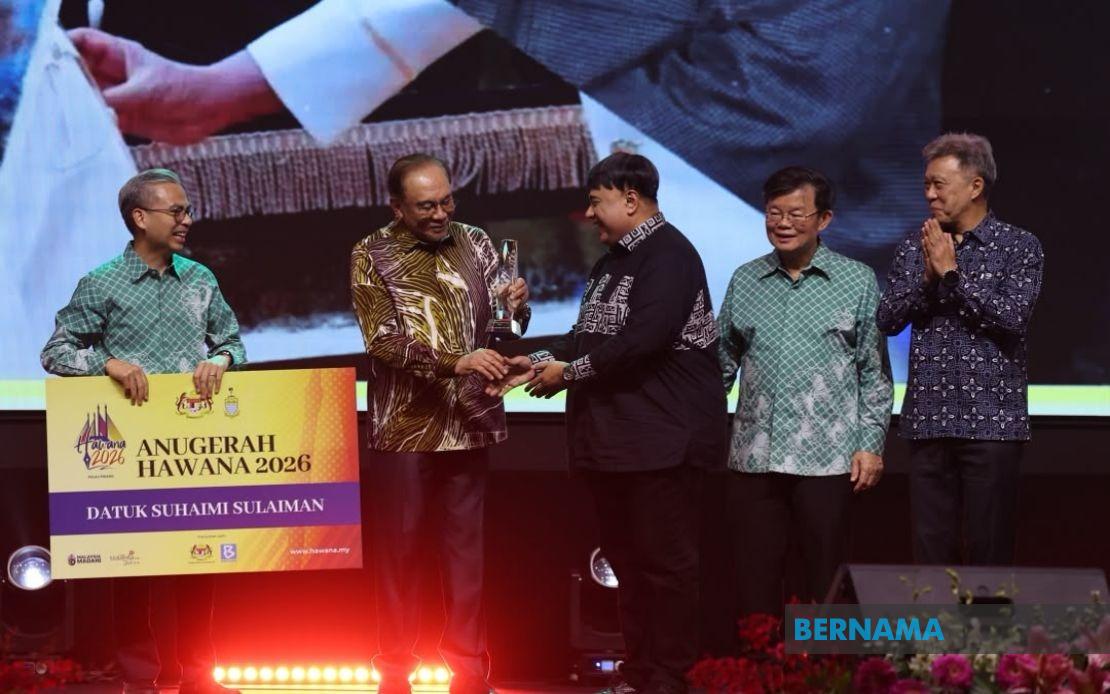
Datuk Suhaimi Sulaiman, whose career has spanned more than thirty years navigating the complexities of Malaysian broadcasting and journalism, received one of the country's most prestigious accolades on June 20 when Prime Minister Datuk Seri Anwar Ibrahim presented him with the National Journalists' Day (HAWANA) 2026 Award at a ceremony in Butterworth. The honour, bestowed before an audience of senior government and media figures, underscored Sulaiman's substantial influence on the nation's media ecosystem during a period of significant transformation in how Malaysians receive and consume news.
The presentation took place at the HAWANA 2026 Grand Finale held at PICCA @ Arena Butterworth Convention Centre, with the event witnessed by Penang Chief Minister Chow Kon Yeow, Communications Minister Datuk Fahmi Fadzil, and Malaysian National News Agency (Bernama) chairman Datuk Seri Wong Chun Wai. The gathering reflected the stature of the recipient and the importance the government places on recognising journalistic excellence and institutional memory within the media sector. Additional attendees included Bernama chief executive officer and HAWANA 2026 Working Committee chairman Datin Paduka Nur-ul Afida Kamaludin, as well as Bernama editor-in-chief Arul Rajoo Durar Raj, indicating the significance Bernama accorded to the occasion.
Sulaiman's career trajectory represents a particularly instructive path through Malaysia's modern media history. His tenure as director-general of Broadcasting Malaysia (RTM), the country's premier state broadcaster, positioned him at the helm during a critical period when traditional media organisations grappled with technological disruption, changing audience preferences, and the need to maintain relevance in an increasingly competitive information landscape. His leadership during these transformative years would have required navigating the delicate balance between maintaining editorial standards, serving the public interest, and adapting institutional structures to contemporary realities.
In remarks to Bernama following the award ceremony, Sulaiman framed the recognition not merely as a celebration of past accomplishments but as a catalyst for continued professional growth and responsibility. He articulated a perspective that emphasises the dynamic nature of journalism and media practice, noting that the field demands perpetual learning and adaptation. This outlook carries particular significance in the Malaysian context, where media practitioners operate within specific regulatory frameworks while simultaneously contending with globalised information flows and evolving audience expectations.
The former RTM chief highlighted artificial intelligence as a defining challenge and opportunity for the contemporary media sector. His observation that AI reshapes the media landscape reflects genuine industry-wide concern about how newsrooms and broadcasting organisations must evolve their practices, skill sets, and business models in response to algorithmic content distribution, machine learning applications, and the potential for AI-generated content. For Malaysian media organisations, which range from established state broadcasters to digital-native news platforms, the transition to AI-integrated operations presents both operational challenges and competitive pressures that will likely define the sector's trajectory throughout the remainder of this decade.
Sulaiman's emphasis on sharing accumulated experience and knowledge carries practical implications for Malaysian journalism. Senior practitioners who articulate a commitment to mentoring emerging journalists and facilitating knowledge transfer help maintain institutional memory and professional standards across the sector. In a period when many traditional news organisations face staffing pressures and younger journalists enter the field with diverse educational backgrounds, veteran figures who remain engaged with contemporary challenges serve an important stabilising and developmental function.
The HAWANA awards programme itself reflects Malaysian institutional commitment to recognising journalistic contributions and maintaining professional standards within the media sector. By honouring practitioners like Sulaiman, the recognition scheme acknowledges that journalism, particularly in a complex multi-ethnic, multi-religious society like Malaysia, serves essential functions in facilitating public discourse, holding institutions accountable, and maintaining informed citizenry. The presence of the Prime Minister and senior government officials at the awards ceremony underscores official appreciation for these societal roles.
For Malaysian readers and media observers, Sulaiman's recognition carries symbolic weight regarding the value placed on broadcasting and journalism as professional disciplines. His award comes at a moment when news organisations across Southeast Asia face questions about sustainability, audience trust, and editorial independence. By publicly honouring someone with deep roots in institutional broadcasting, Malaysian leadership reinforces the notion that structured, professional media organisations remain important components of the information ecosystem, even as digital platforms and independent media outlets proliferate.
The emphasis within Sulaiman's remarks on continuous learning and adaptation speaks to broader realities facing the Malaysian media sector. Digital transformation, audience fragmentation, economic pressures on traditional news models, and technological change collectively create an environment where flexibility and willingness to acquire new competencies become survival skills for media organisations. Experienced practitioners who demonstrate commitment to evolving their approaches rather than retreating into established methods provide models for institutional adaptation that other organisations might study and emulate.
Looking forward, Sulaiman's award and his public statements about the AI era suggest that Malaysian media discourse will increasingly engage with questions about how emerging technologies reshape journalistic practice. The conversation between experienced practitioners like Sulaiman and younger journalists entering the field through varied educational and professional pathways will help shape how Malaysian news organisations approach technological change. Whether through formal mentoring, public commentary, or contributions to industry discussions, practitioners who have successfully navigated previous media transitions can offer valuable perspective on managing the current transformation cycle.
The recognition also implicitly affirms the continued relevance of broadcast journalism and institutional media in Malaysia's information landscape. Despite competition from social media, digital news platforms, and alternative information sources, traditional broadcasters and news organisations retain significant reach, production resources, and regulatory standing. Honouring someone who spent decades leading a major broadcasting institution signals continued confidence in these organisations' societal role, even as their operating environment becomes increasingly complex and competitive.

