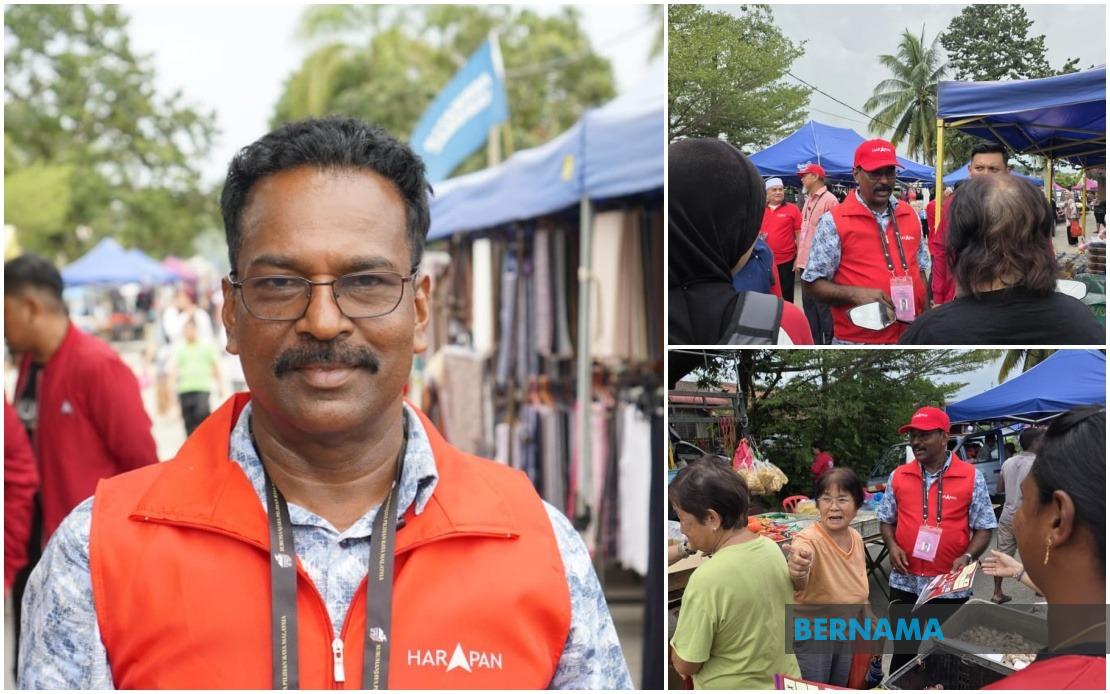
C. Subramani, the Pakatan Harapan candidate contesting Bukit Kepong in the 16th Johor state election, believes he can pull off a surprise victory by tapping into constituent demands for meaningful development. The Pagoh native has launched an assertive campaign centred on addressing long-neglected infrastructure shortfalls and socioeconomic inequities that have festered within the constituency, positioning himself as an agent of tangible change rather than political continuity.
Subramani's optimism stems from what he describes as overwhelmingly positive grassroots reception during his campaign trail. He has undertaken systematic ground visits encompassing Orang Asli settlements, during which he documented specific concerns ranging from inadequate utility services to limited livelihood opportunities. His engagement with indigenous communities signals an attempt to broaden PH's appeal beyond urban centres and traditional support bases, recognising that peripheral populations hold sway in determining electoral outcomes within mixed constituencies.
The candidate has articulated a governance philosophy centred on administrative synergy between state and federal governments. He contends that when both tiers operate in alignment, constituents benefit from faster issue resolution, particularly regarding matters that straddle multiple jurisdictional boundaries. Education infrastructure, irrigation systems, and drainage networks exemplify challenges that require coordination between state-level representatives and federal agencies—coordination he argues has been deficient previously. This emphasis on efficiency-driven governance appeals to pragmatic voters fatigued by bureaucratic delays.
Among Subramani's priority initiatives is the transformation of Bukit Kepong Gallery into a heritage tourism destination capable of catalysing localised economic activity. This strategy acknowledges how cultural assets can drive employment and small business growth, particularly relevant in rural constituencies where alternative revenue streams remain constrained. Complementing this vision are pledges addressing immediate quality-of-life concerns: enhancing street illumination in poorly lit residential areas, widening inadequate bridge infrastructure, and developing affordable housing stock for lower-income households.
Subramani's political trajectory encompasses previous electoral contests, notably his 2022 candidacy in Buloh Kasap during the preceding Johor state election. While that bid proved unsuccessful, he has leveraged the experience to deepen community connections and refine policy platforms based on constituent feedback. This sustained engagement distinguishes him from candidates parachuted into constituencies lacking established relationships with local populations.
The Bukit Kepong contest exemplifies the fragmentation characterising contemporary Malaysian electoral politics. A three-cornered battle involving Pakatan Harapan, Barisan Nasional, and Perikatan Nasional fragments the vote, potentially benefiting candidates with concentrated voter blocs or superior ground organisation. Subramani must navigate this complex terrain by consolidating support among urban and semi-rural voters while simultaneously maintaining penetration within indigenous constituencies—a balancing act requiring sophisticated campaign mechanics.
The broader electoral context reveals 172 candidates vying across 56 state assembly seats throughout Johor, with approximately 2.7 million registered voters participating. This scale indicates a competitively fragmented landscape where constituency-specific dynamics often transcend state-level trends. Local issues—infrastructure deficits, service delivery failures, economic opportunity disparities—frequently outweigh national political narratives in determining voter preference at the state assembly level.
Previous electoral performance in Bukit Kepong provides instructive context. In 2022, Perikatan Nasional's Datuk Dr Sahruddin Jamal secured victory with a narrow majority of 710 votes, indicating an intensely competitive constituency lacking entrenched party dominance. Such slender margins demonstrate that determined campaigns coupled with identified grievances can materially alter electoral calculus. Subramani's campaign implicitly targets disaffected voters from the outgoing administration, portraying his PH candidacy as delivering substantive rather than rhetorical change.
For Malaysian observers, the Bukit Kepong dynamics reflect broader patterns whereby state elections function as electoral laboratories testing voter sentiment independent from federal political dynamics. The Johor election provides insights into how local governance performance shapes electoral behaviour, whether cross-coalition cooperation gains electoral traction, and how effectively opposition parties construct competitive campaigns within constrained resource environments relative to establishment contenders.
Subramani's conviction regarding voter receptiveness to his platform rests partly on recognition that political fatigue transcends traditional coalition boundaries. Constituents increasingly evaluate candidates based on demonstrated competence, community engagement, and credible commitments to addressing specific local challenges rather than partisan affiliation alone. His willingness to invest campaign energy in Orang Asli communities and his emphasis on infrastructure diagnostics potentially resonates with pragmatic voters prioritising outcomes over political symbolism.
The election also reflects evolving Southeast Asian electoral dynamics whereby regional candidates increasingly emphasise localised governance performance and administrative efficiency rather than ideology or historical party narratives. This trend particularly influences state-level contests where constituency-specific concerns dominate campaign discourse. Subramani's platform exemplifies this reorientation toward results-oriented politics, emphasising what his administration would demonstrably accomplish for Bukit Kepong residents.

