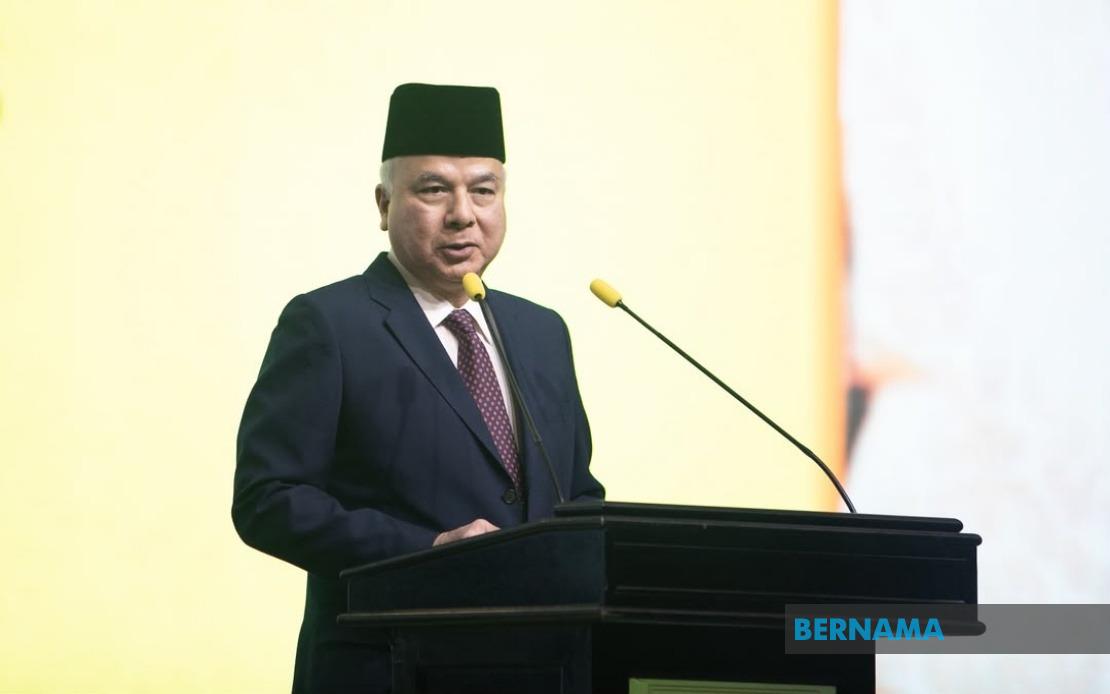
Abundant natural resources and talented populations are insufficient to guarantee a nation's success if the foundations of governance remain fragile. At the 8th World Conference on Islamic Thought and Civilisation in Ipoh, Sultan Nazrin Shah of Perak delivered this sobering assessment, arguing that institutional weakness, unaccountable leadership, and politics driven by personal gain rather than the public interest inevitably undermine even the most materially blessed societies. The conference, titled "Everyone Matters: Pride and Unity in Islam," provided the platform for the sultan to articulate a vision of governance that resonates far beyond Perak's borders, speaking directly to the governance challenges facing Malaysia and the broader Islamic world.
The sultan defined good governance not in abstract theoretical terms but through its practical manifestations. Strong institutions must possess the capacity to endure beyond any individual leader or administration—a principle that speaks to Malaysia's own experience with leadership transitions and the importance of institutional continuity. Transparency in the handling of public resources forms the bedrock of citizen confidence, ensuring that taxpayer contributions genuinely serve collective interests rather than narrow elite circles. This emphasis on fiscal accountability carries particular weight in a region where concerns about misallocation of public funds have periodically undermined trust in government. The rule of law must apply uniformly and impartially, protecting both the powerless and constraining the powerful without exception or favour.
Equally crucial is the cultivation of a political culture that treats disagreement as legitimate rather than treacherous. Sultan Nazrin's observation that the world's most stable democracies are often its most argumentative challenges a common misconception that stability requires political silence or consensus imposed from above. Instead, genuine stability emerges when disagreements flow through established institutional channels—parliaments, courts, regulatory bodies—rather than spilling into the streets or becoming resolved through coercion. This framework directly addresses Malaysian concerns about maintaining cohesion while accommodating diverse political viewpoints and interests. The peaceful transfer of power when voters mandate change represents the ultimate test of a political system's maturity and strength.
Instability, the sultan cautioned, does not arise from disagreement itself but from the breakdown of the shared rules and expectations that govern how disagreements are resolved. When citizens lose confidence in electoral fairness, judicial independence, or the integrity of public office, the entire social fabric deteriorates. The consequences of this erosion fall hardest on the most vulnerable—the poor, the marginalised, and those without voice or influence. This observation carries direct implications for Malaysian policymakers concerned with inclusive development and social cohesion. The trust deficit that emerges when institutions lose legitimacy creates cascading problems extending far beyond politics into economic activity, investment decisions, and social cooperation.
The sultan reframed budget allocation as a moral rather than merely technical document, one that reveals through its line-item choices which segments of the population a government prioritises. This perspective invites scrutiny of how Malaysian federal and state budgets distribute resources across regions, income groups, and ethnic communities. A civil service operating without regard to race, religion, or political affiliation represents state unity in its most tangible form—an ideal that Malaysia's constitutional framework aspires toward but which requires constant renewal through institutional practice and leadership example. Leaders who govern with humility, who listen before legislating, and who recognise their authority as temporary public trust rather than personal property secure the loyalty and national pride of their citizens more effectively than any rhetorical appeals.
Development cannot be pursued in isolation in an interconnected global economy. The sultan emphasised that no nation, regardless of its resource base or human capital, achieves sustained prosperity by withdrawing from international engagement. Trade, investment flows, knowledge exchange, and technological transfer constitute the currents upon which modern economic growth travels. This perspective proves particularly relevant for Malaysia, an economy fundamentally dependent on global markets and cross-border investment. Cooperation between nations, between public and private sectors, and between government and civil society has become the essential operating condition for achieving sustainable growth in the contemporary period.
Historical evidence consistently demonstrates that economies embracing open trade while simultaneously building resilient, diversified domestic industries outperform those retreating into protectionism or dependent on single-sector specialisation. This insight applies directly to Malaysian economic strategy and regional development discussions. However, the sultan cautioned that cooperation must not become a euphemism for dependency. Nations must maintain the capacity to determine their own developmental paths and strategic priorities. The wisdom lies in balance—welcoming foreign capital and expertise while systematically building domestic institutional and technical capacity. This distinction matters enormously in Southeast Asia, where debates about technology transfer, foreign ownership limits, and local content requirements reflect precisely this tension between openness and autonomy.
Islamically-compliant finance represents one of the most underutilised instruments for economic cooperation across the Muslim world, despite its theoretical potential. Malaysia has established itself over decades as the global centre for Islamic financial innovation, from sukuk issuance to takaful products to Syariah-compliant fund management infrastructure. Yet, the sultan argued, the true power of Islamic finance extends well beyond regulatory compliance with prohibitions on riba. The underlying philosophy emphasises risk-sharing, asset-backed finance, and equitable participation in economic returns—principles fundamentally distinct from conventional finance structures. These characteristics position Islamic finance as potentially transformative for development challenges across the Organisation of Islamic Cooperation member states.
If Muslim-majority nations seriously embrace the philosophical foundations of Islamic finance rather than treating it as merely a compliance exercise, it could mobilise capital for cross-border infrastructure investment, small and medium enterprise financing across the OIC, and patient capital deployment toward long-term development priorities. Clean water provision, renewable energy transition, and skills development require precisely the kind of patient, equity-based capital that Islamic finance philosophy encourages. Malaysia's position as the global Islamic finance hub creates both opportunity and responsibility to demonstrate how these instruments can catalyse meaningful development cooperation and shared prosperity across the Islamic world. The sultan's remarks thus position Islamic finance not merely as a financial instrument but as a vehicle for expressing the principle that "everyone matters" through economic structures that prioritise equitable participation and shared benefit rather than wealth concentration.

