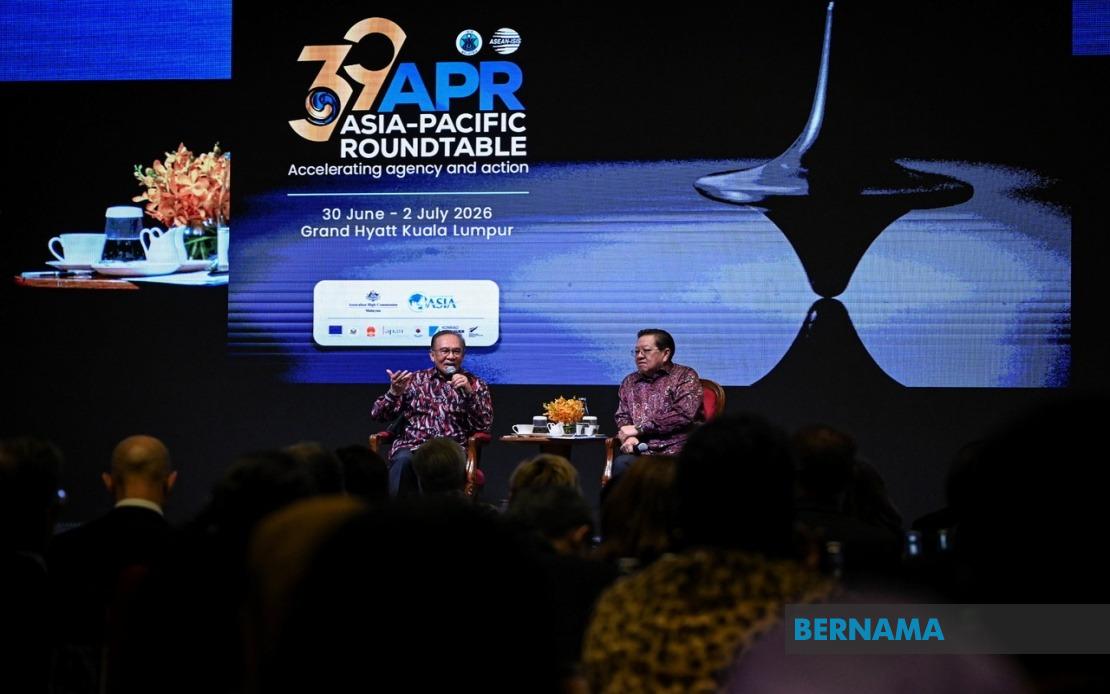
Prime Minister Datuk Seri Anwar Ibrahim has placed domestic governance reform at the centre of his administration's agenda, arguing that a nation must first put its own house in order before attempting to influence international affairs. Speaking at the 39th Asia-Pacific Roundtable in Kuala Lumpur on July 2, Anwar outlined a vision where Malaysia demonstrates its commitment to democratic principles and inclusive governance while simultaneously advancing as a Muslim-majority nation that respects pluralism and moderation.
The Prime Minister identified four pillars underpinning his government's domestic mandate: strengthening institutional governance structures, rooting out corruption across public and private sectors, narrowing the wealth gap that divides Malaysian society, and guaranteeing universal access to quality education and healthcare services. These priorities reflect a recognition that legitimacy and credibility on the world stage depend first on delivering tangible improvements in citizens' daily lives. Rather than pursuing high-profile international posturing, Anwar's framing suggests that Malaysia's influence will ultimately derive from successful implementation of reform at home.
Anwar acknowledged that Malaysia will continue to articulate principled stances on global issues aligned with its values and interests. However, he positioned such engagement as secondary to the immediate work of nation-building and institutional renewal. This approach carries particular significance for a multiracial, multireligious democracy navigating complex regional and international currents. By emphasising that democratic governance and inclusive practices must be demonstrated domestically first, the Prime Minister has signalled that Malaysia's moral authority internationally depends on how effectively it manages diversity and upholds constitutional protections at home.
Central to this vision is the presentation of Malaysia as a living counterexample to narratives portraying Islam and democracy as fundamentally incompatible. The Prime Minister stressed that his government intends to demonstrate that a Muslim-majority nation can simultaneously uphold democratic institutions, champion moderation, and embrace inclusivity. This framing addresses longstanding perceptions in Western discourse while also serving domestic audiences concerned about the country's trajectory and international standing. The emphasis on demonstrating these values through governance outcomes rather than rhetoric alone represents a shift toward results-oriented leadership.
Anwar's discussion of international relations introduced a conceptual framework challenging prevailing interpretations of global tensions. Rather than accepting the notion of a "clash of civilisations"—a construct popularised by political scientist Samuel Huntington—the Prime Minister argued that many conflicts stem fundamentally from misunderstanding and prejudice rather than inherent civilisational incompatibility. By invoking the late Palestinian-American scholar Edward Said's concept of a "clash of ignorance," Anwar suggested that people frequently form judgments about others without adequate understanding or engagement with their worldviews and experiences.
This intellectual positioning has practical implications for Malaysia's regional diplomacy and development partnerships. By reframing international conflict as rooted in ignorance rather than irreconcilable differences, the Prime Minister creates space for dialogue, mutual learning, and collaborative problem-solving. For a Southeast Asian nation navigating relationships with diverse powers and managing its own internal pluralism, this approach offers a constructive alternative to zero-sum thinking and identity-based polarisation that characterises much contemporary geopolitics.
The MADANI framework emerged as the operational expression of these principles, integrating technological modernisation with the preservation and advancement of human values. Rather than treating economic development and social cohesion as competing priorities, the framework positions them as complementary dimensions of progress. This reflects an understanding that sustainable development requires both material advancement and strengthening of social bonds, ethical norms, and intercommunal trust. For Malaysia and comparable regional economies, the MADANI approach offers a template for development that resists the false choice between modernity and tradition.
Anwar drew on Islamic theological concepts to reinforce his governance vision, specifically referencing the Quranic principle of "li ta'arafu"—often translated as "so that you may know one another." Rather than interpreting this merely as passive tolerance, the Prime Minister characterised it as an active commitment to genuine understanding and appreciation of differences. This theological grounding connects Malaysia's governance imperatives to deeper spiritual and philosophical traditions, suggesting that inclusive governance aligns with religious teachings rather than conflicting with them. The invocation resonates particularly within Muslim-majority societies where legitimacy and moral authority derive partly from alignment with Islamic principles.
For a multicommunal nation like Malaysia, where religious and ethnic diversity creates both tremendous potential and genuine governance challenges, this framework addresses a central question: how can a state simultaneously respect religious identity and maintain secular constitutional structures? Anwar's formulation suggests the answer lies not in treating these as antagonistic but in recognising that authentic religious faith encompasses respect for human dignity and the rights of those holding different beliefs. This positions governance reform not as secularisation but as fulfilling religious obligations toward justice, equity, and mutual respect.
The emphasis on ensuring every citizen accesses quality education and healthcare carries specific weight in Malaysia's context, where historical inequalities and regional disparities persist despite decades of development. These commitments address practical grievances affecting millions of Malaysians while simultaneously serving as benchmarks against which his administration can be measured. By articulating these goals publicly at an international forum, the Prime Minister has created accountability mechanisms and signalled seriousness of intent to both domestic constituencies and international observers.
Anwar's remarks at the roundtable also implicitly address criticism from those who contend that Malaysia should prioritise international activism and leadership on global issues. His counterargument—that meaningful global contributions flow from domestic success rather than preceding it—inverts conventional thinking among some political circles. This represents a pragmatic assessment that Malaysia's influence will ultimately depend on demonstrating that diverse communities can coexist peacefully and productively, that institutions function impartially, and that economic benefits are more equitably distributed. These are profoundly challenging objectives requiring sustained attention and reform across multiple government sectors and private institutions.
The Prime Minister's framing also positions Malaysia advantageously within evolving regional alignments and global conversations about development models, democratic governance, and multiculturalism. By articulating a coherent vision integrating religious respect, inclusive democracy, technological advancement, and social equity, Malaysia offers an alternative narrative to polarising ideological frameworks dominating international discourse. Whether this framework translates into sustained institutional change and measurable outcomes will ultimately determine both Malaysia's domestic trajectory and its international credibility in advancing these principles on the world stage.

