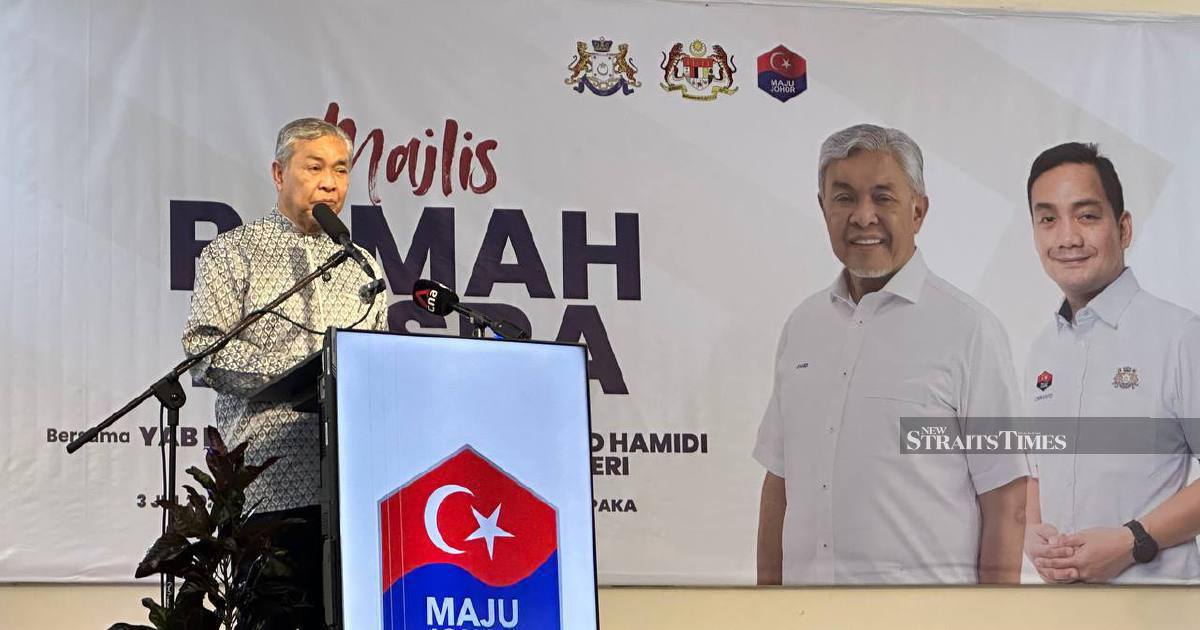
Barisan Nasional chairman Datuk Seri Dr Ahmad Zahid Hamidi has made an urgent appeal to his coalition partners within the unity government to refrain from resurrecting past disputes and criticisms directed at Umno and the broader Barisan Nasional alliance as campaigns intensify across Johor. The plea signals growing concern within the establishment coalition about internal fault lines that could weaken its electoral positioning in one of Malaysia's most politically significant states, where demographic shifts and changing voter preferences have made every campaign increasingly competitive.
Zahid's intervention reflects a broader strategic calculation within Barisan Nasional that sustained attacks from ostensibly allied parties could fracture the unity government's carefully constructed narrative of stability and coherent governance. The Johor campaign presents a critical test case for how effectively the coalition can manage internal differences while maintaining a united front against the opposition. For Malaysian voters accustomed to watching coalition dynamics closely, Zahid's remarks underscore the delicate balancing act required to keep multiple parties with distinct ideological positions and regional interests aligned behind common electoral objectives.
The history between Umno and its various coalition partners contains numerous contentious episodes spanning decades of Malaysian politics. These range from disagreements over resource distribution and ministerial portfolios to more fundamental disputes about governance philosophy and representation. When coalition members publicly resurrect these grievances during campaign periods, the messaging becomes muddled, allowing opposition parties to capitalize on apparent disunity. Zahid's call for restraint can be interpreted as an attempt to establish campaign ground rules that preserve coalition credibility with voters who increasingly demand evidence of effective partnership rather than internal bickering.
Johor holds particular significance in Malaysian electoral calculations. As the country's second-largest state by population and an economic powerhouse, Johor traditionally functions as a bellwether for national political trends. The state's political complexion influences coalition confidence going into federal parliamentary calculations and shapes perceptions about which political forces command genuine grassroots support. Recent electoral patterns in Johor have demonstrated that voter sentiment cannot be taken for granted, even in constituencies where particular parties have historically dominated. This volatility makes campaign discipline and message consistency more critical than ever.
The unity government itself, which consolidated several previously antagonistic political blocs into a single administrative framework, represents an ongoing experiment in Malaysian coalition-building. Success requires not merely electoral victories but sustained ability to manage competing interests across different parties with divergent constituencies and policy priorities. When partners begin publicly dredging up historical grievances, they risk sending signals to voters that the coalition remains fundamentally fractious rather than genuinely unified around shared vision. This perception can translate directly into lost electoral support among centrist voters seeking stability and predictable governance.
Zahid's directive also carries implications for how Barisan Nasional positions itself relative to its primary electoral competitors. Opposition coalitions frequently attempt to exploit coalition partner tensions by suggesting that apparent unity is merely superficial management of deeper conflicts. By encouraging partners to avoid historical recriminations, Zahid aims to deny opposition campaigns this line of attack and instead present a more coherent electoral proposition to voters increasingly fatigued by political instability and concerned about governance effectiveness.
The appeal to restrain campaign rhetoric suggests internal discussions may have already surfaced instances of coalition partners making statements that reference past disputes or criticisms. These interventions typically occur when campaign intensity rises and individual politicians seek to mobilize their own political bases through appeals to partisan grievance or historical memory. Managing these impulses requires continuous coordination and clear messaging guidelines that all coalition participants accept as binding during the critical campaign period. Zahid's public statement essentially serves as both warning and reminder about expectations for coalition behavior.
For Southeast Asian observers watching Malaysia's ongoing political consolidation, Zahid's statement illustrates persistent challenges facing multi-party coalitions attempting to govern complex, diverse societies. The tension between maintaining individual party identity and voter bases while simultaneously demonstrating coalition coherence remains perpetually difficult to navigate. Malaysia's experience becomes relevant for other regional democracies grappling with similar coalition dynamics and the constant pressure between particular interests and broader collective objectives.
The effectiveness of Zahid's appeal will become evident during the Johor campaign itself, where media monitoring and voter feedback will reveal whether coalition partners genuinely restrain historical criticisms or whether campaign pressures override coordination agreements. The outcome carries implications beyond this single state election, potentially signaling to opposition parties and to Malaysian voters more broadly whether the unity government possesses sufficient discipline and genuine cohesion to sustain itself through multiple electoral cycles or whether it remains fundamentally brittle coalition vulnerable to fragmentation under electoral pressure.
Looking forward, how successfully the unity government manages internal tensions during the Johor campaign will likely establish precedents for future elections. Voters increasingly evaluate coalitions not merely by individual party records but by demonstrated ability to work collaboratively toward shared goals. Zahid's call for restraint represents recognition that electoral success depends significantly on voters' perception that coalition partners genuinely support each other rather than merely tolerating one another out of political necessity.

