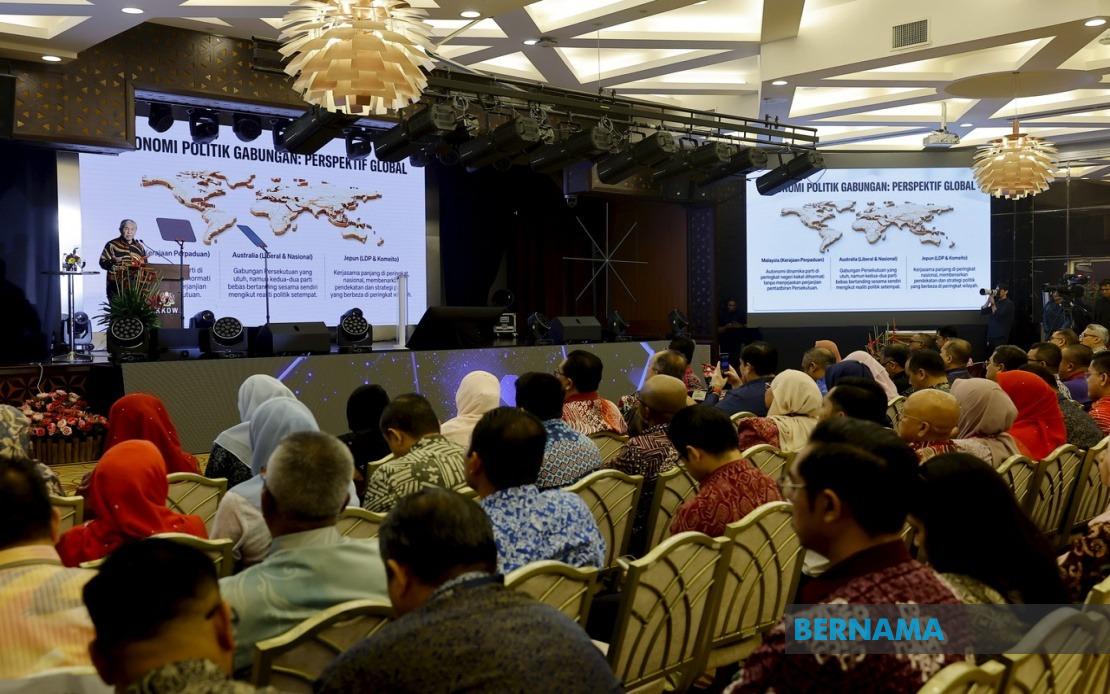
Deputy Prime Minister Datuk Seri Dr Ahmad Zahid Hamidi has moved to allay concerns about the cohesion of Malaysia's governing coalition, declaring that electoral contests and political manoeuvring at the state level will not undermine the stability or functioning of the federal administration. Speaking at a monthly assembly of the Rural and Regional Development Ministry in Putrajaya on Tuesday, Ahmad Zahid, who also chairs Barisan Nasional, stressed that the foundation of the Unity Government rests on a binding compact between coalition partners that will persist as long as Parliament remains in session.
The assurance comes amid heightened political activity following recent state elections, notably in Johor and Negeri Sembilan, where intra-coalition dynamics have drawn public attention. Ahmad Zahid's statement appears designed to project confidence that such electoral fluctuations and regional power struggles will not cascade upwards to destabilise the national government or derail the MADANI administration's agenda. His remarks underscore a central tension within Malaysia's present political arrangement: the need to balance coalition unity at the federal level with the autonomy of member parties to pursue their own interests in state politics.
A critical element of Ahmad Zahid's message addresses a question that has preoccupied political observers since the formation of the Unity Government: whether the coalition can withstand internal strains without fracturing. By explicitly stating that "as long as Parliament is not dissolved, the federal government will continue to function, the administration will carry on, and every responsibility entrusted to us by the people will be fulfilled as usual," the Deputy Prime Minister seeks to establish a clear threshold. The implication is that barring the dissolution of Parliament—a constitutionally significant event—the machinery of federal government remains insulated from state-level political turbulence.
Ahmad Zahid's framing introduces the concept of "political autonomy within a coalition government," a doctrine that permits each member party to chart its own course strategically while maintaining the formal bonds that hold the coalition together. This framework acknowledges that coalition partners need not surrender their individual political identities or core principles to sustain federal cooperation. In practical terms, this means that a party can contest elections aggressively at state level, seek to expand its footprint, or even challenge rival coalition members without breaching the understanding that underpins the federal arrangement. For Malaysian politics, this represents a pragmatic accommodation of competing interests.
The timing of these remarks is significant. State elections in Johor and Negeri Sembilan have been watched closely for signals about shifting political alignments within the broader coalition framework. These contests can serve as testing grounds for parties to measure their support, test messaging, and adjust strategies before potential general elections. Ahmad Zahid's intervention suggests that the leadership of the federal government wishes to establish clear boundaries: state-level competition is permissible and even expected, but it must not be permitted to metastasise into federal instability. This distinction is essential for a coalition government to function over an extended period.
The stability of Malaysia's federal administration rests considerably on the willingness of coalition partners to compartmentalise their political ambitions. The MADANI Government itself represents a relatively recent realignment, bringing together parties that have not always been aligned historically. Maintaining this arrangement requires constant management and clear communication about what is negotiable and what is not. Ahmad Zahid's emphasis on the enduring nature of the coalition agreement "until Parliament is dissolved" appears intended to signal that the partnership is sufficiently robust to absorb state-level political friction without fracturing.
For voters and observers across Malaysia, Ahmad Zahid's statement carries implications for political predictability and governance continuity. If the federal coalition can indeed function independently of state-level dynamics, then citizens can expect policy implementation and administrative functioning to proceed uninterrupted through election cycles and regional political shifts. This has tangible consequences: development projects, budget allocations, and government services should theoretically remain insulated from the ebb and flow of state politics. Conversely, if state elections prove to be harbingers of broader coalitional realignment, Ahmad Zahid's assurances may ring hollow in retrospect.
The concept of political autonomy within coalition governance remains somewhat experimental in the Malaysian context. Traditionally, Malaysia's major coalitions have demanded tighter discipline and more comprehensive alignment across all levels of government. The Unity Government's apparent willingness to tolerate greater variance in state-level behaviour represents either a sign of confidence in the coalition's durability or an acknowledgment of the difficulty of enforcing stricter unity. Ahmad Zahid's remarks suggest the former interpretation: that the coalition is sufficiently entrenched and united on federal matters to permit state-level diversity.
However, this equilibrium carries latent risks. State elections can and often do generate momentum and narrative that spill over into national politics. A party that gains significant ground in state contests may develop increased appetite for federal influence or senior positions. Conversely, parties that falter at state level may seek to consolidate and protect their federal standing. The friction between these centrifugal and centripetal forces could eventually test Ahmad Zahid's assurances about the impermeability of the boundary between state and federal politics. Political analysts will continue to monitor whether recent state election results produce secondary effects on the coalition's federal calculations.
Moving forward, Ahmad Zahid's statement effectively establishes a benchmark against which the Unity Government's durability can be measured. As long as the federal administration continues to function, policies are implemented, and Parliament remains intact, his prediction can be deemed accurate. Should state-level contests produce defections, ministerial reshuffles at the federal level, or visible strain within the coalition, observers will refer back to these assurances to assess whether the architecture of the federal government proved as resilient as claimed. For now, the Deputy Prime Minister has offered a framework for understanding how Malaysia's current coalition model attempts to reconcile the reality of competitive state politics with the requirements of federal stability.

