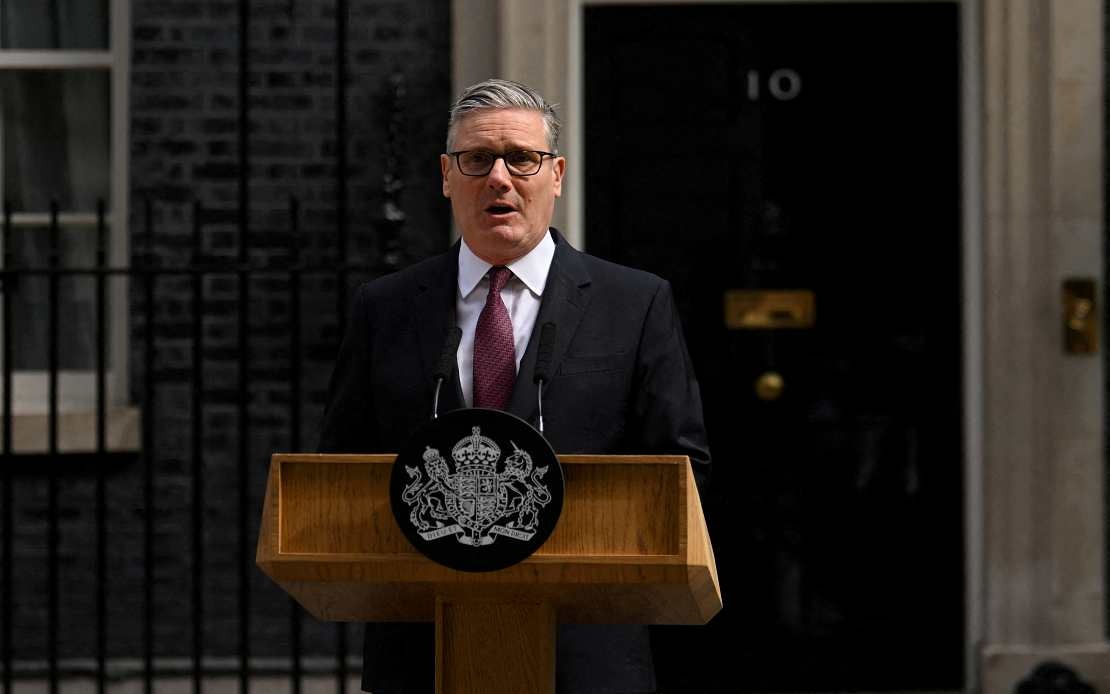
Keir Starmer marked the end of his time as British prime minister on Monday with a final address delivered from Downing Street, declaring his "work is done" before proceeding to Buckingham Palace to formally tender his resignation to King Charles. The outgoing premier indicated that Andy Burnham would inherit the leadership, bringing an unexpected conclusion to a political chapter that began just over two years ago with Labour's decisive general election victory in 2024.
Addressing assembled colleagues, friends, and his wife Victoria Starmer at Number 10, the departing prime minister took stock of his administration's accomplishments and the broader trajectory of the Labour Party under his stewardship. He characterised the nation as "stronger and fairer" than when his government assumed office, framing his departure as the logical conclusion of his mission rather than an abrupt or contested exit. The tone of his remarks suggested a carefully managed transition rather than a crisis-driven resignation, with Starmer presenting the handover as an orderly succession within the party leadership.
Starmer's political narrative over the preceding six and a half years represents one of Westminster's most dramatic reversals. In 2019, Labour had suffered a catastrophic defeat, losing its parliamentary majority and facing questions about its viability as a governing force. Starmer was tasked with an extensive reconstruction project—modernising party messaging, rebuilding institutional credibility, and repositioning Labour to appeal to centrist voters. These efforts culminated in the 2024 general election, which delivered Labour a landslide victory and returned the party to government after more than a decade in opposition.
The brevity of Starmer's premiership—just over two years—contrasts sharply with the extended period he devoted to opposition renewal. This compression of his time in office raises intriguing questions about the political calculations and circumstances that prompted his decision to step aside now rather than leading Labour through a full parliamentary term. For Malaysian observers accustomed to different political cycles and power transitions, the fluidity of British prime ministerial departures underscores the distinct mechanisms of Westminster democracy, where a loss of parliamentary confidence or party support can swiftly unseat a leader, even one elected with a substantial mandate.
Andy Burnham, positioned to succeed Starmer, brings his own profile to the role. As a senior Labour figure, Burnham's elevation represents the party's confidence in continuity combined with generational or stylistic renewal. The transition also signals how Labour intends to maintain momentum on its policy agenda while potentially recalibrating its approach to governance or party management. For regional commentators, the speed and apparent smoothness of this succession reflects the structural advantages of a unified party majority in a parliamentary system, where leadership transitions rarely trigger the constitutional paralysis or extended political uncertainty that might accompany similar shifts in presidential or coalition-based systems.
Starmer's reflection on governing during the preceding two years touched on economic management, public services, and the broader social fabric. His characterisation of Britain as "fairer" suggests particular emphasis on Labour's social justice platform, while "stronger" implies economic and institutional resilience. These framings, though conventional in farewell speeches, become relevant benchmarks against which his administration will be retrospectively judged. For Southeast Asian readers observing British politics from a distance, such assessments of governance quality offer comparative insights into how different democracies measure state performance and legitimacy.
The formal process of resignation involves Starmer presenting himself to King Charles at Buckingham Palace, a ceremonial obligation that underscores the constitutional role of the monarchy in British governance. Following this meeting, King Charles will accept the resignation and formally invite Burnham to form a government, initiating the technical processes of cabinet reshuffles, oath-taking, and the formal establishment of a new administration. This transition, while constitutionally significant, reflects the British system's capacity to manage such shifts without disrupting state functions or triggering wider institutional instability.
Labour's decision to engineer this transition at this particular juncture suggests careful party management and strategic timing. Rather than waiting for internal pressure to mount or electoral prospects to deteriorate, the party has chosen to effect a change when it retains substantial parliamentary numbers and public legitimacy from its recent landslide victory. This proactive approach contrasts with situations where governing parties are forced into leadership changes by deteriorating circumstances, thereby positioning Burnham's administration as inheriting a government still within the window of electoral goodwill.
For Malaysia and other Commonwealth nations, the British transition offers reflections on institutional stability and the mechanisms through which parliamentary democracies accommodate leadership change. The absence of prolonged political crisis, despite a sitting prime minister's departure, demonstrates how parties with strong institutional foundations and clear succession planning can manage such shifts with minimal disruption. Burnham's assumption of office will activate scrutiny of his policy priorities and governing style, particularly regarding economic management, social cohesion, and Britain's international relations—including its engagement with Commonwealth partners and regional allies across Asia-Pacific.
Starmer's emphasis on Labour's transformation from 2019 defeat to 2024 victory serves as his political epitaph, framing his leadership primarily through the lens of party rehabilitation. Whether his tenure as prime minister itself becomes viewed as a transitional phase or as a foundational period for renewed Labour governance will depend substantially on the trajectory of Burnham's administration and the party's performance over the coming parliamentary session. The handover thus represents not a conclusion but a pivot, with Labour repositioning itself under new leadership while attempting to maintain the momentum generated by its recent electoral success.

