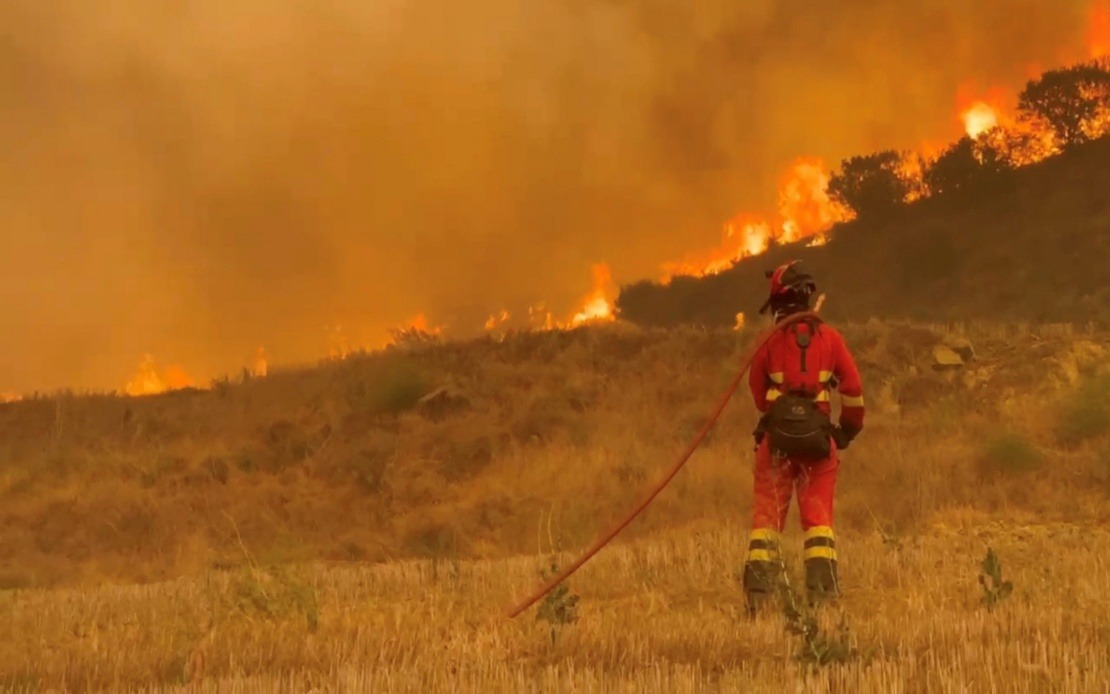
Spain is grappling with an intensifying wildfire crisis as its largest blaze of 2024 continues to ravage the northeastern province of Zaragoza, consuming approximately 12,000 hectares of land since igniting on Wednesday. The rapidly expanding conflagration in the Cinco Villas region has necessitated the urgent evacuation of more than 1,100 people from five municipalities in Zaragoza and an additional community in the neighbouring region of Navarre, with fire officials reporting that conditions remain dangerously volatile and unpredictable as the blaze spreads across a perimeter stretching roughly 60 kilometres.
The intensity of this particular fire underscores a pattern of escalating wildfire activity across Spain during the 2024 season. By Friday, authorities had deployed substantial firefighting resources including approximately 400 ground personnel and 19 aircraft to combat the advancing flames, with tactical priorities shifting throughout the overnight period to focus on shielding residential areas in Uncastillo from encroachment. Road closures across the affected region have severely hampered access and emergency response operations, though power distribution systems have been successfully restored to all communities impacted by the fire's proximity.
The geographical scope of Spain's current wildfire emergency extends well beyond the Zaragoza catastrophe. In the northern province of Guadalajara, the La Mierla fire has engulfed approximately 900 hectares and forced protective lockdown procedures for nearby communities, prompting regional government officials to formally request intervention from Spain's Military Emergency Unit, which deployed roughly 100 additional personnel to reinforce ongoing suppression efforts. Simultaneously, a third significant fire near Lozoyuela in the northern periphery of Madrid continues to burn with an uncertain trajectory, though emergency assessments suggest marginally more favourable conditions compared to the other active fires.
The sheer scale of resource mobilization required reflects the unprecedented strain on Spain's emergency response infrastructure. Fire containment strategies have evolved to prioritise life safety and critical infrastructure protection rather than attempting wholesale suppression across all affected areas simultaneously. The deployment of military-grade emergency units—typically reserved for catastrophic scenarios—illustrates the severity authorities perceive in the current situation and their acknowledgment that conventional firefighting capacity has reached practical limitations.
Investigators have already made headway in determining culpability for at least one of the fires. Civil Guard officers arrested a male suspect implicated in igniting the Madrid-region blaze, establishing potential criminal responsibility early in the investigation phase. This development carries significant implications for legal precedent and public discourse surrounding intentional fire-setting, as the regional government has formally registered itself as a civil party to the legal proceedings, signalling official commitment to holding perpetrators accountable and potentially securing damages compensation.
The environmental conditions fuelling these fires present a complex interaction of short-term meteorological patterns and long-term climatic shifts. The current fire season has been exacerbated by an unusual combination of strong winds, persistently low humidity levels, and elevated temperatures that have stressed vegetation across broad regions. Paradoxically, an abundant accumulation of dry plant matter resulted from substantial rainfall during the preceding spring months—a scenario that created perfect conditions for rapid fire propagation once drought conditions returned.
Climate change emerges as a fundamental underlying factor amplifying wildfire risk across Spain and the broader Mediterranean basin. Rising average temperatures extend the fire season, increase the likelihood of extreme weather events, and fundamentally alter vegetation moisture dynamics. Scientific research increasingly demonstrates that Mediterranean regions are becoming progressively more susceptible to catastrophic fire scenarios as climate patterns shift, a reality that demands long-term policy adjustments alongside immediate emergency response capabilities.
Beyond climate dynamics, the abandonment and depopulation of rural areas represents an often-overlooked structural vulnerability compounding Spain's wildfire challenges. As rural communities deplete due to demographic migration toward urban centres, traditional land management practices—including controlled burning and vegetation thinning—have effectively ceased in many regions. This landscape abandonment has permitted dense accumulation of combustible biomass, transforming previously managed rural territories into tinderbox environments awaiting ignition. The phenomenon illustrates how demographic and economic transformations can inadvertently intensify natural disaster risks.
For Malaysian and Southeast Asian observers, Spain's unfolding wildfire emergency offers sobering lessons regarding climate adaptation and disaster preparedness. While Southeast Asia faces distinct environmental challenges centred on monsoon patterns and tropical forest dynamics, the underlying principles remain relevant: warming temperatures and shifting precipitation patterns will increasingly stress natural systems and amplify disaster frequency. Spain's mobilization of military resources and civil coordination mechanisms demonstrates the institutional responses required when conventional infrastructure proves insufficient.
The economic and social ramifications of Spain's wildfire season will likely extend far beyond immediate property damage. Agricultural losses, ecosystem degradation, air quality deterioration across adjacent regions, and psychological trauma for displaced populations constitute cascading impacts that governments must anticipate. The evacuation of 1,100 people from established communities represents profound social disruption, with many residents potentially unable to return home for extended periods pending fire containment and safety assessments.
As Spain's firefighting operations continue through what meteorologists predict will remain a volatile period, the incident reinforces uncomfortable truths about climate vulnerability in traditionally temperate regions. The combination of drought, heat stress, vegetation abundance, and topographical factors has created conditions where even heavily resourced modern firefighting systems struggle to contain advancing flames. This reality suggests that Spain, along with other Mediterranean nations and fire-prone regions globally, must fundamentally restructure landscape management philosophies and climate adaptation strategies to address the new normal of intensified wildfire activity.

