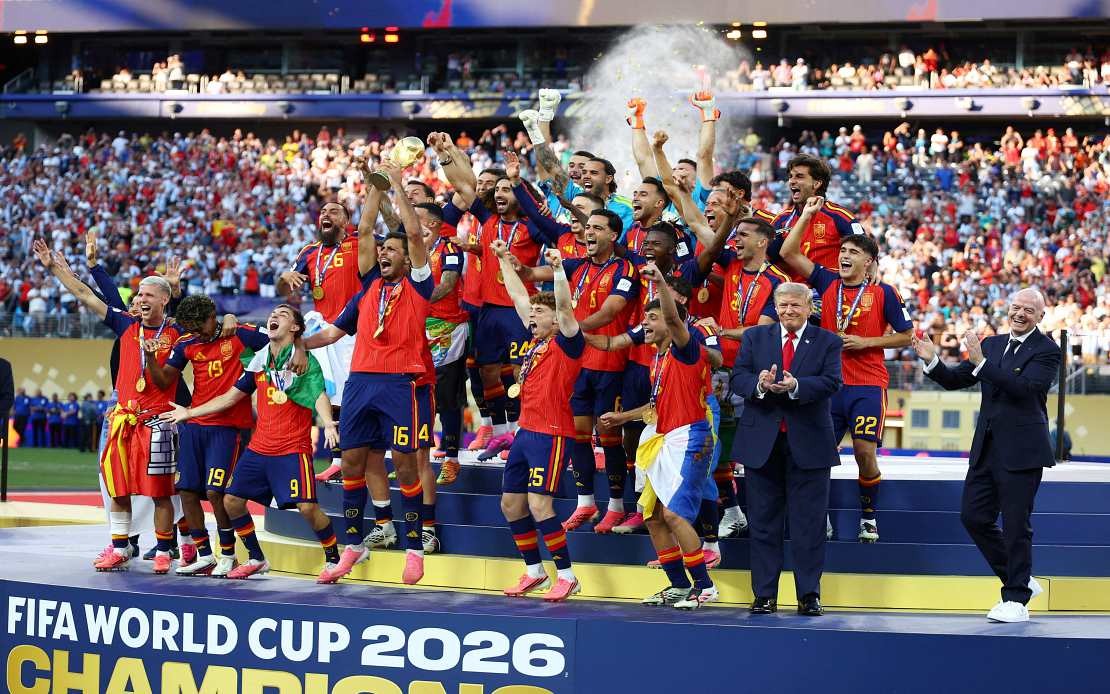
Spain's football team will arrive home in Madrid on Monday afternoon to begin a day of celebrations following their triumphant victory in the FIFA World Cup. The squad, captained by midfielder Rodri, is scheduled to land at Madrid airport at 12:50 pm local time, marking the start of what promises to be an extraordinary display of national jubilation across the Spanish capital. Organisers are preparing for unprecedented crowds as supporters anticipate their heroes' return after the nation's second men's World Cup triumph.
The homecoming itinerary reflects the magnitude of Spain's achievement on the international stage. King Felipe VI will host an official reception at the Royal Palace during the afternoon hours, providing a formal acknowledgement of the team's accomplishment at the highest level of Spanish governance. Following this state occasion, the players will embark on an open-top bus journey through Madrid's streets, where officials expect hundreds of thousands of enthusiastic fans will line the routes to catch glimpses of their sporting heroes and celebrate the nation's success.
The day's festivities will culminate in a major public gathering at Cibales Square, where authorities have scheduled the final celebration event to commence at 6 pm, with the team expected to arrive around 9 pm. This protracted schedule underscores Spain's determination to ensure all citizens have opportunities to participate in recognising the squad's historic achievement. The extended celebration reflects how deeply football resonates within Spanish society and the broader significance of international sporting success for national pride and unity.
Defender Marc Cucurella articulated the team's enthusiasm for the homecoming experience, emphasising the desire to share the victory with the entire nation. "We are really looking forward to returning to Spain. Many people couldn't be here and we want to celebrate with everyone. I think we deserve a good celebration," Cucurella stated. His comments highlight the players' recognition that the World Cup triumph transcends the squad itself, representing a collective achievement in which the broader Spanish population has invested emotional energy and national identity.
The World Cup victory itself came through a dramatic extra-time performance against Argentina in the United States. Forward Ferran Torres scored the decisive goal that secured Spain's second men's World Cup title, adding to the nation's earlier championship in 2010. The achievement demonstrates Spain's enduring competitiveness in international football despite years without a major tournament victory, revitalising the national team's reputation after a period of relative underperformance in recent competitions.
Spain's political leadership was present throughout the tournament campaign, with Prime Minister Pedro Sánchez attending the championship match at the New Jersey stadium. Following the victory, Sánchez posted on social media platform X, stating: "We Are World Champions. Our national team is tremendous. Thanks, Team." This direct engagement from the prime minister demonstrates how sporting success becomes intertwined with political messaging and national governance in contemporary Europe, with government figures seeking to associate themselves with popular achievements.
The Royal Palace reception underscores the ceremonial importance Spain places on the World Cup victory, treating the squad's return as a state occasion worthy of royal participation. King Felipe VI's involvement signals that the achievement transcends sport, representing instead a moment of significant national importance warranting formal recognition from the country's constitutional leadership. Such high-level state involvement in football celebrations has become standard practice in European nations where the sport holds profound cultural significance.
For Malaysian and Southeast Asian observers, Spain's celebration model offers insights into how major football nations mobilise national infrastructure and leadership structures to recognise sporting achievement. The coordination between royal institutions, government, local authorities, and security services to facilitate massive public gatherings reflects the institutional capacity of developed European nations. Malaysia's own football successes, while less frequent at the international level, have similarly generated national celebrations, though typically on a smaller scale reflecting different population densities and organisational frameworks.
The timing of Spain's homecoming also reflects the sport's centralised role in European societies compared to other regions. The willingness of government ministers and royal families to participate in football celebrations demonstrates how thoroughly the sport has embedded itself within national institutions and political culture. This contrasts with some Southeast Asian contexts where political engagement with football remains more peripheral, though growing television viewership and social media engagement suggest shifting attitudes towards the sport's cultural prominence.
The scale of expected attendance at Madrid's celebrations—potentially hundreds of thousands—illustrates football's unparalleled capacity to mobilise public participation across social and demographic boundaries. Such events create rare moments of genuine national unity, transcending regional, ideological, and class divisions through shared investment in sporting success. The Spanish government and municipal authorities have invested considerable resources in facilitating this expression of collective national pride, demonstrating the political value assigned to major sporting victories in contemporary European democracies.
The broader implications of Spain's World Cup success and its celebratory aftermath extend beyond immediate national satisfaction. International sporting achievements enhance a nation's global prestige, contribute to soft power narratives, and generate positive media coverage that influences international perceptions. For a European nation like Spain, maintaining competitive success in football helps sustain the country's image as a modern, dynamic society capable of excellence in globally recognised domains. Such competitions and their associated celebrations have become essential components of national image-making in the contemporary international system.
As Spain prepares for its homecoming festivities, the event serves as a reminder of football's unique capacity to generate genuine moments of collective celebration in increasingly fragmented societies. The convergence of royal participation, political engagement, media coverage, and grassroots enthusiasm creates a national experience that few other phenomena can replicate. For supporters gathering in Madrid throughout Monday, the celebrations represent not merely the recognition of sporting achievement, but participation in a profound expression of Spanish national identity and cultural pride.

