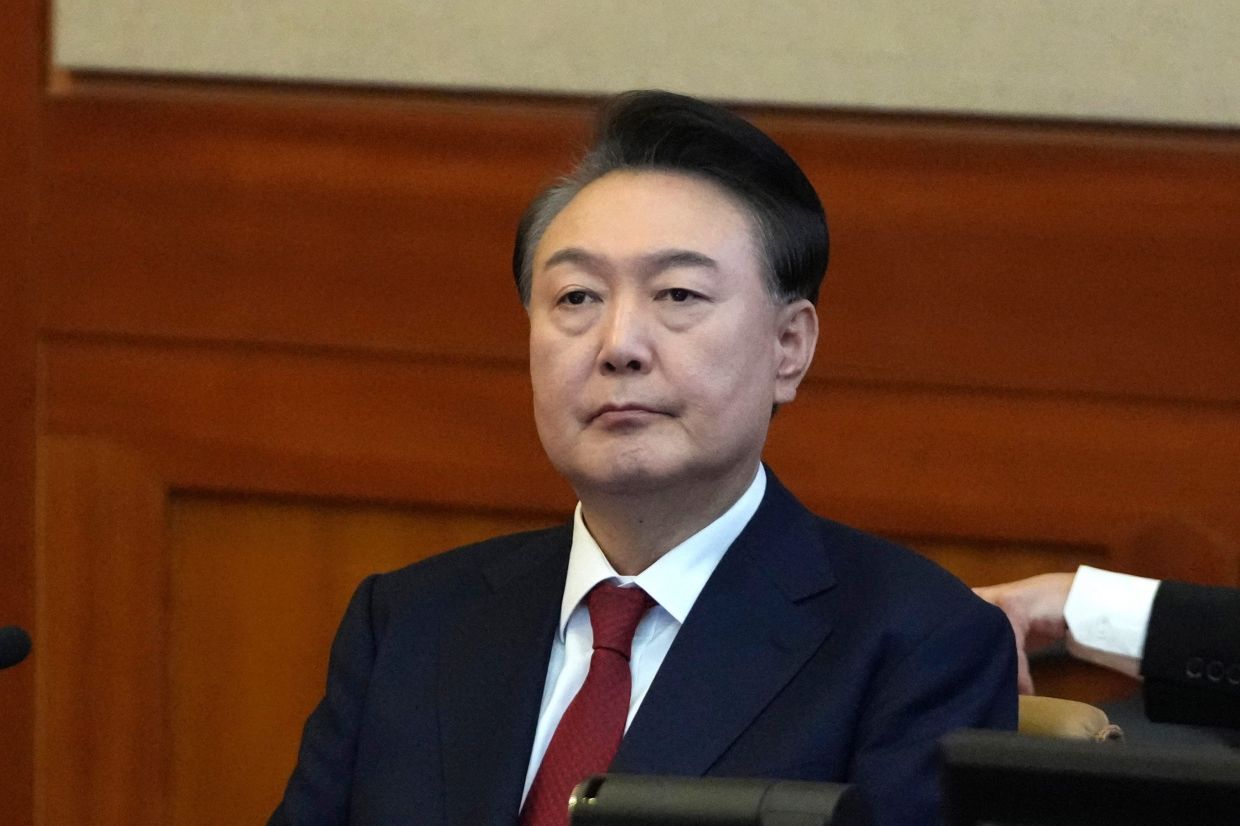
South Korea's top judicial authority has delivered a definitive ruling in one of the nation's most consequential political cases, confirming a seven-year prison term against former president Yoon Suk Yeol for his role in orchestrating a failed martial law declaration. The Supreme Court's decision on Thursday represents the culmination of legal proceedings that have gripped the country since his shocking late-night address in December 2024, when he attempted to suspend civilian rule through emergency decree. The conviction encompasses multiple charges stemming from the chaotic events surrounding the declaration and Yoon's efforts to evade immediate arrest as lawmakers scrambled to overturn his unprecedented move.
Yoon's original conviction in January 2025 at the district court level had resulted in a five-year sentence based on most of the charges brought against him. When the case proceeded to the appellate division in April, judges not only upheld the conviction but elevated the sentence to seven years and added a guilty verdict on the charge of disseminating misleading information to international media. This progression illustrated how courts became progressively convinced of the severity of Yoon's actions as evidence accumulated through successive judicial reviews. The path from a lower sentence to the Supreme Court's validation of the harsher term demonstrates the systematic nature of the legal process, even as it advanced a clear trajectory toward substantial punishment.
The specific charges underlying the seven-year sentence reveal the multifaceted nature of Yoon's alleged misconduct during the martial law crisis. Prosecutors contended that Yoon deliberately obstructed cabinet deliberations by assembling only a carefully selected group of ministers for the critical meeting before declaring martial law, thereby circumventing proper governmental procedures. The indictment further alleged that he orchestrated the creation and destruction of a fraudulent martial law document bearing forged signatures purportedly from the prime minister, a charge that underscored the premeditated quality of his actions. Additional accusations included ordering government officials to craft and transmit a deceptive press statement directed specifically at foreign media outlets, as well as instructing an army commander to delete data stored on secure military communication devices. Each element pointed to a pattern of deliberate falsification and obstruction rather than impulsive action.
Yoon's legal representatives immediately signaled their intention to challenge the Supreme Court's judgment through constitutional avenues, claiming that the court had rendered its decision without engaging in adequate deliberation. The defence team's assertion of "deep regret" and their explicit plan to file complaints highlight the political dimension of the case, as Yoon's supporters continue to contest not merely the sentence but the legitimacy of the entire judicial process. However, the Supreme Court's pronouncement that lower court judgments "contained no errors" effectively closes the primary appellate pathway, making any subsequent challenges considerably more difficult to pursue. This finality carries profound implications for the trajectory of Yoon's imprisonment and the broader political consequences for his supporters and allies.
The December 2024 martial law declaration itself lasted merely six hours before the National Assembly voted to nullify it in an emergency session, yet the cascading effects of Yoon's action reshaped South Korea's political landscape. The announcement triggered widespread public demonstrations, sent stock market indices into steep decline, and caught international partners including the United States by surprise. The swiftness with which lawmakers moved to dismantle the martial law order reflected both constitutional safeguards and deep institutional resistance to Yoon's extraordinary power grab. For Malaysian observers and Southeast Asian analysts, the episode underscores how established democratic institutions, even under severe stress, can function to prevent authoritarian consolidation of power.
Beyond the martial law conviction, Yoon faces additional substantial legal jeopardy. A separate court proceeding resulted in a thirty-year prison sentence following allegations that he dispatched unmanned drones across the border into North Korea to fabricate a crisis scenario intended to provide justification and political cover for his martial law declaration. This conviction on a separate charge compounds his legal predicament and suggests that courts have identified not merely a single impulsive act but rather a coordinated scheme encompassing multiple illegal actions designed to manufacture circumstances supporting his extraordinary powers grab. The accumulation of sentences across different cases means Yoon's total incarceration period will substantially exceed any individual judgment.
Throughout the legal proceedings, Yoon maintained that his martial law declaration was undertaken "solely for the sake of the nation" and subsequently defended it as necessary to eliminate what he characterized as "anti-state forces" and counter purported threats emanating from North Korea. These justifications, repeatedly articulated by Yoon and his legal team, have found little resonance with the courts, which appear unconvinced that national security concerns justified the suspension of constitutional governance. The dismissal of these rationales by judicial authorities suggests that South Korean courts have concluded that no extraordinary circumstances warranted circumventing established legal procedures, regardless of the asserted motivations. This judicial skepticism toward executive claims of national emergency has significance for constitutional governance throughout the region.
The political landscape shifted dramatically in the aftermath of Yoon's martial law attempt, triggering his removal from office in April 2025 and precipitating presidential elections. The electorate subsequently chose Lee Jae Myung of the centre-left Democratic Party, effectively repudiating the political direction Yoon had charted. The transition represented a decisive popular judgment on Yoon's governance and the martial law episode, occurring before his conviction was finalized. This sequence of events meant that Korean voters rendered their verdict through electoral mechanisms even as the judicial system proceeded independently through its deliberative processes. The concurrent operation of political accountability and legal judgment created a comprehensive national reckoning with the martial law crisis.
For Malaysia and the broader Southeast Asian region, the South Korean case offers instructive lessons regarding constitutional boundaries and the judiciary's role in constraining executive power. The Supreme Court's unwavering affirmation of the conviction demonstrates institutional resilience in defending constitutional frameworks against extraordinary executive assertions. Unlike some jurisdictions where courts might defer to executive claims of national emergency, South Korean judges insisted on adhering to established procedures and constitutional norms. The region's observers particularly from countries grappling with questions of institutional strength and constitutional interpretation may find the Korean precedent relevant as they contemplate their own mechanisms for limiting unchecked executive authority. The case illustrates how judicial independence, when robustly exercised, can provide meaningful constraints on even the highest governmental offices.
Yoon's imprisonment trajectory remains fluid despite the Supreme Court's final affirmation, as his legal team pursues constitutional complaints and challenge mechanisms that exist outside the ordinary appellate structure. The distinction between the finality of the Supreme Court's decision regarding the merits of the case and the potential for extraordinary constitutional remedies creates residual legal pathways, though these are substantially narrower and more difficult to navigate than conventional appeals. As Yoon serves his sentences, the broader question of how South Korean society processes this unprecedented political crisis through its legal system will continue to unfold. The Supreme Court's resolute confirmation of accountability represents a critical moment in asserting that even former presidents remain subject to law, a principle that resonates across democratic systems confronting challenges to constitutional governance.

