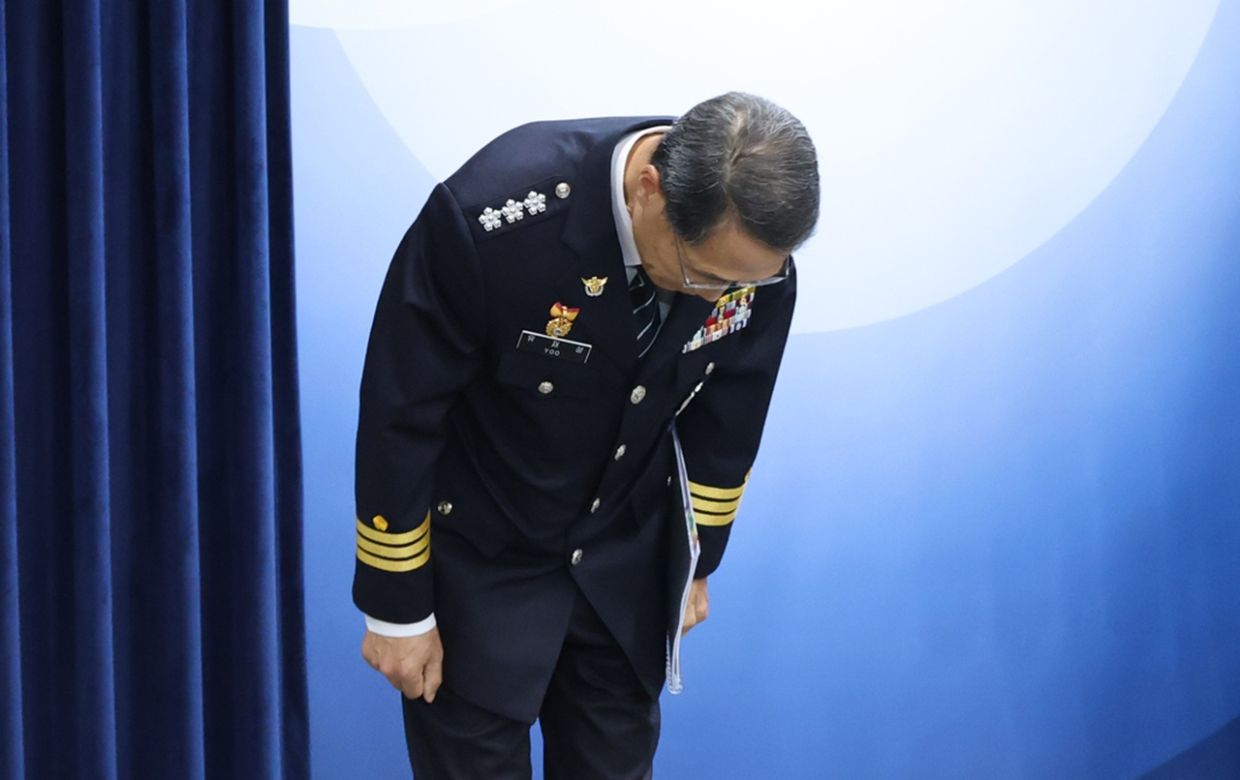
South Korea's police force faces a critical reckoning as Acting National Police Agency Commissioner General Yoo Jae-sung outlined an ambitious reform agenda intended to address systemic failures exposed by a high-profile murder investigation. Speaking at Seoul's Government Complex on Monday, Yoo acknowledged that allegations of investigative misconduct and inappropriate ties between officers have severely damaged public confidence in law enforcement, but signalled that the agency views the crisis as a catalyst for fundamental change rather than a temporary setback to be weathered.
At the centre of the controversy lies the case of Jang Yoon-gi, arrested for allegedly killing a teenage girl in the southern city of Gwangju in May. The investigation spiralled into scandal after revelations that police officers allegedly shared sensitive case details with Jang's father, himself a serving police officer, while simultaneously failing to preserve critical evidence. This combination of lapses—leaking information to a suspect's relative while bungling basic investigative protocols—struck at the credibility of South Korea's law enforcement apparatus and prompted demands from the public and political figures for senior officials to step down.
The centrepiece of Yoo's reform strategy is the establishment of an investigative reform task force by the end of July, which will comprise seven to ten members with external specialists accounting for the majority. This composition reflects an acknowledgment that internal-only review lacks the independence and fresh perspective necessary to address deeply embedded institutional problems. The task force will examine personnel practices designed to sever inappropriate relationships between officers and local communities, an issue that the Jang case has thrown into sharp relief, suggesting that nepotistic or community-based networks may have compromised professional objectivity.
Beyond procedural improvements, the reforms address how police handle cases involving vulnerable populations, a particularly sensitive area given South Korea's ongoing conversations about the protection of minors and marginalised groups. By incorporating external expertise into this discussion, the police agency implicitly acknowledges that officers working within the current system lack sufficient understanding of best practices for these sensitive investigations, requiring outside guidance to establish adequate safeguards.
The National Office of Investigation will soon activate an internal affairs unit with extraordinary scope—investigating serious crimes committed by police personnel of any rank without regard to seniority. This represents a significant departure from past practices where senior officers often enjoyed informal protection or lighter scrutiny. By explicitly removing rank-based exemptions, the agency signals that institutional accountability must apply uniformly, though implementation will test whether such units can function independently when investigating their colleagues' superiors.
The proposed creation of a civilian oversight body under the Korean National Police Commission would establish approximately 100 civilian investigators with authority to examine human rights violations and investigative misconduct. This expansion of civilian oversight requires amendment to the Police Act—a revision already submitted to the National Assembly—indicating that the government recognises the need for legislative backing to ensure the body's independence and legitimacy. For regional observers, particularly those in Southeast Asia monitoring best practices in police accountability, this represents a notable institutional evolution.
Yoo emphasised that such a civilian body would prove effective only if its findings could translate into actual personnel decisions and disciplinary measures, a structural requirement often overlooked in accountability frameworks that lack enforcement teeth. This attention to operability rather than symbolic oversight alone demonstrates a measured understanding that reform proposals must be conceived with implementation realities in mind.
The reforms also address the police rotation system, an Interior Ministry initiative intended to reduce entrenched relationships and corruption through officer mobility. However, Yoo signalled sensitivity to practical concerns raised by rank-and-file officers, noting that expanding mandatory rotations across all ranks would create significant hardship, particularly regarding the provision of official residences. Currently, housing is provided only to superintendent-level and senior officers during transfers; extending this benefit to lower ranks would substantially increase costs while raising questions of fairness and resource allocation.
This negotiated approach to reform—balancing institutional change against officer welfare—reflects a pragmatic recognition that reforms imposed without buy-in from the workforce they affect often face hidden resistance or implementation gaps. By committing to gather rank-and-file opinion and pilot practical measures before broader implementation, the agency attempts to build legitimacy both within and outside its ranks.
Yoo's personal commitment to remain in his position without clinging to office carries symbolic weight in South Korean governance, where scandals often trigger demands for leadership sacrifices. His framing of the task as a duty rather than a burden attempts to reposition reform as a matter of institutional integrity rather than damage control, though public scepticism may persist given the scale of the failures the reforms aim to address.
Regarding Jang's father, the internal inspection will proceed in parallel with a special investigation team's work, with final determinations on follow-up measures postponed until that investigation concludes. This sequencing acknowledges that individual accountability decisions should be informed by the broadest possible factual basis before finality.
For Malaysia and Southeast Asia more broadly, South Korea's police reform initiative offers instructive lessons in institutional accountability. The emphasis on civilian oversight, transparency in investigative procedures, and systematic checks on informal power networks reflects evolved thinking about how law enforcement agencies can maintain legitimacy in societies with high expectations for professional conduct. Whether these South Korean reforms achieve their ambitious goals will significantly influence discussions about police reform across the region.

