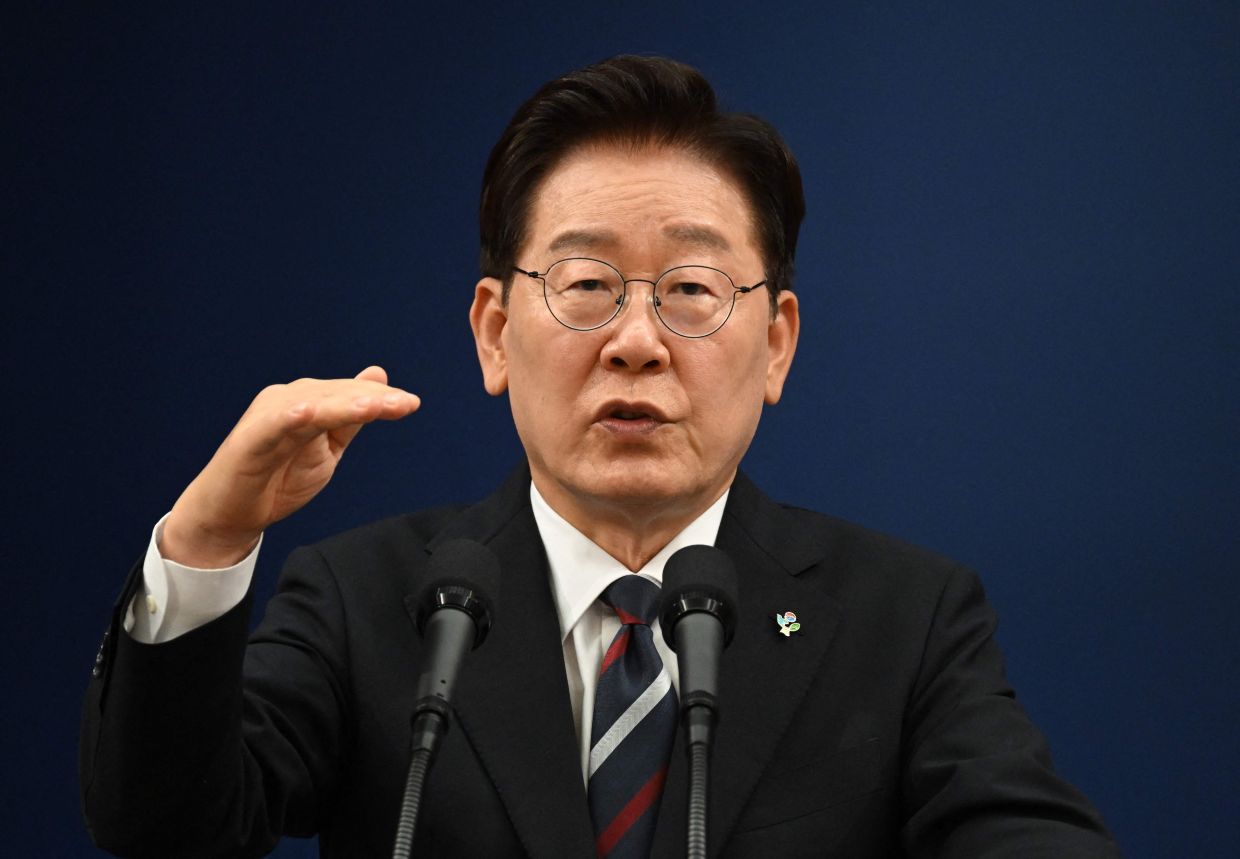
South Korean President Lee Jae Myung faces a significant political turning point as his approval rating has declined for the fifth consecutive week, entering negative territory for the first time since his administration began. A nationwide survey conducted by Realmeter between June 15 and 19 revealed that 46.7 per cent of South Koreans approved of his leadership, down sharply from the previous week, while disapproval climbed to 49.7 per cent. This crossover moment, which occurred only weeks into Lee's term that commenced on June 4, 2025, marks a steeper decline than comparable periods under his recent predecessors and signals growing public discontent with the new administration.
The downward momentum has been unmistakable since May. Lee's approval rating has contracted substantially from its May peak of 60.5 per cent to the current nadir, representing a loss of more than thirteen percentage points in barely six weeks. The erosion has been consistent week after week, with readings of 59.3 per cent, 59.1 per cent, 55.2 per cent, and 51.5 per cent tracking the steady haemorrhaging of public confidence. The June 22 survey marked the watershed moment when his rating dipped beneath the psychologically significant 50 per cent threshold, a symbolic barrier that matters considerably in Korean political discourse. Though the 3.1 percentage point margin between approval and disapproval falls within the survey's margin of error of plus or minus 2 percentage points, the direction of travel is undeniable and troubling for the presidential office.
Two immediate crises have precipitated this collapse in presidential support. The bungled execution of South Korea's June 3 local elections, which suffered from significant ballot shortages and administrative failures, has triggered widespread demands for accountability and transparency. Simultaneously, the ruling Democratic Party of Korea is convulsed by internal leadership struggles as factions jockey for position ahead of the August 17 convention to elect a new party chair. These dual catastrophes have created a perfect storm of political dysfunction, with the electorate viewing the government as simultaneously incompetent and fractious. Analysts note that the combination reflects broader anxieties about institutional stability and governance competence during a period when Koreans anticipated a fresh political beginning.
Geographic variation in the erosion reveals important fault lines in Lee's coalition. The conservative strongholds of Daegu and North Gyeongsang Province registered the steepest declines, with approval plummeting 9.9 percentage points to just 34.6 per cent. This collapse in traditionally friendly territory is particularly alarming for Lee, as it suggests core conservative voters are deserting the administration over specific grievances. The Greater Seoul region, comprising Incheon and Gyeonggi Province alongside the capital itself, experienced substantial slippage as well. In Incheon and Gyeonggi Province, approval dropped 7.6 percentage points to 44.8 per cent, while Seoul itself fell to 39.8 per cent. These major urban centres represent crucial battlegrounds in Korean elections, and their movement away from the president signals vulnerability in densely populated vote-rich areas.
Demographic analysis demonstrates that Lee is haemorrhaging support across ideological and generational lines, though patterns vary significantly. Moderate voters, a critical swing constituency, saw positive assessments decline 4.9 percentage points to 47.5 per cent, indicating that centrist South Koreans are becoming skeptical of the administration. Liberal voters remain substantially more supportive at 80.4 per cent, though even this base saw a 3.2 percentage point decline. Conservative voters, presumably Lee's natural constituency, registered approval of only 19.8 per cent after dropping 0.7 percentage points. This suggests that Lee has lost coherence as a unifying conservative figure and is instead viewed as a divisive force even among those who should constitute his strongest supporters.
The presidential office responded to the unfavourable polling by adopting a posture of humility and receptiveness. Cheong Wa Dae issued a statement acknowledging the latest survey results and pledging heightened attentiveness to public concerns and expectations. Officials framed the approval rating fluctuations as reflections of citizen assessments regarding both economic performance and broader state administration. This diplomatic response attempted to acknowledge public sentiment without making substantive policy concessions or explanations, a calculated approach designed to appear responsive whilst maintaining flexibility. Whether such rhetorical gestures can arrest the downward spiral remains uncertain, particularly given that multiple underlying problems persist unresolved.
Context matters considerably for understanding the severity of Lee's predicament. Former President Yoon Suk Yeol experienced a similar disapproval surge, but it arrived only six weeks into his tenure. Former President Park Geun-hye saw disapproval exceed approval roughly sixteen months into her presidency in June 2014, whilst Moon Jae-in reached that threshold approximately nineteen months into his term in December 2018. Lee's timeline accelerates this deterioration markedly, suggesting either particularly acute governing failures or an electorate more volatile and less inclined toward patience with new administrations. The comparison underscores that Lee's position, though serious, follows established patterns in recent South Korean politics where public confidence in presidents frequently fractures under pressure.
Analysts identify secondary factors that have contributed to the decline despite some countervailing positive developments. Lee's successful European trip generated favourable international attention and reinforced his diplomatic engagement profile. Simultaneously, the Kospi stock index achieved a breakthrough above the 9,000-point mark, signalling market confidence in economic prospects. Yet these positive elements proved insufficient to counterbalance the corrosive effects of electoral mismanagement and party dysfunction. More troublingly, expanding disparities in the asset market have eroded support specifically among moderate voters and residents of the Greater Seoul area. This suggests that economic inequality concerns and perceptions of unequal opportunity have penetrated mainstream discourse, undercutting the administration's economic narrative among precisely the demographic groups most likely to determine electoral outcomes.
Party-level polling reveals additional complexity in the political landscape. A separate Realmeter survey of 1,001 voters conducted June 18 and 19 found that the conservative People Power Party maintained a narrow 42.3 per cent support level, ahead of the opposition Democratic Party at 40.1 per cent, though the gap had contracted from the previous week. The People Power Party faces mounting pressure as it navigates controversies surrounding the electoral failures and debates over whether to conduct a complete rerun and abolish early voting procedures. Internal conflicts over potential leadership resignation have fractured conservative cohesion and accelerated the exodus of younger voters, with support among those in their twenties falling 10.5 percentage points to 48.6 per cent and those in their thirties declining 5.1 percentage points to 47.4 per cent.
The Democratic Party's modest rebound to 40.1 per cent support reflects a strategic pivot toward unity and emphasising collective responsibility following the bipartisan agreement to launch a National Assembly investigation into election administration failures. Despite continuing factional tensions, the party has mobilised messaging around government success and institutional stability, which appears to have resonated with its core base. This suggests that opposition parties gain advantage when governments appear chaotic, a dynamic that could reshape electoral calculations ahead of legislative contests. The narrowing gap between the two major parties indicates that South Korea's political market remains substantially competitive and fluid, with swings possible based on near-term events and messaging effectiveness.
For Malaysian and Southeast Asian observers, the South Korean situation illustrates broader patterns in advanced democracies where new administrations face intense scrutiny and eroding patience. The rapid collapse of approval in response to operational failures suggests publics increasingly demand competent governance and are less tolerant of chaos or visible institutional dysfunction. The prominence of electoral mismanagement in triggering crisis also underscores that election administration—often regarded as technical or procedural—carries profound political consequences when executed poorly. Additionally, the emergence of asset market inequality as a political pressure point reflects transnational anxieties about distributional justice and meritocratic opportunity that resonate across developed economies. South Korea's trajectory will merit continued attention as a case study in how contemporary democracies respond to governance crises and how rapidly public support can crystallise around or against political leadership.

