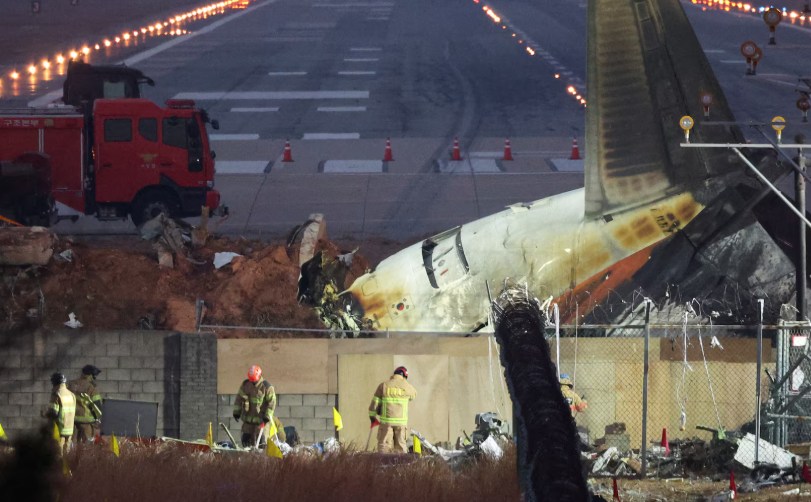
South Korean police have intensified their investigation into one of the nation's deadliest aviation disasters by conducting raids on the Korea Airports Corporation (KAC) and the transport ministry, seeking additional evidence as the inquiry expands to encompass broader institutional failures. The operation on Tuesday targeted KAC, which manages most of the country's major domestic airports apart from Incheon International, alongside the transport ministry and Busan Regional Office of Aviation, marking an escalation in the systematic examination of the incident that claimed 179 lives on December 29, 2024, at Muan International Airport.
The coordinated search operation represents the third time investigators have descended upon the transport ministry to gather documents and materials relevant to their expanding case file. Police have already identified 74 suspects in connection with the disaster, with charges centering on professional negligence resulting in death or injury—a legal classification that could implicate officials and administrators who bore responsibility for safety protocols and oversight mechanisms at the airport and related agencies. The breadth of the suspect pool underscores the authorities' assessment that systemic shortcomings, rather than isolated individual error, may have contributed to the crash.
Beyond the negligence charges currently in play, investigators are actively considering whether to pursue additional counts relating to causing a serious public disaster. This prospective charge carries more substantial legal consequences and suggests the police believe their examination may uncover evidence of gross dereliction of duty or reckless disregard for public safety that transcends the conduct of individual personnel. Such a charge would implicate organizational cultures and institutional decision-making at the highest levels of the agencies under scrutiny.
The investigation's dual focus remains on establishing the precise technical and operational factors that precipitated the crash, while simultaneously examining whether the relevant government bodies fulfilled their responsibilities in managing safety standards and emergency response protocols. For Malaysia and other Southeast Asian nations that share similar aviation infrastructure and regulatory frameworks, the unfolding investigation offers a sobering case study in how institutional accountability operates when catastrophic incidents occur. The comprehensive nature of the South Korean inquiry—targeting not just individual actors but the organizations themselves—reflects a determination to prevent recurrence through systemic reform.
The timing and scope of the raids suggest that investigators have moved beyond preliminary fact-gathering and are now pursuing specific documentary evidence that could establish culpability at organizational and ministerial levels. The transport ministry's repeated appearance as a raid location indicates that police believe documentary evidence held by that department is central to establishing whether regulatory oversights or policy failures contributed to conditions that made the disaster possible. This approach mirrors international best practices in air accident investigation, where institutional responsibilities are scrutinized alongside technical factors.
For aviation regulators and airport authorities across Southeast Asia, including Malaysia's aviation sector, the Jeju Air investigation underscores the critical importance of maintaining robust safety cultures and documentation practices that can withstand regulatory scrutiny. The scale of charges being pursued—eventually potentially including public disaster charges—demonstrates that authorities increasingly hold institutions accountable not merely for compliance with rules, but for the underlying safety outcomes those rules are designed to protect. Malaysia's own aviation authorities will likely be monitoring this investigation closely, as it may establish precedents for how negligence in aviation oversight is prosecuted in regional jurisprudence.
The 179 fatalities recorded in the Muan airport incident rank it among the deadliest aviation accidents in South Korean history and represent a trauma that has galvanized public demand for comprehensive accountability. This political and social pressure has evidently driven authorities to conduct an exceptionally thorough examination of all potentially culpable institutions and individuals. The raids represent more than routine investigative procedure; they signal a commitment to public accountability that reflects the severity of the loss suffered by families and the broader society.
The expansion of investigative activity suggests that preliminary technical analysis of the crash has been substantially completed, and authorities are now in the phase of establishing human and institutional responsibility. By targeting the agencies responsible for airport operations, transport regulation, and aviation oversight simultaneously, police are constructing an integrated narrative that examines how multiple institutions either fulfilled or failed their respective mandates. This comprehensive approach makes it more difficult for individual organizations to deflect responsibility by attributing failures to external factors beyond their control.
The potential application of serious public disaster charges would represent a significant development in how South Korean law treats aviation accidents. Rather than focusing narrowly on the mechanics of the crash itself, such charges would position the investigation within the broader framework of state responsibility for public safety—a categorization that carries substantial implications for how institutional actors, including government ministers and agency heads, approach their regulatory obligations. For a region like Southeast Asia where aviation infrastructure is rapidly expanding, the precedent being established in Seoul carries considerable weight in shaping how regulators and airports approach safety accountability.

