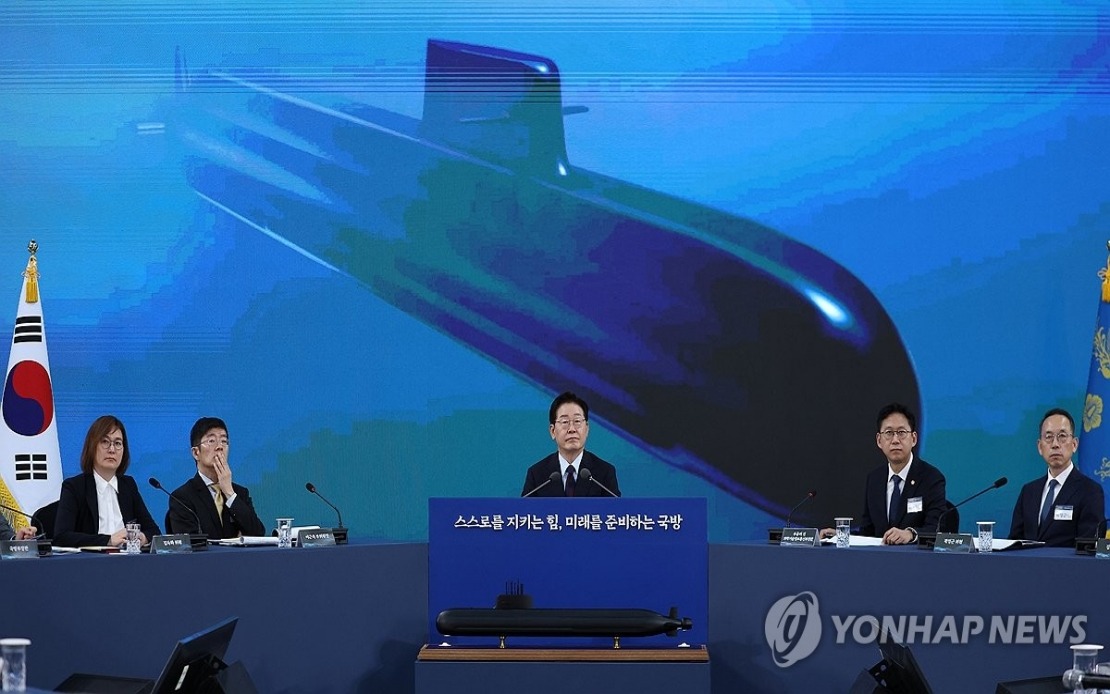
South Korea's defence ministry unveiled a draft bill on Wednesday designed to create the statutory foundation for its ambitious nuclear-powered submarine programme, marking a significant milestone in the country's push to acquire cutting-edge underwater capabilities alongside American support. The legislative initiative represents the formal codification of what was previously announced during high-level diplomatic talks and reflects Seoul's determination to accelerate one of its most strategically important defence projects in coming years.
The centrepiece of this legislative effort is the Jang Bogo N project, an undertaking that envisions the construction of at least three attack submarines displacing 8,000 tonnes each by the middle of the 2030s. These vessels will operate using nuclear propulsion—specifically high-assay low-enriched uranium enriched to levels below 20 per cent—while carrying conventional armaments rather than atomic weapons. The timeline underscores Seoul's sense of strategic urgency, as geopolitical tensions in Northeast Asia continue to intensify with provocations from North Korea and assertive Chinese military activities in the region.
The diplomatic foundation for this project crystallised following October summit discussions between South Korea's President Lee Jae Myung and US President Donald Trump, when Washington granted Seoul the crucial authorisation to proceed with nuclear submarine development. This approval represented a watershed moment, as American consent had previously been withheld due to nuclear nonproliferation concerns. The shift signals Washington's confidence in Seoul's commitment to responsible nuclear stewardship and reflects broader strategic alignment between the two allies amid evolving regional security dynamics that increasingly favour technological parity with potential adversaries.
Crucially, the proposed legislation contains explicit stipulations addressing international nuclear safeguard anxieties. The bill includes unambiguous language stating that the submarine programme carries no intention whatsoever to develop, manufacture, or stockpile nuclear weapons—a provision designed to preempt both international criticism and domestic political pressure for independent nuclear capability. By embedding these assurances directly into statute, Seoul seeks to demonstrate that nonproliferation commitments are not merely policy preferences but fundamental legal obligations binding on future governments and administrations.
The draft further commits South Korea to honouring the Nuclear Non-Proliferation Treaty and mandates full cooperation with the International Atomic Energy Agency concerning nuclear safeguard inspections and verification procedures. These provisions directly address historical anxieties within the international community regarding South Korea's latent nuclear capability, particularly given periodic domestic calls from conservative politicians and defence analysts for autonomous nuclear deterrence. By codifying these restrictions into law, Seoul attempts to elevate nonproliferation compliance beyond executive discretion, making any future divergence politically and legally untenable.
The legislation also establishes robust frameworks for public safety and environmental protection relating to radioactive materials, recognising the legitimate civilian concerns about operating advanced nuclear reactors in densely populated South Korea. Safety standards for the submarines themselves receive particular attention, reflecting the hazardous nature of operating nuclear-powered vessels in confined waters near major population centres. These provisions acknowledge that the nuclear submarine programme cannot be treated as a purely military matter but requires rigorous civilian oversight and environmental stewardship comparable to civilian nuclear power regulation.
To expedite programme execution, the bill seeks exemptions from standard defence procurement procedures, including mandatory feasibility studies that typically delay major weapons system acquisitions. Research and development timelines face compression, and contract negotiations will operate under more flexible cost adjustment mechanisms rather than rigid fixed-price arrangements. These accelerations reflect Seoul's assessment that traditional bureaucratic processes would prove incompatible with the technical complexity and strategic urgency characterising nuclear submarine development. For regional observers, this procedural streamlining signals South Korea's determination to achieve operational capability swiftly, potentially influencing security calculations throughout East Asia.
A defence ministry official acknowledged the unprecedented nature of this undertaking, describing the nuclear submarine programme as the first instance globally where a weapons platform integrates nuclear energy as its fundamental power source. This statement underscores the multifaceted complexity inherent in the project, as it necessarily intersects defence acquisition frameworks with nuclear safety management regimes historically developed for civilian applications. The current legal architecture, the official explained, contains sufficient gaps and ambiguities that bespoke legislation became indispensable for coherent programme management and regulatory oversight.
The bill mandates establishment of a strategy committee operating under the Prime Minister's authority to deliberate on implementation matters, including determination of suitable geographical sites for project infrastructure facilities. Defence ministry officials will conduct comprehensive reviews of the programme's implementation trajectory every decade, providing regularised checkpoints for evaluating progress and adjusting approaches as technological capabilities and strategic environments evolve. These governance structures reflect awareness that nuclear submarine programmes demand sustained, long-term institutional commitment extending across multiple political administrations and electoral cycles.
For Southeast Asia and the broader Indo-Pacific region, South Korea's advancement of this programme carries substantial implications for regional military balance and strategic stability. The emergence of advanced submarine platforms equipped with nuclear propulsion would substantially enhance South Korea's undersea warfare capabilities, potentially altering deterrence calculations affecting the entire region. Malaysian defence planners and regional strategists must consider how expanded South Korean naval capabilities integrate within existing balance-of-power frameworks and whether such developments encourage similar acquisition efforts among other regional actors seeking advanced military technologies.
The ministry has initiated public consultation mechanisms, inviting citizen feedback through early September before formal submission to the National Assembly for legislative deliberation. This consultative approach, while procedurally appropriate, also reflects sensitivities surrounding nuclear technology deployment within South Korea's densely populated landscape. Public acceptance represents a prerequisite for sustainable programme implementation, particularly if communities near proposed submarine facilities harbour environmental or safety reservations. The consultation period will likely prove contentious, as domestic critics questioning the necessity and wisdom of nuclear submarine acquisition seek platforms for expressing alternative viewpoints regarding defence priorities and resource allocation.
The legislative framework represents more than technical legal architecture; it constitutes a comprehensive expression of South Korea's strategic vision for maritime security and its preferred partnership orientation toward the United States during a period of considerable geopolitical turbulence. By embedding nuclear submarine development within rigorous nonproliferation constraints and establishing multilayered oversight mechanisms, Seoul endeavours to reconcile legitimate security aspirations with international legal obligations—a balancing act increasingly challenging for technologically advanced nations in an era of intensifying strategic competition.

