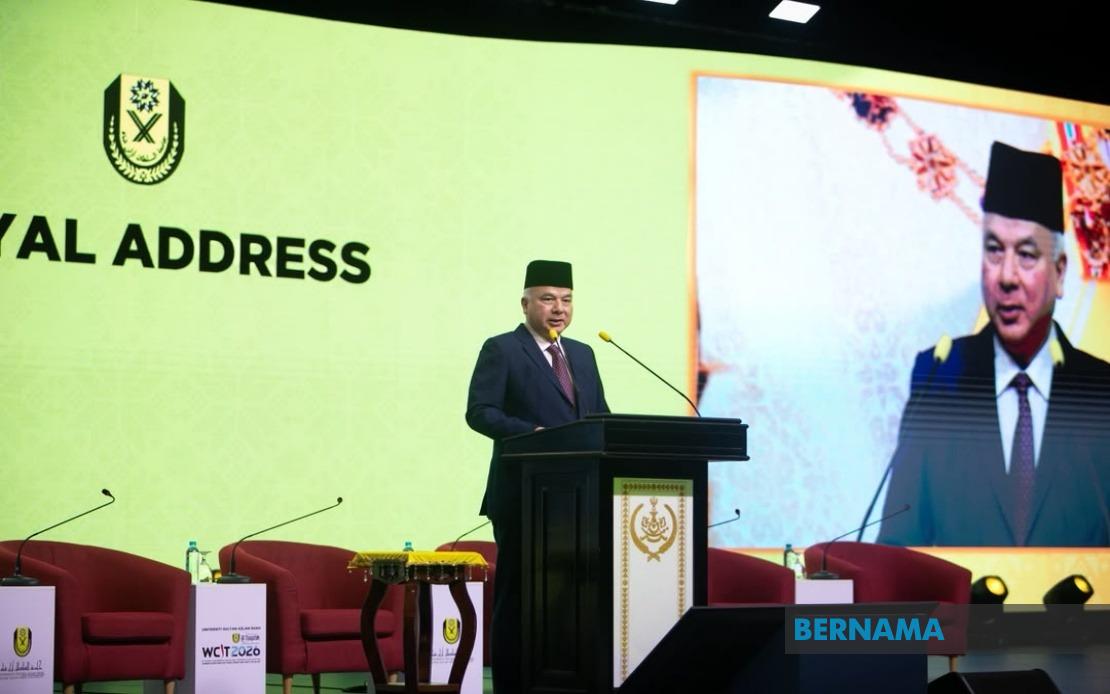
Sultan Nazrin Shah of Perak has challenged conventional thinking on national security, arguing that the bonds holding a society together matter far more than any defensive apparatus. Speaking at the 8th World Conference on Islamic Thought and Civilisation in Ipoh on July 21, the royal delivered a pointed message: while traditional security concerns—border defence, cybersecurity, extremism prevention—remain legitimate governmental responsibilities, they pale beside the importance of fostering genuine social cohesion. His intervention comes at a moment when many nations grapple with polarisation and internal fracture, making his thesis particularly resonant for Southeast Asia's diverse, plural societies.
The Sultan articulated a vision in which national security and national integrity are inseparable. A country fortified against external aggression but corroded by internal corruption, injustice, and communal mistrust has achieved nothing meaningful, he suggested. This framing inverts the usual security hierarchy: the most sophisticated air defence systems or intelligence networks cannot compensate for a fractured social fabric. For Malaysia specifically—a nation built on careful constitutional bargains among multiple ethnic and religious communities—this argument carries institutional weight. The deliberate structure of the Malaysian state, with its guarantees of bumiputera status, Islamic primacy, and constitutional monarchy, reflects precisely the understanding that durability flows from making all communities feel they have a stake in the system.
A particular emphasis of the address centred on the misuse of religion as a political tool, a concern that extends well beyond Malaysia's borders. Sultan Nazrin cautioned against the manipulation of faith to justify division, drawing a distinction between religion as a unifying force and religion as a weapon of exclusion. This warning addresses a genuine regional phenomenon: the weaponisation of religious identity in electoral contests, communal disputes, and governance. In Malaysia's context, periodic flare-ups over religious jurisdiction, Islamic education curricula, and the proper scope of Syariah law demonstrate how easily theological disputes become political battlegrounds. The Sultan's argument—that true religious integrity demands unity rather than division—offers a counter-narrative to zero-sum framings that pit Muslim and non-Muslim interests against one another.
The concept of meaningful belonging emerged as central to the Sultan's thesis. Citizens must perceive themselves reflected fairly not merely in the abstract machinery of state, but tangibly in laws, economic opportunity, education systems, and leadership structures. This moves beyond symbolic inclusion—token representation in official photographs or ceremonial events—toward substantive participation and benefit. For Malaysia, where wealth disparities follow both ethnic and class lines, and where access to quality education and economic advancement remains unevenly distributed, this articulation poses uncomfortable questions about whether all communities genuinely experience the system as legitimately theirs. The prosperity of one group, he implied, cannot substitute for the grievances of another.
Sultan Nazrin drew an explicit contrast between unity imposed through coercion and unity rooted in authentic belonging. The former, he suggested, remains inherently fragile, susceptible to collapse when enforcement mechanisms weaken or when the coercive power itself becomes delegitimised. The latter, built on genuine shared stakes and reciprocal recognition, possesses genuine resilience. This distinction carries implications for governance philosophy: it counsels against attempting to manufacture unity through security sweeps, surveillance, or restrictions on expression, strategies that typically generate resentment rather than commitment. Instead, the path to durable security involves ensuring that citizens—across religious, ethnic, and socioeconomic divides—perceive the system as fundamentally fair and responsive to their interests.
On the practical dimension of human development, the Sultan addressed education as foundational to meeting contemporary challenges. He articulated concerns about curriculum design in an era of artificial intelligence and automation, arguing that rote memorisation and standardised testing—suitable for earlier industrial economies—ill-serve societies navigating rapid technological change. This assessment resonates across Southeast Asia, where education systems often remain locked into pedagogical approaches designed for mid-twentieth-century labour markets. Universities and schools churning out graduates trained to absorb and recall information produce workers made obsolete by search engines and machine learning.
The Sultan's specific recommendations for education reform emphasise capacities that technology cannot easily replicate. Critical thinking, ethical reasoning, creativity, and adaptability constitute the genuinely future-relevant human competencies, he argued. Notably, he did not advocate abandoning rigorous training in sciences and mathematics, but rather embedding these within a broader humanistic education encompassing arts, philosophy, and moral reflection. For Southeast Asian policymakers confronting both the pressure to compete globally in technical fields and the need to maintain cultural and ethical rootedness, this formulation offers a middle path: neither wholesale Westernisation of curricula nor nostalgic retreat into traditional pedagogies, but rather a thoughtful integration of rational inquiry with humanistic depth.
The Sultan also insisted on parity between academic and vocational pathways, a principle frequently endorsed in rhetoric but rarely implemented with genuine resource commitment and social respect. In many Southeast Asian societies, technical and trades education remains the refuge of lower-achieving or lower-status students, whilst academic tracks leading to university and professional credentials carry disproportionate prestige and parental investment. Revaluing skilled tradespersonship as equally dignified to medical or engineering careers requires cultural as well as policy shifts—recognition that a well-trained electrician, carpenter, or technician performs labour as valuable as that of credentialed professionals. This has particular relevance for Malaysia and the region as automation eliminates routine jobs but creates sustained demand for human expertise in maintenance, repair, and skilled creation.
Islamic education specifically merits attention in Sultan Nazrin's framework. He presented a vision in which Islamic learning, properly conceived, already embodies the integration of revealed knowledge with rational inquiry that contemporary education requires. This positions Islamic education not as archaic or at odds with modernity, but as potentially harboring resources for addressing contemporary challenges. For Muslim-majority nations in Southeast Asia, where debates about Islamic education often pit traditional religious schools against secular modern systems, this framing suggests a third way: Islamic institutions that combine rigorous engagement with foundational religious texts alongside development of scientific literacy, critical reasoning, and ethical sophistication. Such integration would require curricular innovation and investment but could position Islamic schools as vehicles for genuine contemporary relevance rather than repositories of inherited tradition.
The gathering itself—attended by Deputy Prime Minister Datuk Seri Fadillah Yusof, Perak Menteri Besar Datuk Seri Saarani Mohamad, and Higher Education Minister Datuk Seri Dr Zambry Abd Kadir—suggests these arguments carry weight within Malaysia's governance circles. The presence of such senior officials indicates receptivity to the Sultan's framing, even if translating principle into policy remains challenging. Implementation would require difficult trade-offs: accepting messiness and dissent as preferable to imposed order, investing substantially in inclusive education, and genuinely decentralising power and economic opportunity rather than concentrating them. Whether Malaysian policymakers will embrace these implications remains an open question.

