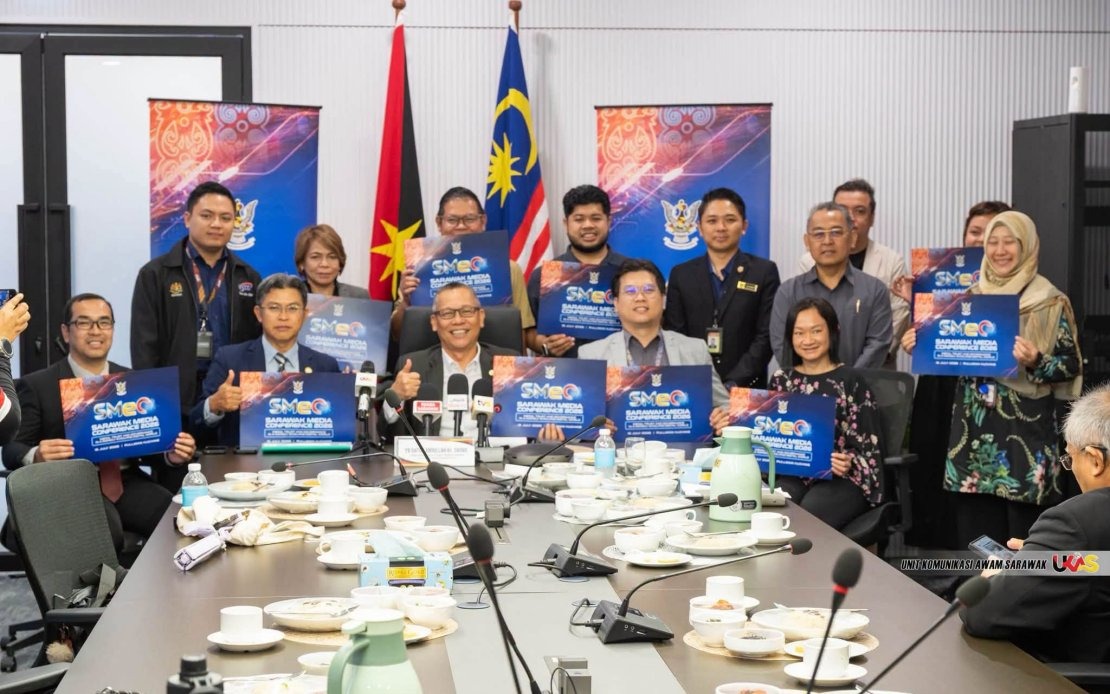
The inaugural Sarawak Media Conference (SMeC) 2026 will bring together approximately 800 participants from across the media, communications, academic and policy sectors on Thursday in Kuching. The event, orchestrated by the Sarawak Government through the Sarawak Public Communications Unit (UKAS), represents a significant regional effort to address pressing questions surrounding journalism's credibility, institutional accountability, and the profound shifts occurring within newsrooms globally. Sarawak Premier Tan Sri Abang Johari Tun Openg will officially open the proceedings, underscoring the state government's commitment to fostering dialogue around information ecosystems and their evolution in the contemporary landscape.
According to Datuk Abdullah Saidol, Deputy Minister in the Sarawak Premier's Department responsible for Corporate Affairs, Information and UKAS, the conference operates under the overarching theme "Media, Trust and Governance in a Rapidly Evolving Digital World." This framing reflects widespread international preoccupation with declining public confidence in traditional news institutions, particularly as technological disruption reshapes how information circulates, who produces it, and how audiences authenticate sources. The choice of theme signals recognition that Sarawak, like much of Malaysia and Southeast Asia, grapples with the complex interplay between media freedom, institutional governance standards, and the proliferation of unverified content online.
The substantive agenda centres on two interconnected pillars. First, organisers intend to deepen understanding of mechanisms through which media outlets can rebuild and sustain public trust—a crucial concern given global surveys indicating eroding confidence in news institutions across multiple demographics. Second, the conference will examine governance frameworks that balance editorial independence with accountability, attempting to reconcile the sector's self-regulatory impulses with broader societal expectations of responsible reportage. These discussions carry particular relevance for Malaysia, where ongoing debates about press freedom, political influence over media ownership, and journalistic standards continue to shape the regulatory environment.
The digital transformation dimension extends beyond mere technological adoption to encompass fundamental questions about journalism's future. Artificial intelligence, automation in newsrooms, and algorithmic content distribution present both opportunities and risks. SMeC 2026 will explore how newsrooms can harness computational tools to enhance investigative capacity and reach while maintaining editorial integrity and avoiding the pitfalls of algorithmic bias or misinformation amplification. For Malaysian journalists accustomed to operating within constraints related to political sensitivity and legal liability, these technical considerations intersect with longstanding professional and ethical questions.
The conference lineup includes prominent regional voices. SOL Digital founder Lunnie Gan and Malaysian Media Council deputy chairman Premesh Chandran will contribute perspectives drawn from digital innovation and media governance respectively. Their participation suggests the event aims beyond theoretical discussion toward practical insights grounded in actual industry experience. Gan's positioning within the digital media ecosystem contrasts with Chandran's focus on establishing normative standards, potentially creating productive tension around questions of innovation versus regulation that dominate contemporary media policy conversations across Southeast Asia.
Beyond the daytime conference programme, evening activities will commemorate the Sarawak-level National Journalists' Day (HAWANA) 2026 celebration. This ceremonial dimension, attended by Deputy Prime Minister Datuk Seri Fadillah Yusof, elevates the gathering's political significance and acknowledges journalism's role in the broader democratic and social fabric. Such high-level attendance reinforces messaging about government regard for the profession while potentially creating expectations regarding policy responsiveness to issues journalists raise during conference deliberations.
The Sarawak Premier's Special Appreciation Awards will recognise excellence across five distinct professional categories: Editor/Journalist/Stringer, Photographer, Videographer, Radio News Presenter/Broadcaster, and Social Media Influencer. This taxonomy reflects evolving definitions of journalism practice, explicitly acknowledging that contemporary information work extends beyond traditional gatekeepers to include visual storytellers and digital-native content creators. For Malaysian journalism, which traditionally centred on print and broadcast reporters, formal recognition of these diverse roles signals institutional adaptation to audience fragmentation and multiplatform consumption patterns.
The inclusion of social media influencers within the awards framework represents a particularly telling modernisation. It implicitly recognises that credible information dissemination increasingly occurs through personalities and communities operating outside conventional newsroom hierarchies. This development reflects global patterns where younger audiences rely on social platforms as primary news sources, effectively dismantling the monopoly traditional media once held over public information. For Malaysia's nascent digital journalism sector and independent content creators navigating regulatory uncertainty, such acknowledgment carries both symbolic and practical significance.
Sarawak's initiative to host a media conference of this scale occurs within a broader regional context of intensifying scrutiny around information integrity. Across Southeast Asia, governments, media organisations, and civil society confront shared challenges including disinformation campaigns, foreign interference in information spaces, and the erosion of professional journalism economics due to advertising migration to technology platforms. SMeC 2026 provides a platform for Malaysian and regional practitioners to benchmark approaches, share lessons learned, and potentially identify collaborative responses to transnational information challenges.
The timing of this inaugural conference reflects recognition that media governance and digital transformation cannot be addressed through national silos. Information flows, technology platforms, and audience behaviours operate at regional and global scales, yet local contexts—political systems, regulatory frameworks, audience demographics, economic structures—fundamentally shape how these universal pressures manifest. For SMeC 2026 participants from Malaysia and other Southeast Asian jurisdictions, deliberations will likely centre on calibrating responses that respect local conditions while learning from international best practice.
The conference structure and participant composition suggest organisers intend genuine cross-sectoral engagement. Bringing together media practitioners, academics, policymakers, industry leaders and students creates conditions for dialogue that transcends traditional boundaries between news organisations, government, and civil society. Malaysian attendees will encounter Sarawak-specific policy perspectives while contributing expertise from contexts like Peninsular Malaysia's more complex media ownership structures and higher political stakes in journalism.
For Malaysian media organisations and individual journalists, SMeC 2026 offers opportunity to engage substantively with governance questions and digital strategy in a setting somewhat removed from partisan domestic pressures. Sarawak's relative geographic distance from the federal capital creates psychological space for frank discussion. The conference thus functions not merely as information-sharing forum but potentially as catalyst for industry self-reflection and renewed commitment to professional standards amid technological and institutional turbulence.
Looking forward, the success of SMeC 2026 may establish precedent for regular convening of media sector stakeholders across Malaysia and the broader region. Such forums become increasingly vital as convergence between news production, government communication, and social media accelerates, blurring traditional lines between institutional roles. Whether this inaugural conference generates concrete policy recommendations, professional network strengthening, or renewed commitment to ethical journalism standards will determine its lasting impact on Malaysia's information ecosystem.

