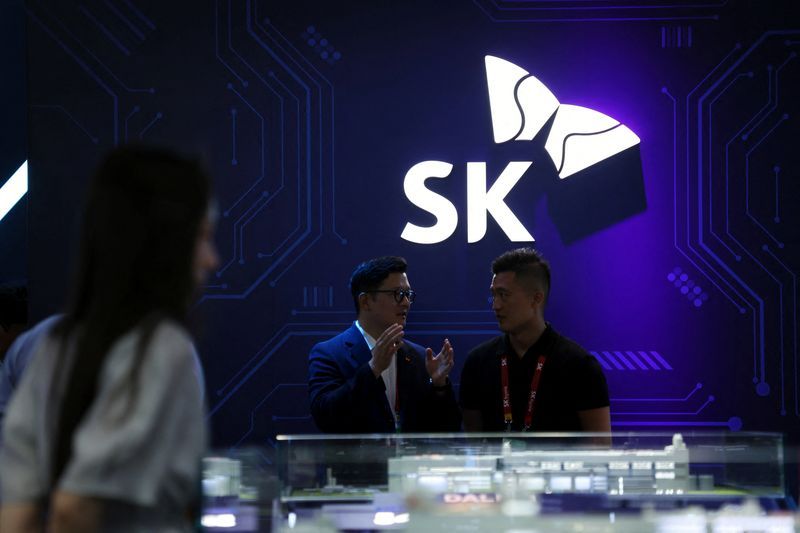
South Korea's memory chip giant SK Hynix announced plans Wednesday to raise as much as 45.45 trillion won—approximately $29.43 billion—by listing American Depositary Receipts on the Nasdaq exchange, positioning itself to capitalize on surging global demand for artificial intelligence infrastructure. The listing, scheduled for July 10, represents an aggressive capital-raising strategy designed to strengthen the company's competitive footing in the lucrative memory chip market whilst broadening its investor base beyond South Korea.
The fundraising initiative will involve the issuance of 17.79 million newly created shares to underpin the ADR offering, with each ADR representing ten common shares. The final quantum could fluctuate once bookbuilding commences, according to regulatory filings submitted by the company. Should the deal close at the upper end of the proposed pricing band, it would eclipse the previous record for ADR offerings, surpassing the $21.8 billion that Chinese e-commerce platform Alibaba raised during its landmark 2014 New York Stock Exchange debut—a particularly significant threshold given the prominence of that transaction in global capital markets history.
The proceeds will be deployed strategically across three major capital expenditure initiatives aimed at fortifying SK Hynix's manufacturing capabilities. The company intends to construct a new fabrication facility in Yongin, establish an advanced packaging manufacturing operation in Cheongju, and acquire cutting-edge chipmaking equipment including an Extreme Ultraviolet Scanner—technology essential for producing the most advanced semiconductor designs. This infrastructure expansion reflects management's conviction that demand for high-performance memory chips will continue expanding across the coming years, particularly driven by artificial intelligence applications requiring substantial computational power.
The timing of SK Hynix's capital-raising campaign coincides with extraordinary momentum in the semiconductor sector, particularly for companies supplying the specialist memory components that power artificial intelligence systems. The company has emerged as a critical supplier of high-bandwidth memory chips—components specifically engineered to facilitate rapid data movement in AI accelerators—serving marquee customers including graphics processing specialist Nvidia and Alphabet's Google subsidiary. This positioning within the AI supply chain has delivered remarkable financial performance, enabling SK Hynix to achieve a remarkable milestone on Monday when it superseded Samsung Electronics to become South Korea's most valuable publicly traded company by market capitalisation.
The achievement underscores the dramatic reallocation of investor attention within the Korean technology sector, where traditional smartphone and consumer electronics manufacturers are ceding prominence to pure-play semiconductor companies. SK Hynix's ascendancy reflects the outsized returns associated with supplying critical infrastructure for the artificial intelligence revolution, where demand for specialised chips has dramatically outpaced broader semiconductor market growth. This shift carries profound implications for Korean corporate valuations more broadly, signalling that technology investors increasingly prioritise exposure to foundational AI infrastructure over established consumer-oriented electronics conglomerates.
The offering will be coordinated by a heavyweight banking consortium including BofA Securities, Citigroup Global Markets, Goldman Sachs, and JP Morgan Securities, underscoring the transaction's strategic importance and the confidence major financial institutions hold regarding market appetite for SK Hynix equity exposure. The participation of these premier investment banks reflects both the magnitude of the capital requirement and the anticipated demand from global institutional investors seeking exposure to semiconductor companies benefiting from artificial intelligence adoption. The involvement of multiple tier-one banks also demonstrates the competitive intensity surrounding equity offerings in this segment, where banks recognise substantial advisory and underwriting revenues.
For Malaysian investors and the broader Southeast Asian investment community, SK Hynix's expansion carries several noteworthy implications. The company's capital-intensive growth strategy underscores how competitive advantages in semiconductor manufacturing increasingly depend upon sustained investment in state-of-the-art fabrication facilities and equipment. Regional semiconductor manufacturers and technology hubs across Southeast Asia must contend with competitors possessing substantially larger balance sheets and access to deep capital markets. Additionally, as SK Hynix expands production capacity, competitive dynamics within memory chip markets may shift, potentially affecting pricing and margins for smaller regional competitors and their customers throughout the region.
The ADR listing mechanism itself warrants consideration for Malaysian and Southeast Asian capital markets participants. American Depositary Receipts enable foreign companies to access United States equity markets whilst maintaining primary stock exchange listings in their home countries, effectively creating dual trading opportunities for international investors. This structure has proven particularly effective for Asian technology companies seeking to broaden their shareholder base beyond domestic boundaries. SK Hynix's decision to pursue this route rather than consolidating all trading on South Korean exchanges reflects management's determination to achieve optimal valuation and operational flexibility across international capital markets.
From a macroeconomic perspective, SK Hynix's capital expenditure plans represent significant economic activity for South Korea, generating employment, stimulating upstream suppliers, and reinforcing the nation's position as a global semiconductor manufacturing centre. However, the concentration of such substantial capital allocation within a single company also illustrates broader trends toward industrial consolidation, where technological leadership and manufacturing scale increasingly cluster around a small number of exceptionally well-capitalised multinational enterprises. For developing economies throughout Asia, including those in Southeast Asia, this dynamic raises questions about the sustainability of distributed semiconductor manufacturing versus increasingly centralised production at scale in advanced economies possessing superior infrastructure, technological capabilities, and access to capital.
The success of SK Hynix's ADR offering will likely hinge upon demonstrating that its capital expenditure investments will generate adequate returns sufficient to justify the substantial valuation implied by the fundraising at upper-band pricing levels. Management must convince investors that artificial intelligence demand will remain sufficiently robust to sustain high memory chip utilisation rates across the extended period required to recoup multibillion-dollar manufacturing investments. Market conditions favouring semiconductor stocks could shift, potentially rendering such optimistic assumptions unjustified, though current industry fundamentals appear conducive to such ambitious expansion programmes.

