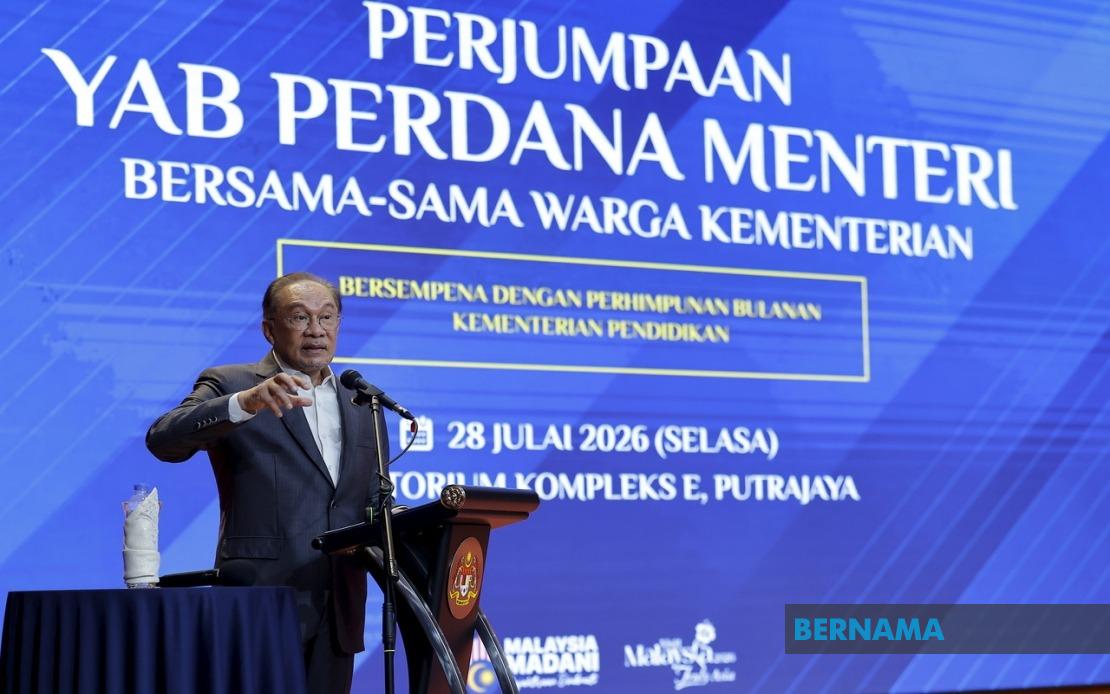
Prime Minister Datuk Seri Anwar Ibrahim has reversed an earlier proposal to transfer Malaysia's Sixth Form pre-university programme to the Ministry of Higher Education, announcing instead that the system will remain under the Ministry of Education's purview. The decision, made during a meeting with MOE staff in Putrajaya on July 28, reflects a reassessment of the administrative restructuring plan that had been previously flagged, prioritising continuity over institutional reorganisation.
Anwar's announcement came after consultations with key government officials including Education Minister Fadhlina Sidek, Chief Secretary to the Government Tan Sri Shamsul Azri Abu Bakar, and Public Service director-general Tan Sri Wan Ahmad Dahlan Abdul Aziz. The deliberations underscore the complexity of managing Malaysia's pre-university landscape, where multiple agencies oversee different educational pathways leading to tertiary study. The prime minister's decision signals that maintaining the existing operational framework takes precedence over the proposed consolidation strategy.
The rationale behind keeping Sixth Form within the MOE's remit centres on two critical operational dimensions: the intricate systems governing student administration and the established service agreements affecting educators in this sector. These institutional arrangements have evolved over decades and carry significant implications for thousands of secondary school students annually who pursue Form Six as a pathway to university admission. Disrupting these arrangements through a ministerial transfer could introduce delays, confusion, or inconsistencies in student progression and academic record-keeping.
For Malaysian students, Sixth Form represents one of three main pre-university routes alongside Matriculation and Diploma programmes. The Sixth Form pathway, built on the existing secondary education structure, has deep institutional integration within MOE operations, encompassing curriculum delivery, examination administration, and student progression tracking. The continuity decision ensures that these processes remain uninterrupted, avoiding potential disruptions during a transitional period that could have disadvantaged the current and incoming cohorts of students.
Anwar's reversal reflects broader complexities in Malaysia's higher education architecture, where the division of responsibility between the MOE and the Ministry of Higher Education has long been a source of policy debate. While Matriculation and Diploma programmes fall primarily under MOHE, Sixth Form occupies a hybrid space, functioning as a pre-university preparation pathway while remaining administratively embedded within the secondary education system. This structural reality makes transferring Sixth Form a more complicated undertaking than simply shifting institutional oversight.
The earlier announcement regarding MOHE's potential assumption of both Sixth Form and Matriculation programmes represented an attempt to consolidate pre-university education under a single ministry, rationalising administrative structures and potentially improving coordination between preparatory programmes and higher education institutions. However, the practical impediments proved substantial enough to warrant reconsideration. Teacher service schemes, in particular, presented significant obstacles, as educators within Sixth Form operate under different contractual and remuneration frameworks compared to MOHE-affiliated staff.
This decision carries implications for Malaysia's broader educational reform agenda. Policymakers seeking to streamline governance structures must contend with deeply embedded institutional relationships and personnel arrangements that cannot be easily reconfigured without careful planning and stakeholder consultation. The FM's acknowledgement of these complexities demonstrates a pragmatic approach, recognising that administrative efficiency gains must be balanced against potential operational disruptions and staff welfare concerns.
For Southeast Asian observers, Malaysia's experience illustrates the challenges inherent in restructuring education governance. The region's rapidly expanding pre-university sectors face similar pressures to consolidate management and improve institutional alignment, yet encounter comparable obstacles rooted in historical arrangements, employment protections, and operational dependencies. How Malaysia navigates these tensions may offer lessons for neighbouring countries contemplating comparable reforms.
The decision also underscores the importance of stakeholder engagement in education policy-making. The consultation process that preceded Anwar's announcement, involving the education minister, chief secretary, and public service leadership, reflects recognition that educational restructuring requires consensus across multiple government agencies and consideration of workforce implications. This collaborative approach contrasts with top-down mandates that might generate resistance or unintended consequences.
Moving forward, the MOE will continue managing Sixth Form within its existing framework, handling student admissions, curriculum implementation, examination coordination, and progression monitoring as before. This preserves the linkage between secondary and pre-university education while leaving open the possibility of future administrative reforms should circumstances change. The decision represents a calculated pause rather than a permanent rejection of potential consolidation, allowing time for more detailed planning should such restructuring eventually be pursued.
For Malaysian educators within Sixth Form, the announcement provides institutional certainty and protection of existing service conditions. The stability of remaining within the MOE system offers continuity in employment arrangements and professional development pathways, addressing what appears to have been a significant concern during the deliberation process. This focus on preserving workforce arrangements reflects broader principles of sound government employment management.
The reversal also demonstrates the importance of adequate consultation periods before announcing major policy shifts affecting education. The earlier public announcement about transferring Sixth Form to MOHE, followed by this decision to maintain the status quo, highlights how careful stakeholder engagement—encompassing administrators, educators, and student representatives—can refine policy approaches and identify practical limitations not immediately apparent in initial conceptualisations.

