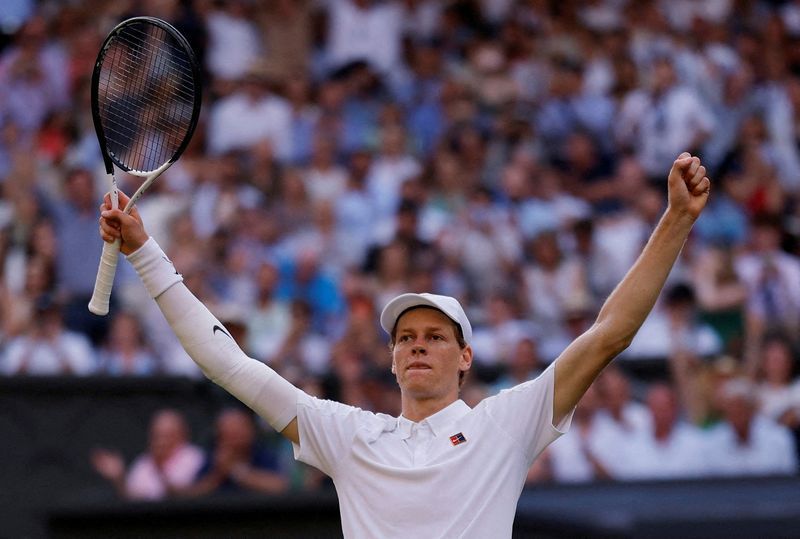
Jannik Sinner's arrival at Wimbledon this week marks a crucial juncture in the Italian's bid to silence the growing chorus of doubt surrounding his capacity to dominate tennis at the highest level. The world number one heads to the All England Club not as the unstoppable force that swept through the clay-court season, but as a fractured favourite tasked with resurrecting both his confidence and his championship credentials on grass. The narrative has shifted dramatically in recent weeks—from inevitable coronation to vulnerability—and that shift has created genuine daylight for competitors who smell blood in the water.
Sinner's trajectory before the French Open seemed almost predetermined. His 30-match winning streak stretching back to February represented the kind of sustained excellence that separates champions from pretenders. Yet Roland Garros exposed something previously hidden: the physical toll of relentless competition without adequate recovery. Rather than a minor dip, the 24-year-old's second-round exit signals potential structural weaknesses in how he manages his body through demanding stretches of international play. The concerning nature of his collapse lies not merely in the result but in the context—a player who appeared invincible suddenly struggling to move with the dynamism that defines his game.
Mats Wilander, the seven-times Grand Slam champion whose perspective carries considerable weight, attributes Sinner's Paris failure to cumulative fatigue rather than fundamental decline. Speaking to La Gazzetta dello Sport, Wilander identified the root cause as insufficient recovery during the two months preceding Roland Garros, a period when Sinner competed frequently with minimal opportunity to rebuild his physical reserves. Yet Wilander's analysis contains a cautionary note: while rest may restore Sinner to form, grass remains inherently unpredictable, a surface where even the best-prepared players face unexpected challenges. This distinction matters profoundly. Wimbledon is not merely another arena where Sinner applies his proven methods; it represents genuinely neutral terrain where accumulated momentum counts for considerably less.
The absence of Carlos Alcaraz through injury fundamentally reshapes the competitive landscape at Wimbledon. The Spanish champion's losses to Sinner elsewhere notwithstanding, Alcaraz possesses the aggressive grasscourt credentials that have produced consecutive titles at the All England Club in 2023 and 2024. His withdrawal eliminates not just one rival but removes a template for how elite grass-court tennis can be played in the modern era. This vacuum creates cascading implications throughout the draw, suddenly making previously secondary contenders genuinely credible challengers.
Novak Djokovic emerges as perhaps the most ominous figure lurking within that vacuum. The 39-year-old Serb arrives at Wimbledon pursuing his eighth title—a number that would equal Roger Federer's historic haul—while simultaneously chasing an elusive standalone 25th Grand Slam title. These are not abstract ambitions for a fading veteran; they represent concrete opportunities to cement a legacy already among tennis's greatest. Though Djokovic also stumbled at Roland Garros, his grasscourt pedigree remains unquestionable. Former three-times Wimbledon finalist Andy Roddick articulated the calculus clearly on his podcast: with Alcaraz absent and Sinner's invincibility fractured, Djokovic possesses precisely the kind of realistic title opportunity that may not emerge frequently in his remaining competitive window.
Roddick's assessment captures a psychological reality often overlooked in tactical analysis. Djokovic will arrive at the All England Club not burdened by the pressure of inevitable favouritism but liberated by circumstance to pursue a genuine opportunity. His movement remains exceptional, his return of serve continues to unsettle opponents, and his mental resilience in high-pressure moments remains largely unmatched. The Serb last won Wimbledon four years ago, and while that timeline suggests decline, it also means his grasscourt fundamentals require minimal adjustment. He arrives as a calculated threat rather than a desperate longshot.
Alexander Zverev represents an altogether different category of challenger. The German's maiden Grand Slam victory at Roland Garros last month broke through the psychological ceiling that has haunted his career, transforming him from perennial underachiever into Major winner. Yet translating clay-court success onto grass demands more than momentum; it requires technical adaptation and mental compartmentalization. Boris Becker, the six-times Grand Slam champion, has declared Zverev his Wimbledon favourite in light of Alcaraz's absence and Sinner's questions. Becker's reasoning emphasizes Zverev's exceptional serve—the single most valuable weapon on grass, essentially providing entry into the semi-finals for players possessing elite serving ability. For Zverev, Wimbledon represents an unprecedented opportunity: with established threats diminished, grasscourt success suddenly becomes attainable rather than speculative.
Beyond these three figures, a secondary tier of contenders has materialized to complicate calculations further. American Ben Shelton possesses the raw weaponry to trouble any opponent, while fellow Americans Taylor Fritz and Frances Tiafoe carry sufficient firepower to generate deep runs. Roland Garros runner-up Flavio Cobolli, meanwhile, represents the emerging generation gaining experience at sport's highest level. None of these players would typically be considered legitimate championship threats at Wimbledon, yet the altered circumstances created by Alcaraz's injury and Sinner's vulnerability have expanded the realistic contender pool considerably.
For Malaysian and Southeast Asian followers monitoring the tournament, Sinner's Wimbledon campaign carries implications extending beyond immediate results. The Italian represents the new generation attempting to establish sustained dominance in an era when physical and mental demands have never been higher. His struggle raises pertinent questions about whether any player can genuinely maintain the exhausting schedule necessary to win multiple Grand Slams annually without encountering diminishing returns. The answers will emerge across these two weeks of play on grass, where Sinner must prove that reset opportunities can genuinely erase recent doubts.
The All England Club begins Monday with a tournament narrative that has shifted dramatically from foreordained conclusion to genuine competitive uncertainty. Sinner remains the defending champion and world number one, retaining obvious advantages. Yet the protecting aura of invincibility has been compromised, creating space for challengers who will approach Wimbledon not with resignation but with genuine belief. How Sinner responds to this pressure, and whether he can execute his game with precision on a surface that offers no margin for error, will determine whether he emerges as champion or whether the narrative of his temporary vulnerability proves prescient.

