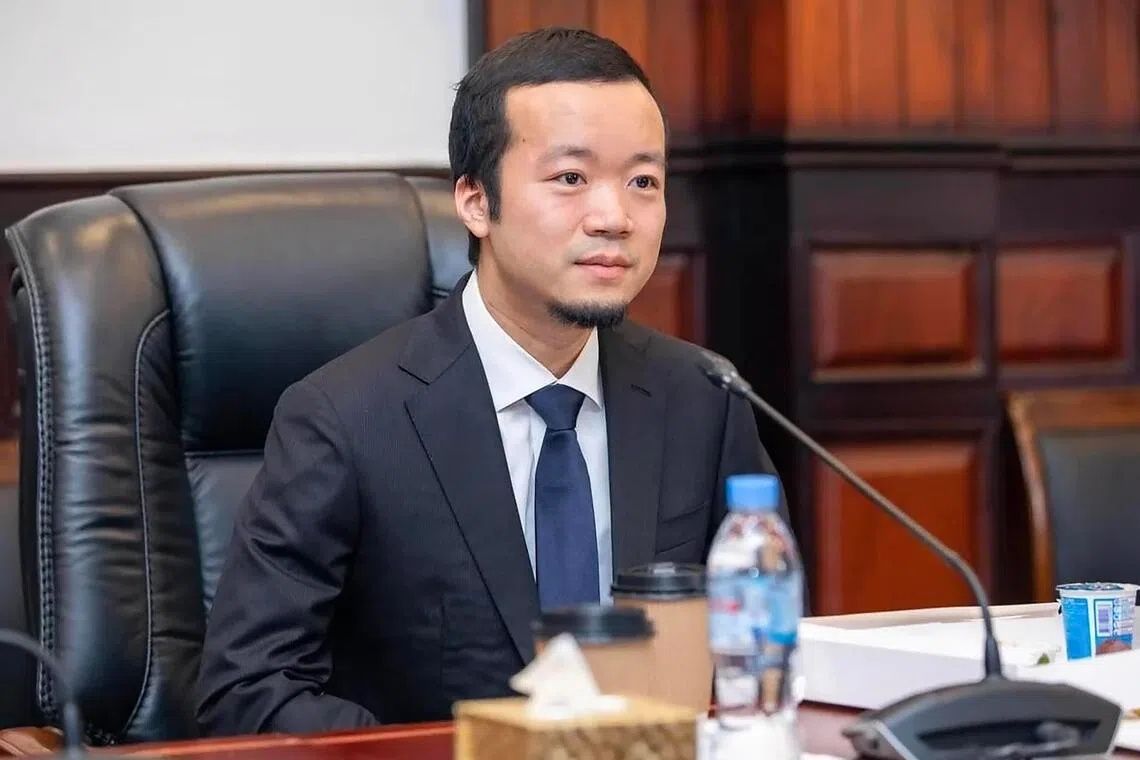
A collaborative investigation spanning six months has exposed the identity and operations of a key figure in a multibillion-dollar international fraud network that exploited vulnerable workers across Southeast Asia. Chen Sokly—born Chen Xing in Shanghai in 1986—served as the trusted lieutenant of crime boss Chen Zhi, managing the sophisticated money-laundering operations of Prince Holding Group. The investigation by The Straits Times and the Organised Crime and Corruption Reporting Project (OCCRP) pieced together corporate records, citizenship documents, and property transactions across multiple jurisdictions to establish Sokly's central role in one of the largest financial fraud schemes in modern history.
Sokly's rise through the criminal ranks exemplifies the borderless nature of modern transnational crime syndicates. After acquiring Cambodian citizenship around the end of 2017—documented in official government records—he reinvented himself as Chen Sokly, shedding his birth name to obscure his identity. But his network of aliases extended far beyond Cambodia. In Singapore's business circles, he was known as Martin Chen, a moniker that helped him operate property investments and corporate ventures with minimal scrutiny. This deliberate identity fragmentation across jurisdictions allowed him to manage the syndicate's most sensitive functions while maintaining a veneer of legitimate business activity.
According to a New York indictment filed on October 8, 2025, Sokly's primary responsibility was to function as the group's risk control officer—a euphemism for managing threats from law enforcement and state interference. His role transcended conventional business oversight; he was tasked with actively corrupting foreign officials and monitoring investigative activities directed at the Prince Group and its sprawling network of subsidiary operations. Court documents allege that in May 2023, Sokly negotiated directly with a Chinese government official who promised to shield Prince Group associates from legal consequences. In an arrangement that underscores the brazen nature of the scheme, Sokly agreed to provide financial support to the official's son in exchange for protection and influence over local police operations.
The extent of Sokly's reach into government structures became evident through a ledger of bribes allegedly maintained by Chen Zhi himself and later recovered by US authorities. In 2019 alone, Sokly facilitated the purchase of a yacht valued at more than US$3 million as a gift to a foreign government official—a transaction that revealed the staggering resources available to the syndicate for corrupting state actors. Sokly's confidence in his network of compromised officials was such that he dismissed warnings about the Cambodian government's crackdown on scam compounds, asserting with apparent certainty that the Prince Group remained untouchable. His communications with Chen Zhi frequently dwelt on the scope of his influence, with boasts about the depth of official protection the syndicate had purchased across multiple countries.
Beyond his role as a fixer and corruption manager, Sokly also served as the group's enforcer, maintaining discipline within the sprawling criminal organization through implicit and explicit threats of violence. When syndicate members threatened the group's operational integrity—such as stealing from the collective fund—Sokly was summoned to address the breach. In July 2024, Chen Zhi instructed another associate to contact Sokly to handle a delinquent member, demonstrating the hierarchy that placed Sokly as the operational muscle backing financial intimidation. This dual role as both administrator of corruption and instrument of enforcement made him indispensable to Chen Zhi's leadership.
Singapore emerged as Sokly's primary base of operations, a choice that reflected the city-state's role as a financial hub for legitimate and illicit capital flows. In 2017, Sokly announced his arrival with the purchase of a S$11 million luxury apartment at 10 Leedon Heights, an exclusive residential enclave. The acquisition signaled his intention to embed himself within Singapore's wealth ecosystem. Shortly thereafter, he established M Capital Global Holdings, investing just over S$5 million alongside his wife, who remained listed as a co-shareholder. Over the subsequent two years, Sokly registered himself as director of at least 16 Singapore companies, though he systematically removed himself from most of these corporate structures between 2020 and 2023—a pattern suggesting either a deliberate reduction in visible exposure or a shift toward more opaque ownership structures.
Sokly's corporate footprint in Singapore centered on office space in Shenton Way, the heart of the city's central business district. When ST investigators visited the building, they discovered that the office addresses linked to Sokly's directorships were occupied by unrelated companies, suggesting the use of shell structures to create the appearance of legitimate commercial activity while facilitating money movement. Former employees familiar with his operations indicated that Sokly maintained a deliberate presence of only two to three months annually in Singapore, conducting business in a calculated manner. His evenings were spent socializing with syndicate associates, including frequent meetings with Chen Zhi, during which they would discuss operational matters over drinks—a routine that combined the social conventions of legitimate business with the informal coordination of global crime.
Sokly's material wealth in Singapore reflected the extraordinary profits flowing through the Prince Group's illicit operations. Beyond the luxury apartment, he maintained a fleet of expensive vehicles including a Bentley and a seven-seater luxury SUV, kept at his Leedon Heights residence. This conspicuous display of wealth was consistent with the behavior of syndicate insiders across multiple jurisdictions, a pattern that eventually attracted regulatory attention. Property records from California reveal another dimension of Sokly's asset accumulation strategy. In 2019, he purchased a residential property in the United States from Fang Zhizhen, a member of the Knight Attack Group, an earlier cybercriminal syndicate that predated Prince Group. This transaction linked Sokly to an earlier generation of transnational crime operators, suggesting continuity between criminal networks and the movement of personnel and capital between them.
Sokly's American real estate holdings expanded significantly over the subsequent years. He sold the California property in 2024 for approximately US$4.5 million, realizing substantial gains on the initial investment. However, in a move that suggested awareness of impending enforcement action, Sokly transferred ownership of a separate US$4 million property to his wife on November 4, 2025—just weeks after sweeping sanctions were imposed on Prince Group and its associates. In December 2025, the property was placed in a trust controlled by his wife, a structure commonly employed to shield assets from seizure or forfeiture proceedings.
The revelation of Sokly's operations across Singapore, the United States, and Cambodia underscores the regional implications of transnational organized crime networks. Singapore's role as a financial center inadvertently facilitates the layering and integration stages of sophisticated money-laundering schemes, where illicit proceeds are converted into seemingly legitimate business investments and real estate. The exploitation of Cambodia's scam compounds—operations that forced foreign nationals into illegal call-center fraud schemes—generated an estimated US$30 million daily in illicit revenue according to boasts made by Sokly himself. This capital then flowed through networks of shell companies, corrupt officials, and real estate purchases across multiple jurisdictions, with Southeast Asian financial hubs serving as crucial nodes in the laundering infrastructure.
The indictment against Chen Zhi and his associates, which led to the forfeiture of 127,271 bitcoins valued at approximately US$15 billion at the time, represented one of the largest financial fraud takedowns in history. The US government's decision to drop sanctions against Chen Zhi just six days after the indictment—a decision that remains unexplained in public statements—raised questions about the political and diplomatic considerations underlying enforcement action against transnational crime syndicates. Sokly's current whereabouts are believed to be in the United States, though the timing of his asset transfers suggests an awareness of enforcement pressure. His case illustrates how individual actors within criminal networks exploit jurisdictional boundaries and regulatory gaps to accumulate wealth while corrupting state institutions.
For Southeast Asian authorities and financial regulators, the Sokly case presents uncomfortable lessons about the vulnerability of their respective financial systems to infiltration by organized crime networks. His ability to operate openly in Singapore's corporate and real estate markets, while simultaneously managing a global corruption apparatus, demonstrates the limitations of anti-money-laundering frameworks in detecting sophisticated operators who maintain legitimate business facades. The investigation's findings emphasize the need for enhanced regional coordination on financial intelligence sharing and the development of regulatory mechanisms capable of identifying the movement of illicit proceeds through legitimate channels. Sokly's transformation from Chen Xing to multiple personas across different jurisdictions exploited the fragmentation of enforcement systems, a gap that transnational crime networks will continue to exploit absent coordinated regional responses.

