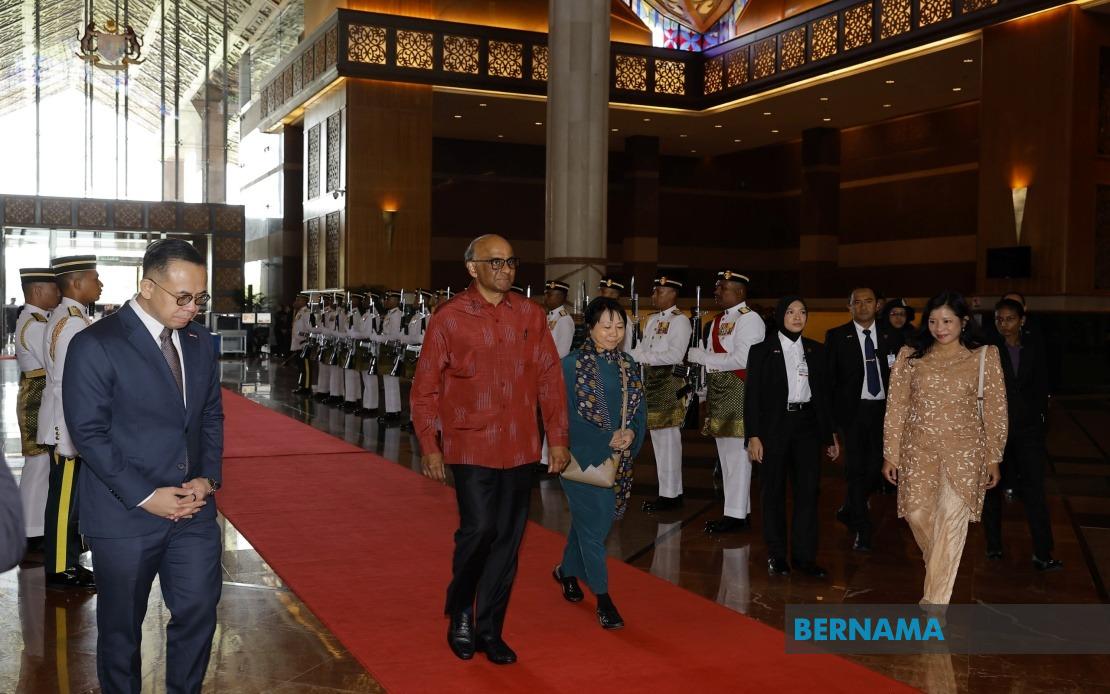
Singapore President Tharman Shanmugaratnam and his delegation departed Malaysia on Monday afternoon, bringing to a close a three-day state visit that underscored the enduring diplomatic bonds between the two neighbouring countries. The President, accompanied by his spouse Jane Ittogi, left Kuala Lumpur International Airport Terminal 1 on a commercial flight at 2.20 pm, concluding an engagement that touched on multiple facets of bilateral cooperation and cultural exchange.
The departure ceremony reflected the formal protocol typically accorded to visiting heads of state. Upon arrival at the Bunga Raya Complex at KLIA at 1.45 pm, Tharman was given a static Guard of Honour comprising officers and personnel from the First Battalion of the Royal Ranger Regiment. Minister of Entrepreneur and Cooperatives Development Steven Sim represented the Malaysian government at the farewell, signalling the importance both nations place on maintaining their relationship.
Tharman's visit to Malaysia, which commenced on Sunday, had been initiated through a formal invitation from His Majesty Sultan Ibrahim, King of Malaysia. The timing and sequencing of the state visit held particular significance in the diplomatic calendar, as it functioned as a reciprocal gesture following Sultan Ibrahim's own state visit to Singapore on May 6 and 7, 2024. Such exchanges between heads of state serve as important mechanisms for reinforcing personal rapport and institutional connections at the highest levels of government.
For Tharman, this marked his inaugural state visit to Malaysia since he assumed the office of Singapore's ninth President on September 14, 2023. As a new head of state, establishing direct relationships with neighbouring leaders represents a priority for consolidating his role and signalling continuity in Singapore's foreign policy orientation. The Malaysian leg of his early presidency demonstrated the weight both governments place on the Singapore-Malaysia relationship, which remains central to regional stability and prosperity.
The formal engagements during the visit illustrated the breadth of institutional contact between the two nations. On Monday, Tharman participated in a state welcoming ceremony before proceeding to Istana Negara for an audience with Sultan Ibrahim. This encounter formed the ceremonial centrepiece of the visit, allowing both leaders to discuss matters of mutual interest within an intimate setting. The presence of Malaysia's Prime Minister Datuk Seri Anwar Ibrahim, along with senior cabinet ministers including Foreign Minister Datuk Seri Mohamad Hasan, Investment, Trade and Industry Minister Datuk Seri Johari Abdul Ghani, and Minister Sim, underscored the high-level coordination evident throughout the proceedings.
Diplomatically, the composition of the Malaysian delegation meeting with Tharman revealed the sectors receiving particular emphasis during the visit. The inclusion of the trade and industry minister alongside the foreign minister suggested discussions extended beyond ceremonial courtesy to encompass economic cooperation, investment frameworks, and commercial ties that increasingly define modern state-to-state relations. Such delegations typically signal which governmental portfolios view engagement with Singapore as strategically significant.
Beyond the federal level, Malaysia's royal structure ensured comprehensive representation of the nation's institutional fabric. On the penultimate day of the visit, the Sultan of Selangor, Sultan Sharafuddin Idris Shah, granted an audience to Tharman at Istana Alam Shah. This engagement reflected Malaysia's federal system, wherein state rulers maintain autonomous diplomatic protocols alongside national-level interactions. The inclusion of a state-level audience demonstrated the multifaceted nature of Malaysia-Singapore relations, which operate across numerous institutional channels.
The concept of reciprocal state visits carries considerable weight within Southeast Asian diplomacy. By formally reciprocating Sultan Ibrahim's May visit to Singapore, Malaysia's reception of Tharman reinforced the principle of mutual respect and balanced engagement. Such symmetry in high-level visits prevents any perception of asymmetric relationships and ensures both nations maintain equivalent platforms for diplomatic communication. For two neighbouring city-state and peninsula nation separated by the Strait of Johor, managing perceptions of equal standing remains perpetually important.
The broader context of Malaysia-Singapore relations encompasses decades of complex history, economic interdependence, and occasional tensions over maritime boundaries, water agreements, and immigration matters. State visits like this one provide structured opportunities for leaders to address contentious issues privately whilst publicly affirming the relationship's fundamentally cooperative nature. The ceremonial dimensions—the guard of honour, the formal audiences, the ministerial delegations—serve both practical functions in facilitating discussion and symbolic functions in demonstrating political commitment to the bilateral relationship.
For Malaysian and regional observers, Tharman's visit represented an affirmation that Singapore remains firmly oriented toward its immediate geographical neighbourhood despite its global financial and commercial interests. Similarly, Malaysia's elaborate reception signalled that managing the relationship with Singapore remains a priority across multiple governmental levels. Such consistency in engagement helps stabilise the broader Southeast Asian geopolitical environment, where bilateral relationships significantly influence regional dynamics.
Looking ahead, the visit establishes a foundation for continued dialogue between Tharman and Malaysian leadership throughout his presidency. The personal relationships forged during state visits typically translate into more regular and substantive communication through diplomatic channels, ministerial visits, and working-level engagement. The Singapore President's time in Malaysia, though concluded, seeds the groundwork for addressing bilateral challenges and pursuing shared opportunities in trade, security cooperation, and cultural exchange.
The departure from KLIA represented not merely the end of a ceremonial visit but rather another chapter in the ongoing management of one of Southeast Asia's most important bilateral relationships. As both nations navigate regional economic shifts, geopolitical realignments, and transnational challenges, maintaining strong institutional connections and personal rapport at the leadership level becomes increasingly valuable. Tharman's visit, by all measures, achieved its purpose of reinforcing ties whilst positioning both governments for sustained cooperation in an evolving regional landscape.

