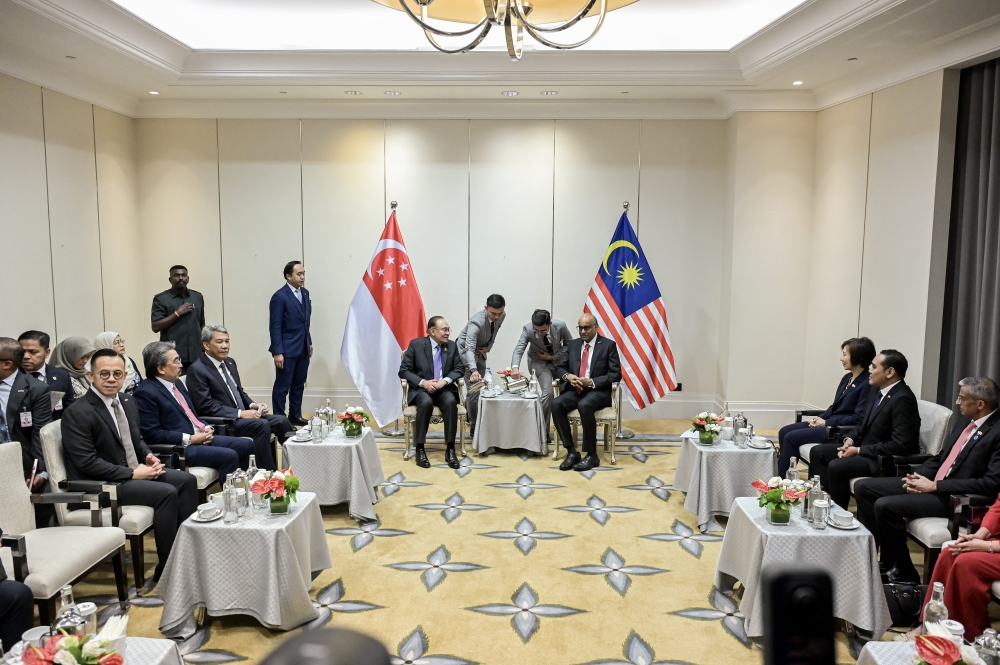
Singapore President Halimah Yacob held substantive discussions with Prime Minister Datuk Seri Anwar Ibrahim during a 40-minute courtesy call in Kuala Lumpur on Monday, marking a diplomatic engagement that reflected the two nations' commitment to deepening their relationship despite ongoing regional complexities. The meeting, which took place at the Prime Minister's office, underscored the significance both governments place on maintaining strong bilateral channels as they navigate broader Southeast Asian strategic challenges.
The courtesy call served as an important touchstone in Malaysia-Singapore relations, particularly given the historical weight of bilateral ties between Southeast Asia's two most economically developed nations. The two leaders used the platform to discuss matters of mutual interest spanning economic cooperation, trade facilitation, and cross-border initiatives that directly affect millions of citizens in both countries. Such high-level engagements are carefully calibrated diplomatic exercises that signal political will and establish frameworks for ongoing dialogue between senior officials and technical teams.
During the meeting, both leaders likely reviewed the status of existing bilateral agreements and explored opportunities for expanding cooperation in sectors where complementarities exist. Malaysia and Singapore maintain extensive trade relationships, with Singapore serving as a crucial financial hub for Malaysian enterprises seeking regional and global market access. The conversation would have touched upon logistics networks, port operations, and supply chain integration—practical matters that require sustained political attention to overcome bureaucratic and regulatory hurdles that periodically arise.
The state visit itself represents a formal diplomatic gesture with symbolic importance. Such visits typically involve ceremonial elements alongside substantive policy discussions, allowing both nations to reaffirm their commitment to peaceful coexistence and shared prosperity. For Malaysia, receiving a sitting head of state from Singapore carries weight in demonstrating the country's standing in regional diplomatic circles and its capacity to host high-level international engagements.
Regional dynamics inevitably colour Malaysia-Singapore relations, particularly regarding maritime security, freedom of navigation in the Strait of Malacca, and responses to major power competition in Southeast Asia. As the two nations that straddle one of the world's most critical maritime chokepoints, their coordination on security matters extends beyond bilateral concerns to affect global trade flows and geopolitical stability. The discussion likely encompassed how Malaysia and Singapore can collaborate on transnational challenges including environmental management, port security cooperation, and responses to irregular migration patterns.
Economic integration between the two nations has deepened considerably, with Singaporean investment flowing into Malaysian manufacturing, financial services, and infrastructure projects. Conversely, Malaysian businesses rely heavily on Singapore's capital markets and logistical expertise. The Prime Minister and President would have discussed mechanisms to facilitate this economic interdependence while ensuring both societies benefit equitably from their commercial relationships. Trade facilitation measures, port automation standards, and regulatory harmonisation represent practical areas where political support translates into business benefits.
The timing of this state visit carries particular relevance given Malaysia's recent political stabilisation and renewed emphasis on international engagement. Prime Minister Anwar Ibrahim's administration has prioritised regional diplomacy and repositioning Malaysia as a reliable partner in Southeast Asian affairs. This meeting with Singapore's President underscores that commitment and signals to other regional actors that Malaysia remains focused on constructive bilateral relationships.
Cultural and people-to-people exchange programmes likely featured in the discussion, as these soft power initiatives strengthen the human connections underpinning formal diplomatic relationships. Educational scholarships, cultural festivals, and sports collaborations create networks of citizens with vested interests in maintaining peaceful ties. Given the historical complexities in Malaysia-Singapore relations, investing in these people-to-people connections serves as a confidence-building measure that extends beyond government-to-government interactions.
From a regional perspective, strong Malaysia-Singapore cooperation enhances the effectiveness of ASEAN as a regional organisation. The two nations' ability to work constructively together on shared challenges sets a positive tone for broader Southeast Asian cooperation on issues ranging from climate change to pandemic response. Their economic and technological prowess means that collaborative efforts often set standards and models that influence wider regional practice.
The formal courtesy call framework allows both leaders to address sensitive issues discreetly while maintaining public diplomatic courtesy. Bilateral tensions, when they arise, can be managed through such channels without escalating to public disputes that complicate resolution. This professional diplomatic approach has generally characterised Malaysia-Singapore interactions, even when disagreements on specific matters emerge.
Looking forward, this meeting establishes momentum for follow-up discussions at working levels between government agencies and ministries. The substantive engagement during such high-level visits typically cascades into action items that keep bilateral machinery moving productively. Whether focusing on infrastructure projects, trade agreements, or security coordination, the foundations established during presidential and prime ministerial meetings provide the political capital necessary for bureaucrats to resolve technical obstacles.
The state visit ultimately demonstrates that despite geographical proximity and occasional friction points, Malaysia and Singapore recognise their fundamental interdependence and the mutual benefits that flow from stable, forward-looking bilateral relations. As both nations address domestic priorities and regional responsibilities, maintaining this diplomatic engagement serves their collective interests and contributes to broader Southeast Asian stability.

