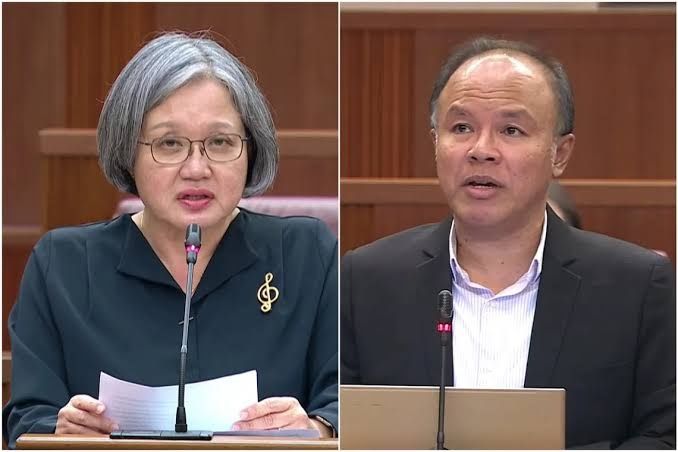
Singapore's Parliament has formally closed the book on disciplinary action against Workers' Party leaders Sylvia Lim and Faisal Manap, with the government acknowledging that procedural deadlines under parliamentary law have rendered further penalties impossible. Leader of the House Indranee Rajah delivered a ministerial statement on July 7 explaining why Parliament, despite confirming the two officials lied to a parliamentary committee, cannot now move forward with sanctions that would normally follow such misconduct.
The case originated from controversial statements made by former Sengkang GRC MP Raeesah Khan, who fabricated an anecdote about police conduct during a 2021 parliamentary speech. A subsequent parliamentary inquiry determined that Khan had misled the chamber, and that party leader Pritam Singh had instructed her to conceal the falsehood. Lim and Faisal, who were both serving as Members of Parliament for Aljunied GRC at the time, attended the meeting where this directive was allegedly issued but subsequently denied to investigators that such a discussion had occurred, effectively providing false testimony to Parliament's Committee of Privileges.
The parliamentary committee's findings were eventually validated through the criminal justice system. Pritam Singh faced separate prosecution and was convicted by the District Court in February 2025 of lying to Parliament. Though he appealed, the High Court upheld his conviction in December 2025, providing independent judicial confirmation of the original committee's conclusions that Lim and Faisal had indeed lied during their testimony. This legal vindication of the investigative findings, however, arrived too late to trigger remedial parliamentary action.
The crux of Parliament's predicament lies in Section 22 of the Parliament (Privileges, Immunities and Powers) Act, which establishes strict temporal limits on when the legislature can punish members for contempt or dishonesty. The law permits Parliament to discipline offences committed either in the current session or in the final session of the preceding parliamentary term. Since the original lying occurred during the first session of the now-dissolved 14th Parliament, and since Singapore has since held a general election in 2025 leading to the convening of the 15th Parliament, the statutory window for action has definitively closed.
Indranee acknowledged the frustration inherent in this outcome, stating that had circumstances unfolded differently, she would have recommended a more robust disciplinary response. She pointed out that Parliament did possess the legal authority to act immediately following the Committee of Privileges report in 2021, but elected instead to extend clemency to Lim and Faisal while awaiting the resolution of Pritam's more serious criminal case. This decision, made in the interest of fairness, ultimately backfired procedurally when Pritam's extended legal battles consumed sufficient time to push the matter past the statutory deadline.
The government's approach reveals fundamental tensions between procedural fairness and institutional accountability. By waiting for Pritam's judicial proceedings to conclude before addressing his deputies, Parliament sought to avoid the appearance of punishing subordinates before their superior had exhausted his legal remedies. Yet this forbearance inadvertently allowed the passage of time itself to become an escape clause. Indranee characterised this as an unfortunate consequence of the timing rather than as an injustice, emphasising that the law's constraints must be observed regardless of circumstantial inconvenience.
Parliament retains one residual option to signal disapproval: passing a motion expressing regret at the conduct of Lim and Faisal. However, Indranee noted that the legislature had already demonstrated its clear stance on dishonesty when it passed a January motion declaring Pritam Singh unsuitable to serve as Leader of the Opposition. This earlier expression of institutional disapproval renders an additional motion somewhat redundant, though technically available.
The Workers' Party had already begun moving past the controversy internally. At party elections and meetings on June 28, members voted to retain Pritam as leader despite his conviction, effectively signalling that rank-and-file support remained intact despite the reputational damage. Lim's response in Parliament on July 7, while not explicitly objecting to the government's statement, reiterated her earlier contention that references to her conduct in Pritam's appeal judgment derived solely from prosecution evidence presented in court, where she had no opportunity to testify or present her own account as a defence witness.
For Malaysian observers, this case illuminates how parliamentary systems grapple with institutional accountability when members mislead legislatures. Singapore's approach—establishing statute-of-limitations provisions under parliamentary privileges law—reflects a broader principle that indefinite liability would be unjust. Yet it also demonstrates how procedural protections, however well-intentioned, can paradoxically shield wrongdoers when circumstances conspire to delay proceedings. The interaction between criminal law timelines and parliamentary disciplinary deadlines created an unintended loophole that neither the legislature nor the executive anticipated when the original facts emerged in 2021.
The closure of this matter does not erase the fundamental findings that Lim and Faisal misled Parliament, a fact confirmed by multiple investigative and judicial bodies. Rather, it reflects the operation of constitutional provisions designed to prevent endless parliamentary persecution while simultaneously protecting the institution's dignity through other available means. For regional governance watchers, the case underscores how even transparent, rules-based systems can produce outcomes that feel substantively unjust when procedural deadlines are allowed to expire, particularly when those deadlines result from administrative delays rather than party misconduct.
Singapore's Parliament has thus closed a long-running institutional scandal without imposing formal penalties on two of its members, relying instead on the earlier motion against their leader and the confidence that public scrutiny and reputational damage constitute their own form of accountability. Whether this resolution adequately serves Parliament's interest in maintaining the integrity of legislative proceedings remains a question that transcends Singapore's borders, relevant to all Westminster-derived systems throughout Asia.

